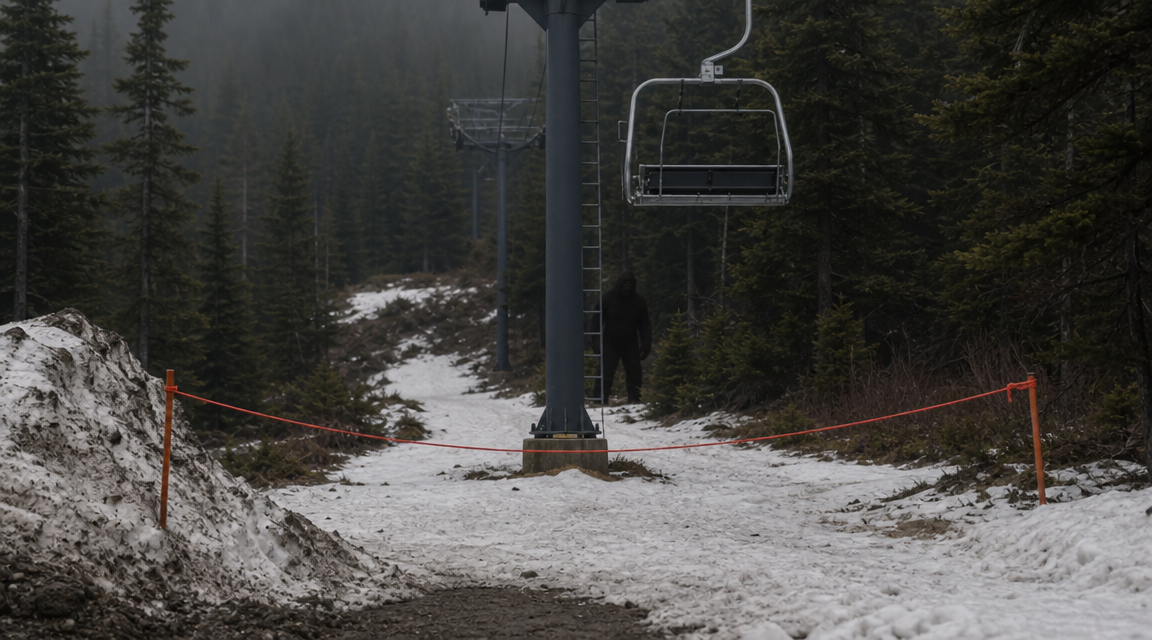
The North Cowl chairlift has not carried skiers since the resort mothballed that side of the mountain in 2019. On maps it is still drawn as a thin black line climbing through fir and hemlock, but locals know it as a quiet, shut-down corridor where the haul rope hangs motionless above brush and the chairs creak only when wind moves through the bowl. That is why a short maintenance camera file recorded there this spring is drawing attention from Bigfoot researchers and skeptics alike. The camera still does not show a clear face, a dramatic chase, or a footprint in mud. It shows something stranger: a red safety rope that appears to have been moved, and a dark, solid, unusually broad figure standing behind a chairlift tower where no person was scheduled to be.
The camera images was taken by a lift mechanic contracted to inspect the abandoned North Cowl line after a winter of heavy rime ice. According to the account shared with a regional outdoors forum, the mechanic parked below the lower terminal just after 7 a.m. and walked uphill with a phone mounted to his chest harness. The resort had asked him to document the tower pads, crossarms, and cable grips before a summer salvage crew arrived. The area was closed, signed, and blocked with a red rope at the access road, more of a warning than a true barrier. In the first seconds of the camera file, that rope is visible sagging between two orange stakes, still bright against dirty snow.
What happens later is the detail people keep replaying. About twelve minutes into the inspection, the mechanic turns back toward Tower 6, a steel support set at the edge of a stand of black spruce. The red rope, which should be lower on the service track behind him, is now seen draped across a different gap near a small utility shed. It looks as if someone lifted it off one stake and reset it twenty or thirty yards uphill. No snowmobile track, boot track, or obvious drag mark is visible in the packed spring crust. The mechanic apparently does not notice the rope change at the time; he is narrating corrosion on a ladder bracket.
Then the camera steadies on the tower. Behind the gray vertical column, partly masked by shadow and old chair seats hanging overhead, is a figure that does not match the clean lines of the lift equipment. It is dark brown to black, matte rather than reflective, and wider through the shoulders than the tower itself. The top of it is rounded, not hooded or helmeted. It stands with no visible gap between legs, as if the lower half is hidden by brush and bermed snow, and it remains still for roughly four seconds. When the mechanic steps left, the tower blocks the view. When he steps right again, the shape is gone.
A single still frame makes the object look like a smear. The moving camera images is more interesting because the lift tower, hanging chair, and trees shift with the mechanic’s steps while the dark mass holds its own position in depth. camera file analysts who have looked at the camera still argue that it is not simply a shadow sliding across the background. The morning light is flat and overcast, there are no strong sun angles, and the figure’s edge stays consistent even as foreground cables wobble slightly in the frame. The shape appears to occupy a narrow pocket between the tower base and a line of spruce trunks.

Size estimates are difficult, but not impossible. Tower 6 has a posted maintenance plate that lists the ladder spacing, and one chair passing in front of the view provides another rough scale. Using those references, the visible height of the figure from snow line to crown seems to fall somewhere between six and seven and a half feet. The more striking measurement is width. Even allowing for blur, the shoulders or upper torso look much broader than a bundled worker in a parka would appear at that distance. There is no high-visibility vest, hard hat, backpack outline, or tool handle visible.
The mechanic later told the forum moderator he was alone on the assignment and had radioed in at the gate. The resort noted no other crew was logged for the North Cowl lift that morning. That does not eliminate trespassers, wildlife officers, or hikers, but it does make the location unusual for a casual walk. The access road was still patched with snow, the old lift corridor is steep, and the closed side of the mountain offers no maintained trail to a viewpoint. Whoever or whatever stood behind Tower 6 would have had to enter a posted industrial area before most staff arrived.

The red rope complicates the story. If the rope was truly moved, it suggests an intelligence interacting with the closure barrier. Skeptics argue that the camera angle may make two separate ropes look like one relocated rope, or that the mechanic passed a second line without mentioning it. That is possible, and without a full site survey the point remains unsettled. Yet the rope in both shots has the same faded knot near its left side and the same frayed tail hanging below the strand. Viewers have also noted that one orange stake from the opening shot appears empty later, tilted in the snow where the rope had been tied.

Wildlife explanations have been proposed. A bear standing near the tower could produce a dark, bulky outline, and black bears do inhabit the lower North Cowl drainage. But the figure’s upper edge is high and relatively narrow at the crown, with no obvious snout, ear profile, or forward lean. It does not sway, sniff, or drop to all fours before leaving. A moose is even less convincing because no legs, ears, pale muzzle, or antler bases appear. The camera still’s most frustrating quality is that it preserves just enough information to rule out easy answers while not preserving enough to make a definitive identification.
For Bigfoot researchers, the setting fits a pattern often discussed but rarely documented well: abandoned ski infrastructure as a travel corridor. Old lift cuts create long openings through dense forest, and closed resorts can become quiet lanes between drainages. They offer human-made objects that might attract curiosity without the constant traffic of an active slope. A red rope, bright against snow and tied across a road, would be exactly the kind of novel object an animal or unknown primate might investigate. The North Cowl camera file does not prove that happened, but it gives the idea a concrete scene.
One notable element is the figure’s behavior. It does not run when the mechanic approaches. It appears to use the chairlift tower as cover, staying behind the steel column until the camera’s angle changes. If the disappearance is genuine and not an artifact of motion blur, the figure seems to step backward into the spruce shadow rather than cross the open snow. That kind of retreat would explain why the mechanic did not hear heavy movement. The bowl was full of dripping meltwater and metallic lift noise, and the chest-mounted phone captures more jacket rustle than ambient sound.
The original camera file has not been released in full resolution, which is a serious limitation. The copy circulating online has compression artifacts, and the platform strips metadata that might confirm time and device details. Investigators have requested the raw file, the work order, and permission to photograph Tower 6 from the same path. Until that happens, the case sits in the uncomfortable middle ground of modern evidence: stronger than a campfire story, weaker than a clean multi-angle camera record. It is compelling because several small details line up, not because any one frame settles the question.
What should viewers look for? First, watch the red rope in the early and later shots, especially the knot and the empty stake. Second, compare the dark figure to the tower’s ladder and the hanging chair seat, not to the trees behind it. Third, notice that the object has a blocky, continuous body with no fabric highlights or loose gear. Finally, ask whether a normal trespasser would stand motionless behind a lift tower in a closed bowl at dawn, then vanish without calling out to the only worker on site.
The North Cowl camera images may eventually be explained by a person, a bear, or a misleading angle in poor light. Responsible analysis has to leave that door open. But for now it remains one of the more intriguing pieces of recent Sasquatch evidence precisely because it is quiet. There is no theatrical roar, no dramatic zoom, and no obvious attempt to create a monster moment. A mechanic documents a dead chairlift, a safety rope is no longer where it was, and for four seconds a broad dark figure stands where the mountain should have been empty.
Reader Context
This Weird Witnessed story is an editorial reconstruction, written as eerie visual storytelling rather than a verified report. For more context, see Bigfoot and Sasquatch Stories Guide and How WeirdWitnessed Creates Reconstructed Horror Stories.