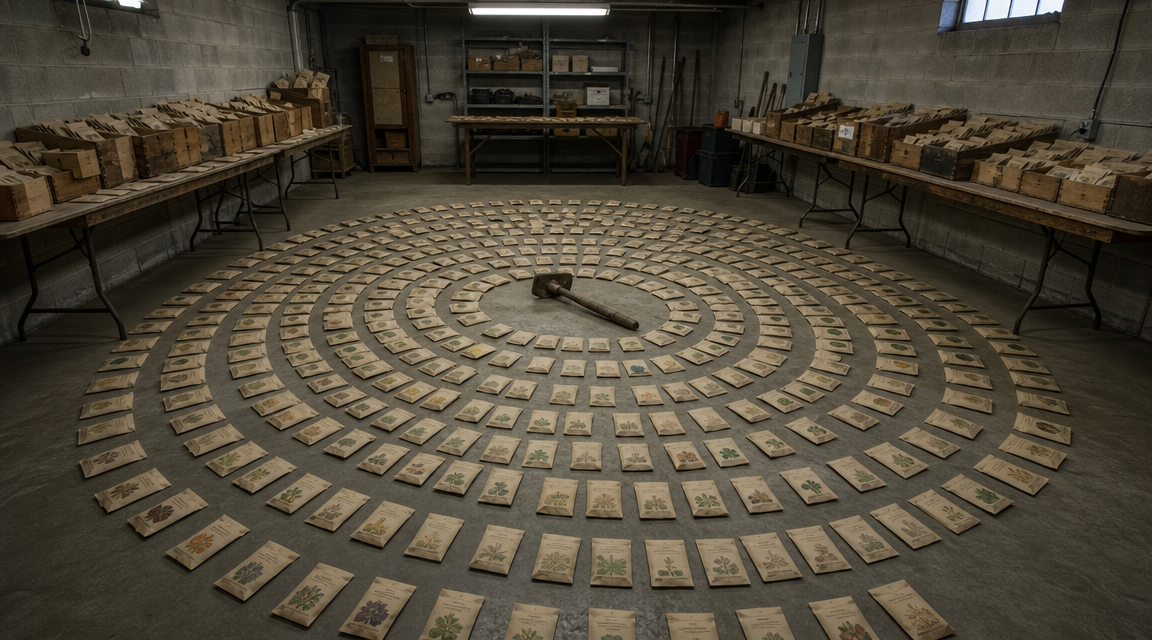
At 6:18 a.m. Monday, the Raven Creek County Seed Library should have been empty except for the dehumidifier and the locked cabinet of heritage beans. Instead, the basement workroom looked as if someone had spent the night arranging hundreds of seed packets into a careful spiral around a dead soil probe, then stepped behind the plastic drying curtains before the first volunteer opened the door.
The seed library operates below the old county extension office, a brick building that smells of damp cardboard. Local gardeners donate saved seed each autumn. Volunteers dry, label, test, and file packets so residents can “borrow” seeds in spring and return more after harvest. Nothing about the place suggests spectacle. The basement has cinderblock walls, fluorescent lights, folding tables, and two rows of ceiling track hung with translucent plastic curtains used to isolate drying trays from dust.
That ordinary setting is why the image now circulating among Raven Creek residents is so difficult to dismiss. It was not taken by a thrill seeker. It was captured by a county inventory camera mounted above the accession desk, a device that snaps a still frame every ten minutes whenever the basement motion sensor wakes the system. The controversial frame, stamped 04:40:12, shows the floor beneath the worktables covered with small tan, white, and kraft-paper seed packets. They form a spiral almost nine feet wide, narrowing inward toward a handheld soil probe lying flat on the concrete.
The probe was dead. Not merely switched off, according to the equipment log, but electrically ruined. The battery compartment had been opened, the two AA batteries were cold enough to sweat, and the digital display showed no digits. The metal sensing tip, normally polished from use, had turned a dull charcoal color. Around it, the innermost ring of packets was not random. Volunteers later identified sunflower, amaranth, glass gem corn, moonflower, black hollyhock, rattlesnake bean, and a local squash variety known as Stump Hollow White. None had been shelved in the same drawer.
“Someone would have had to know our filing system, but also ignore it completely,” said Mara Quill, who has coordinated the seed library since 2019. “The packets were placed faceup, labels pointing in the direction of the curve, like they were being read from the center outward.”
Quill was the person who found the arrangement. She arrived early to check moisture readings after a weekend of rain. The exterior door was locked. The basement door at the bottom of the interior stairs was locked. The alarm panel showed no overnight entry after 8:07 p.m., when Saturday volunteers had left. Yet when Quill switched on the stairwell light, she saw packets reaching nearly to the last step.
Her first thought was that a shelf had collapsed. Then she saw the spiral. Then, because she is the sort of person who checks procedures even while frightened, she backed upstairs and called the county facilities manager before touching anything.
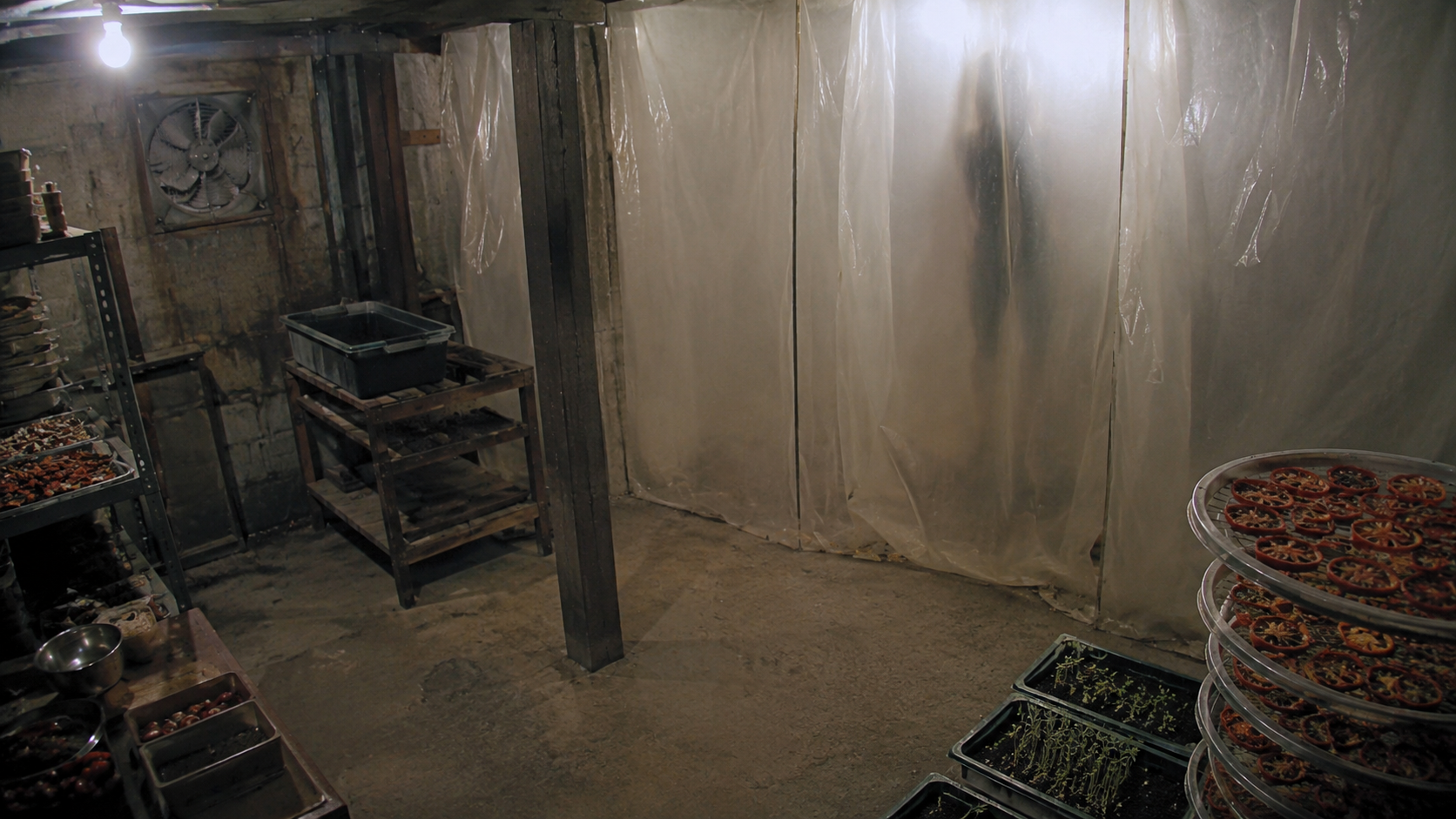
Facilities staff reviewed the camera card expecting to find a person in the act. Most frames between 8:10 p.m. and 4:30 a.m. showed darkness and the faint green status dot on the dehumidifier. At 4:40, the motion-triggered frame appeared. At 4:50, another frame showed the same spiral from the same angle, but the plastic drying curtains at the back of the room had shifted, as though something behind them had moved closer to the aisle. At 5:00, the curtains were still.
The first image is the one people keep enlarging. Behind the curtains, near the rack where tomato seeds were drying on paper plates, there is a thin dark shape. It is taller than the tables but narrower than a person’s shoulders. The outline begins just above floor level, rises in one continuous vertical taper, bends slightly near the top, and seems to disappear into the shadowed seam where two plastic sheets overlap. No face is visible. No hands are visible. There is only a lean, upright absence, made darker by the milky curtain in front of it.
Skeptics have offered normal explanations. A coat on a rack. A folded tripod. A torn piece of plastic catching shadow from the emergency light. Those explanations would be easier if the object appeared in any earlier or later frame. It does not. The drying area was photographed empty on Friday afternoon during a volunteer orientation. The rack held trays, string, binder clips, and the curtains. No coat. No tripod. No vertical black item.
The camera itself has also been examined. County IT contractor Lyle Banton told the local paper that the file’s metadata matches the rest of the overnight captures. “It’s a low-end camera, so I’m not saying it proves anything exotic,” Banton said. “But I did not see evidence that the frame was pasted together. The compression, timestamp sequence, and card write order are consistent.”
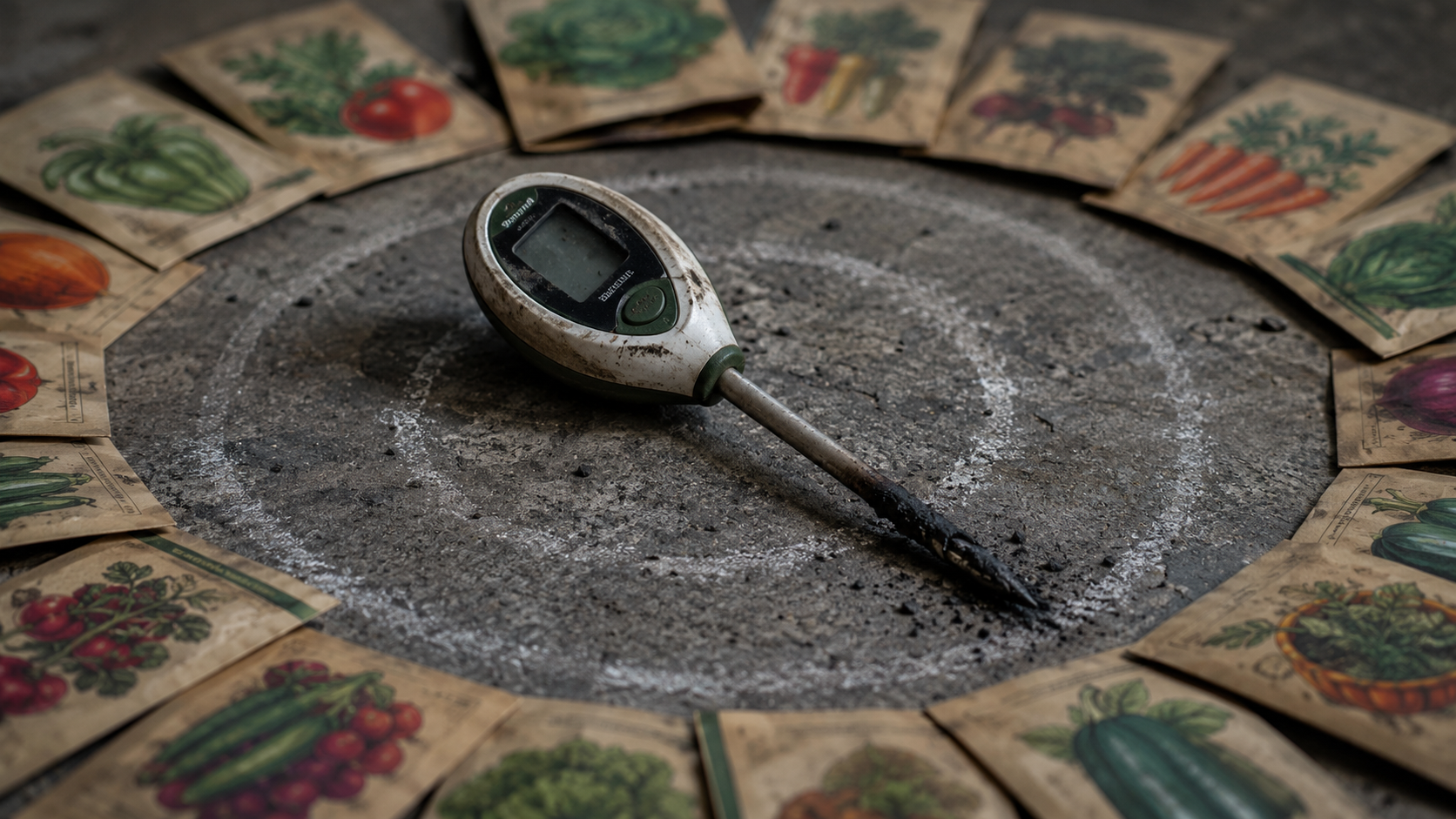
More troubling than the image is the condition of the seeds. None of the packets in the spiral were torn. None were wet. But the contents of seventy-three packets had changed position inside the envelopes. Seeds that should have rested at the bottom had slid into crescent lines along the inner edge, as if the packets had been gently vibrated or exposed to a static pull. When volunteers lifted a few packets, they found fine gray dust beneath them, not enough to sweep into a pile but enough to mark the spiral path on the concrete.
A sample of that dust was taken by the extension office. No official report has been released. One staff member, speaking only because the library is funded by donations and “people deserve to know why we shut down for three days,” said the dust did not look like basement grit. It was uniform, soft, and nearly black under magnification. It clung to metal tools and to the dead probe tip, but not to nitrile gloves.
There was also the smell. Quill described it as “rain on hot pennies.” Another volunteer said it reminded her of opening an old television after it burned out. The odor was strongest near the probe, weaker along the outer rings, and absent by noon.
By Tuesday evening, the county had removed the public post acknowledging “an unusual overnight disturbance.” The seed library announced that all affected seeds would be quarantined, tested for germination, and not distributed this season. That decision angered some gardeners who had contributed rare local lines. It also fueled the rumor that the spiral’s order mattered.
Several residents noticed that the packets were not arranged alphabetically, by crop family, or by donor. A retired math teacher traced the labels from outer ring to center and claimed the sequence repeated intervals of 5, 8, and 13 before breaking at the dead probe. A church youth group member pointed out that every packet nearest the center belonged to plants known for night blooming, unusual coloration, or deep taproots. Quill has discouraged this sort of decoding. “They are seeds,” she said. “They are not a message board.”
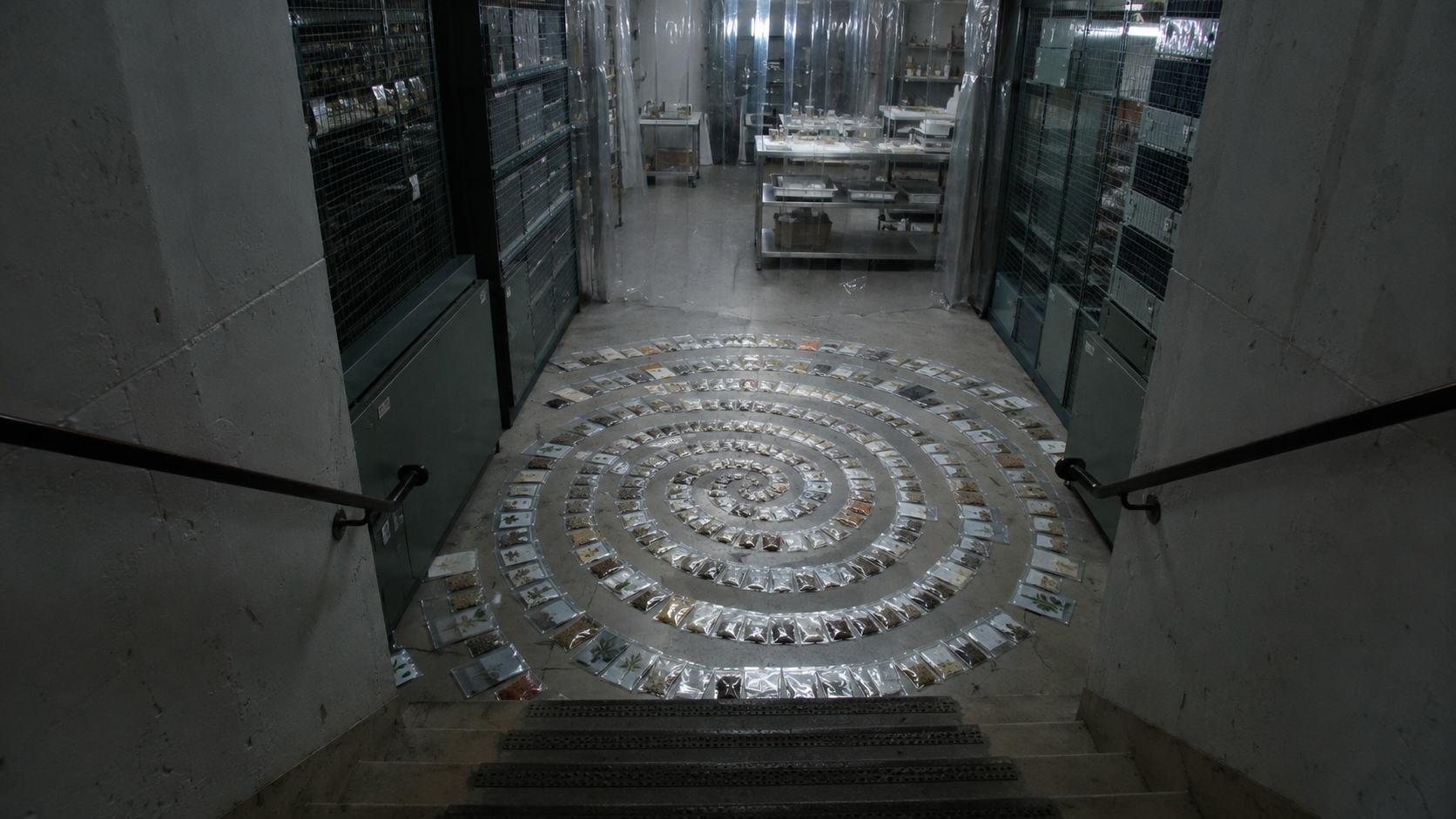
But the phrase “message board” is exactly what makes the photograph linger. If an intruder wanted attention, why avoid the camera until the end? If a prankster wanted fear, why leave every door locked and every packet intact? If the arrangement was accidental, why does it resolve so cleanly around the ruined instrument?
The soil probe may be the most important object in the case. It was stored in a drawer, not left on the floor. It measures moisture, temperature, pH, and conductivity. Volunteers used it the previous Thursday to check starter soil for a children’s workshop. The log shows normal readings. After the basement event, the probe could not be revived. A local electronics repair hobbyist opened it and reportedly found a darkened streak across the circuit board, not like a short from liquid but like a line drawn with soot.
That detail has led to the dominant theory among those who believe the photo shows an unknown visitor: whatever entered the seed library interacted first with the probe, then with the seeds. It may have been measuring, sorting, or responding to biological material. The spiral could be a pattern made for itself rather than for us, a way of organizing dormant life by properties our labels only approximate.
There is no evidence of a spacecraft, no glowing marks on the lawn, and no dramatic witness account. The basement offers only a locked room, a broken measuring tool, displaced seeds, a temporary metallic smell, and a thin dark shape behind plastic curtains. That may be why the Raven Creek image feels stronger than louder stories. It does not ask us to imagine the sky opening. It asks us to imagine something quiet and curious standing in a county basement before dawn, studying what humans save in paper envelopes for another season.
Quill has reopened the library, though the drying curtains have been replaced with clear panels and the inventory camera now records continuously. The spiral dust stain remains faintly visible under the tables despite mopping. The dead probe sits in a sealed evidence bag in the extension office safe. The quarantined packets are boxed by ring position, because even the skeptics agreed the order should be preserved until testing is complete.
When asked whether she believes the shape behind the curtain was a person, Quill did not answer directly. She said she has worked with seeds long enough to respect patience. “Most things do not look alive until conditions are right,” she said. “That basement felt like something had been waiting for the right conditions, too.”
Reader Context
This Weird Witnessed story is an editorial reconstruction, written as eerie visual storytelling rather than a verified report. For more context, see UFOs and Unknown Visitors Guide and How WeirdWitnessed Creates Reconstructed Horror Stories.