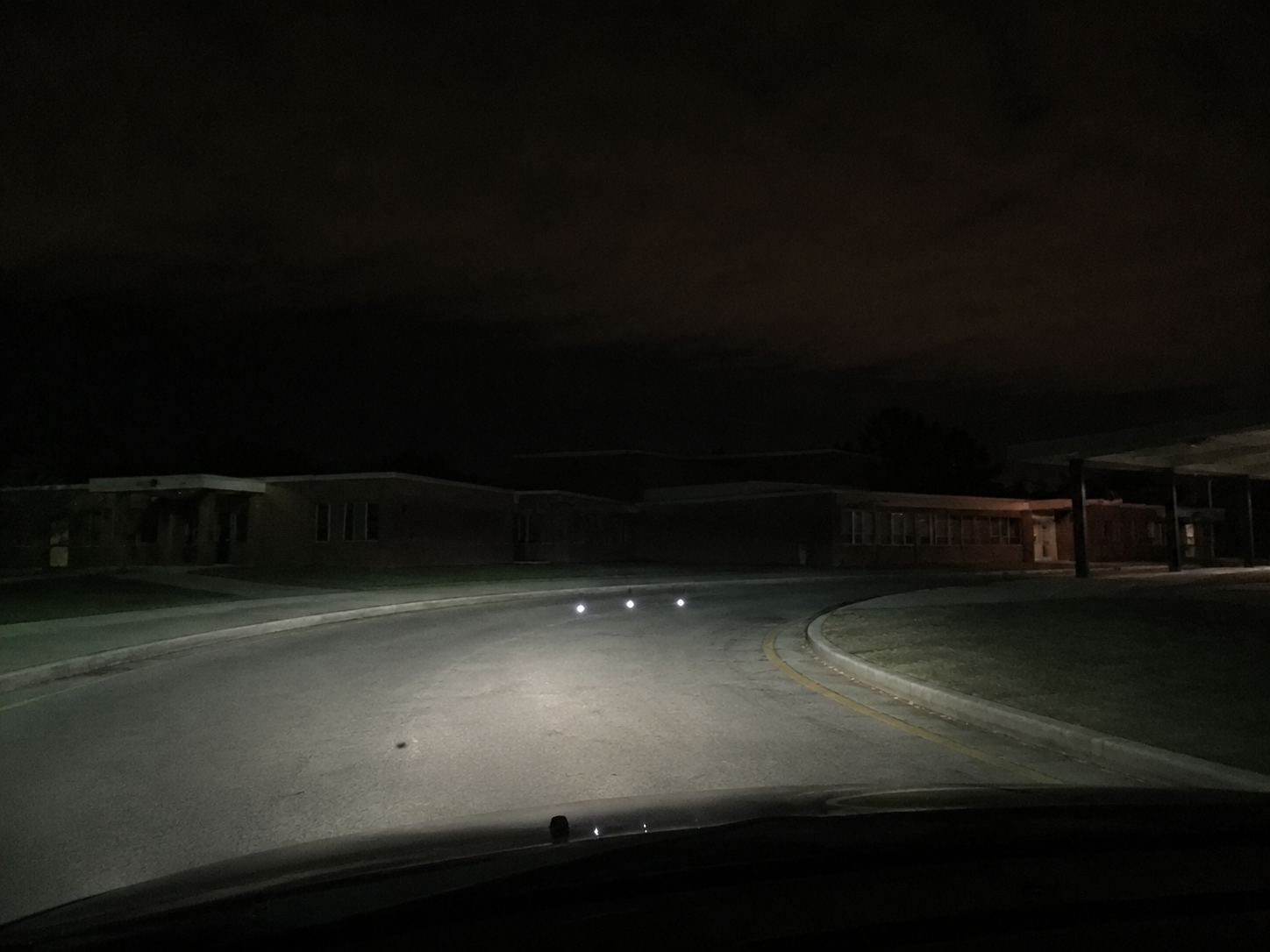
The camera still begins with one of the least dramatic views imaginable: an empty school bus loop, a dark building, and the dashboard of a maintenance pickup idling near the curb.
That plainness is part of why people in Mercer County still talk about it. There is no dramatic beam, no clear saucer shape, and no official declaration that anything otherworldly arrived at the school. What the dash camera shows is simpler and more frustrating. Three low lights appear over the bus lane after midnight, hold position for several seconds, drift as a group, and then vanish during a brief break in the audio.
The custodian who shared the camera file reportedly said he had parked there to finish a checklist after a basketball tournament. The school was closed, the buses were gone, and the loop lights had switched to their dim overnight setting. He did not claim to see a craft with his own eyes. According to the local version of the story, he noticed the lights only later while reviewing the dash camera images because the camera had marked the camera still as an event.
That distinction matters. This is not a detail people read as alien visitors. It is a small local mystery built around a camera, a quiet lane, and five details that make the easy explanations feel unfinished.
WHAT THE camera images SHOWS:
- Three lights appear low over the empty bus loop.
- The lights move together but do not match the road or roofline.
- The dash camera audio drops out for almost four seconds.
- No buses, delivery vehicles, or drones were logged on campus.
- The lights reflect faintly on wet pavement before disappearing.
1. The Lights Are Lower Than Viewers Expect
Most UFO stories begin by asking whether lights in the sky could have been aircraft. That is the sensible first question here too.
The difficulty is height. The three lights in the bus loop camera file do not appear high over the school. They look low, close enough to cast a weak reflection on the wet asphalt beneath them. The custodian estimated that they were above the lane, not above the far tree line. That estimate is not scientific, but the dash camera angle makes the lights seem strangely near to the ground.
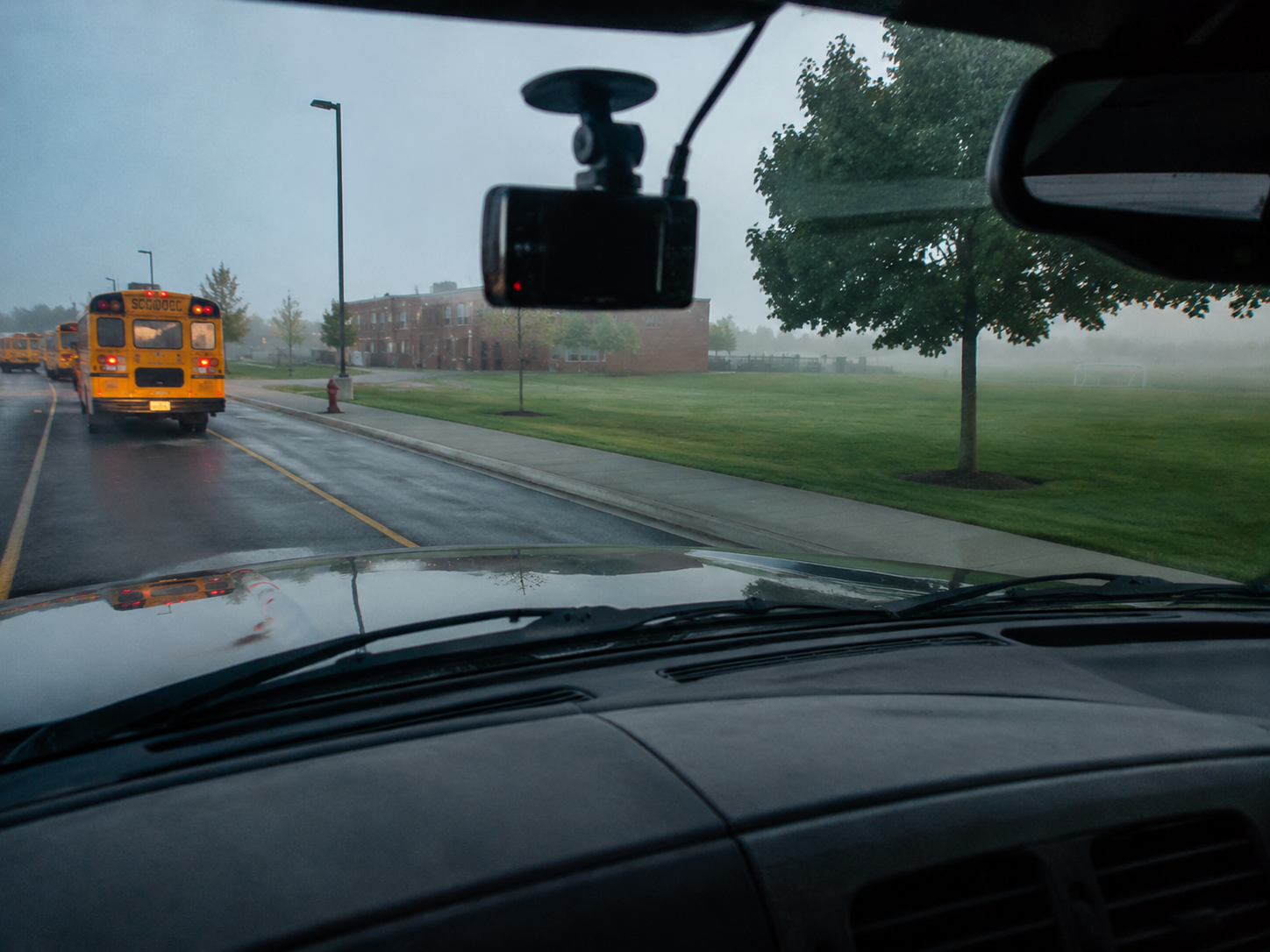
If they were distant aircraft, their position should have shifted behind the roofline as the camera moved slightly with the idling truck. Instead, the lights remain in relation to the curved curb and the painted bus lane.
Could it be a trick of perspective? Absolutely. Night camera images compresses distance, and a dash camera can make faraway lights look close. Still, the low placement is the first detail that makes the camera still harder to file away as ordinary air traffic.
CAPTION: The lights appear low enough that viewers keep comparing them to the bus lane instead of the sky.
2. The Formation Changes Without Spreading Apart
At first the lights form a shallow triangle. The upper light sits slightly ahead of the two lower ones, and the whole shape hangs near the center of the loop.
About eight seconds into the camera still, the right-hand light lowers. The three points become almost level, then return to a triangle as the group drifts left. The movement is small, but it is the reason the camera still is replayed frame by frame.
If the lights were attached to one object, the shift could be explained by rotation. If they were separate drones, the tight spacing would require coordinated movement. If they were reflections inside the windshield, they should have moved with the vehicle vibration or changed when the camera adjusted exposure.
None of those explanations can be ruled out. The camera images is too limited for certainty. But the lights behave as if they are connected by an invisible frame, even while their shape subtly changes.
That is the detail local viewers tend to describe in folklore language. They say the lights “held together” or “knew where each other was.” Those phrases are not evidence, but they show why the camera file feels less like three random dots.
3. The Audio Gap Arrives at the Worst Possible Moment
The strangest part of the camera still may be what it does not contain.
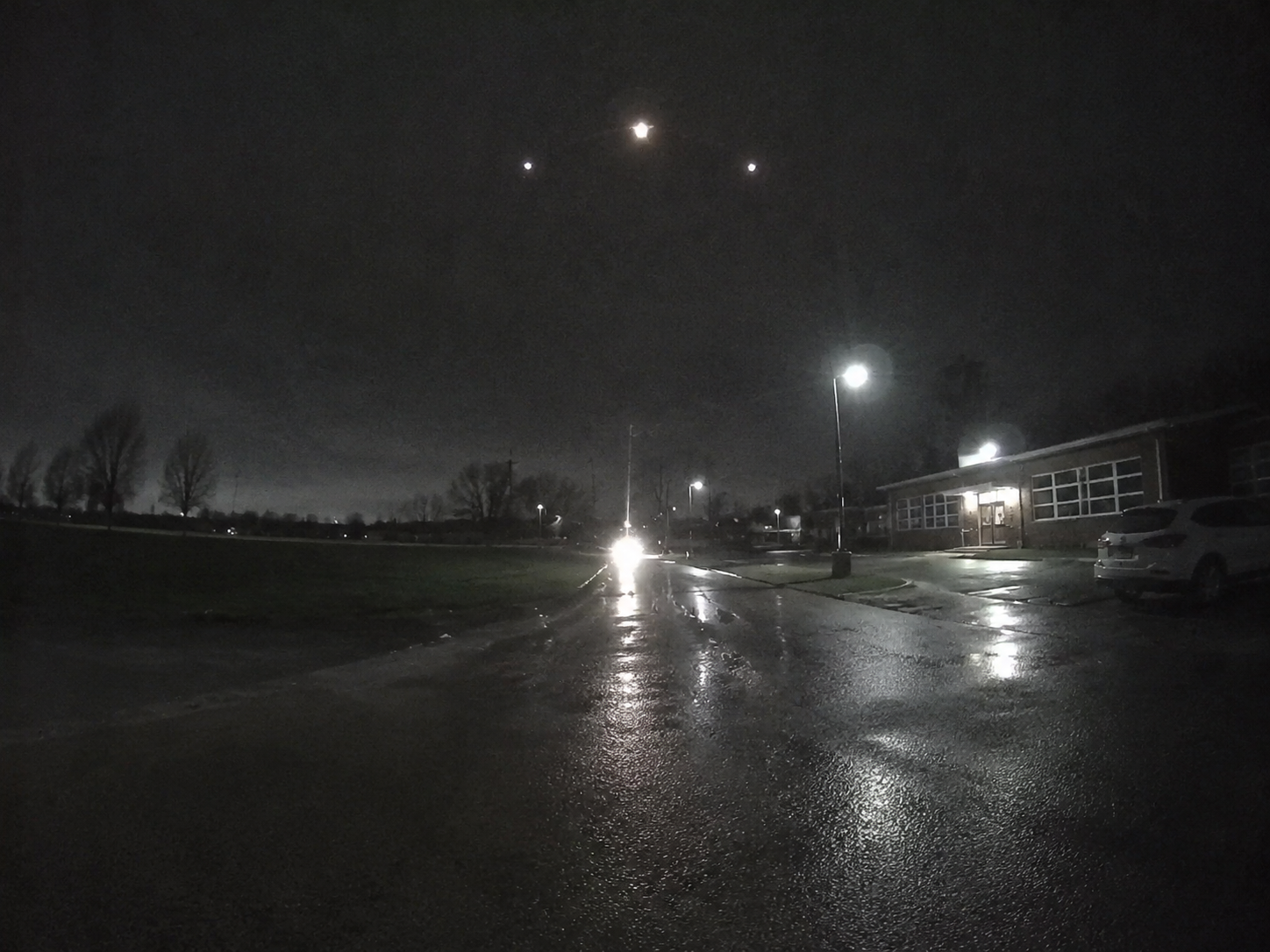
For most of the camera record, the dash camera captures normal cabin noise: the low hum of the engine, a heater fan, and one brief squeak as the custodian shifts in the seat. Then, just as the lights flatten into a line, the audio drops out. It returns almost four seconds later, after the lights have moved farther left.
A technical issue is the most likely explanation. Cheap dash cameras cut audio for many reasons. A memory card can stutter. A file segment can split. A microphone connection can fail for a moment. Nothing about the audio gap suggests that anything unusual caused it.
But the timing is uncomfortable. It removes the exact seconds when a listener would want to know whether there was a rotor sound, a car passing nearby, a voice in the cab, or any other ordinary clue.
The custodian reportedly told a school board member that he did not remember hearing anything unusual that night. That does not settle the matter. It only adds to the oddness: the camera flagged movement, recorded lights, and lost sound when the movement became most interesting.
4. The Campus Logs Do Not Explain a Vehicle
The school district’s routine records are not glamorous, but they are useful in stories like this.
In the recreated version, the bus garage gate was locked by 9:40 p.m. The final activity bus left earlier in the evening. No food delivery, maintenance contractor, or late pickup was listed for the loop after midnight. The custodian’s truck was the only known vehicle near that side of the building.
That does not mean no vehicle could have passed nearby. Rural schools sit among farm roads, service lanes, and private drives. Headlights can sweep across buildings from surprising angles. A truck cresting a hill could create lights that seem to hover if the road itself is hidden.
Still, people who know the school say the loop is shielded by a field and a low equipment shed. For headlights to produce the effect, they would need to appear above the lane, remain grouped, move together, and reflect on wet pavement without lighting up the surrounding brick wall in a normal way.
That is possible, but not neat. The lack of an obvious vehicle on the logs leaves the dash camera still in the category of unexplained rather than explained.
CAPTION: The empty bus lane is important because the school had no scheduled traffic there after midnight.
5. The Reflection on the Pavement Is Small but Persistent
The fifth detail is easy to miss. Beneath the lights, on the damp pavement, there is a faint shimmer.
It is not a bright reflection. It does not look like a spotlight. It appears as three weak smudges that move when the lights move. That has become the argument against the idea that the lights were purely an internal windshield reflection.
Windshield reflections can be convincing. A phone screen, dashboard indicator, or passing light behind the driver can appear to float outside. But internal reflections usually do not create consistent matching glints on exterior pavement unless the camera is catching both a real light source and its reflection.
The pavement had been wet from earlier rain, which helps explain why even weak lights might show there. It also complicates the case. Water can mirror distant lights and distort their position, making the strange look stranger.
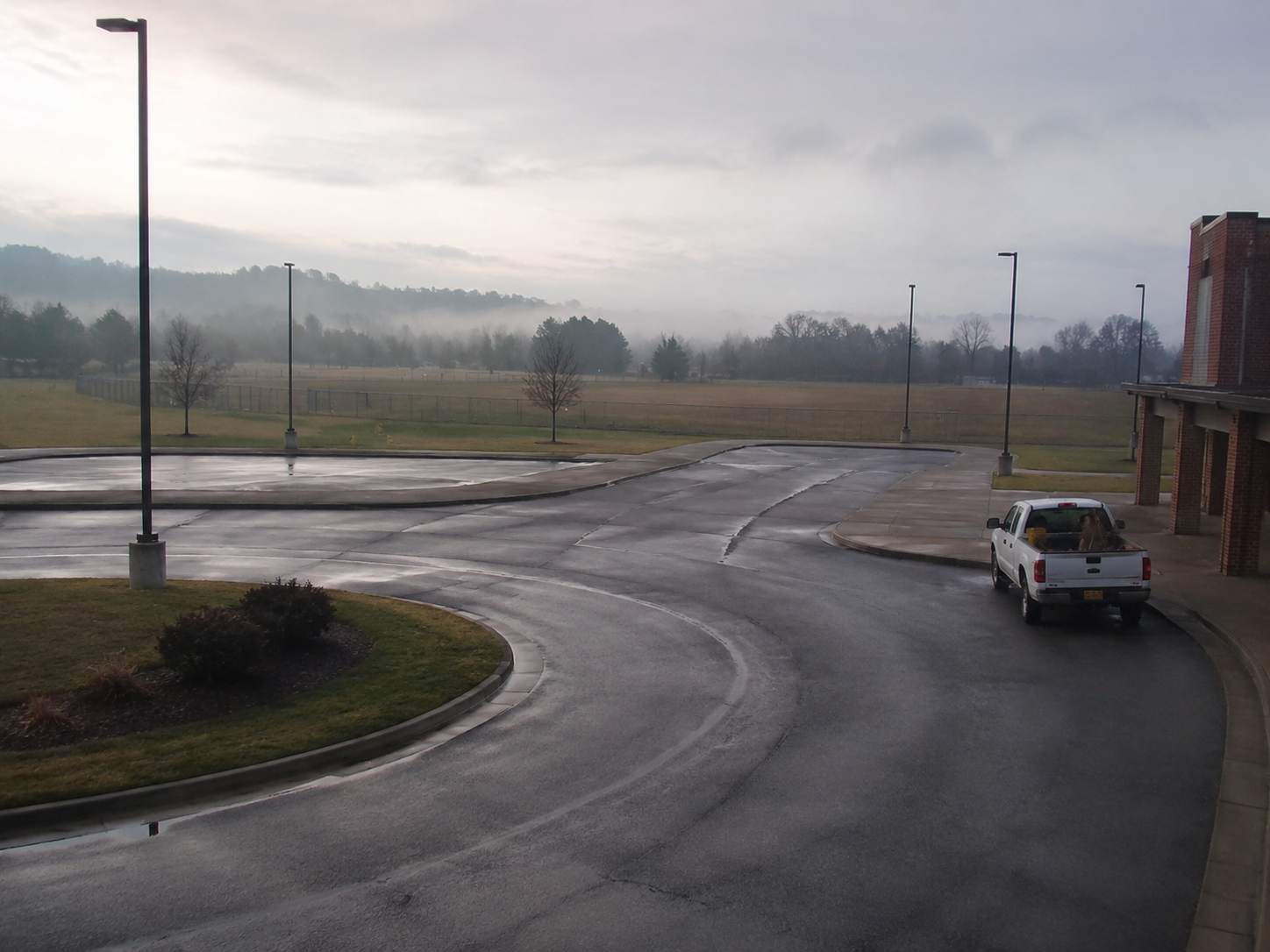
By morning, there was nothing to inspect. No scorch marks, no tracks, no damaged pavement, and no official report of a landing. The bus loop looked ordinary again.
That ordinary ending is what gives the story its local flavor. The camera still does not prove a visitation. It does not identify a craft. It simply shows three low lights, an audio gap, and a school lane that should have been empty.
For some residents, that is enough to keep the camera file in the town’s growing file of almost-stories: things seen by a camera, discussed in careful voices, and never fully settled.
Until a better explanation appears, the rural school bus loop remains less a smoking gun than a stubborn question: if the lights were ordinary, why did every ordinary clue arrive just out of reach?
Reader Context
This Weird Witnessed story is an editorial reconstruction, written as eerie visual storytelling rather than a verified report. For more context, see UFOs and Unknown Visitors Guide and How WeirdWitnessed Creates Reconstructed Horror Stories.