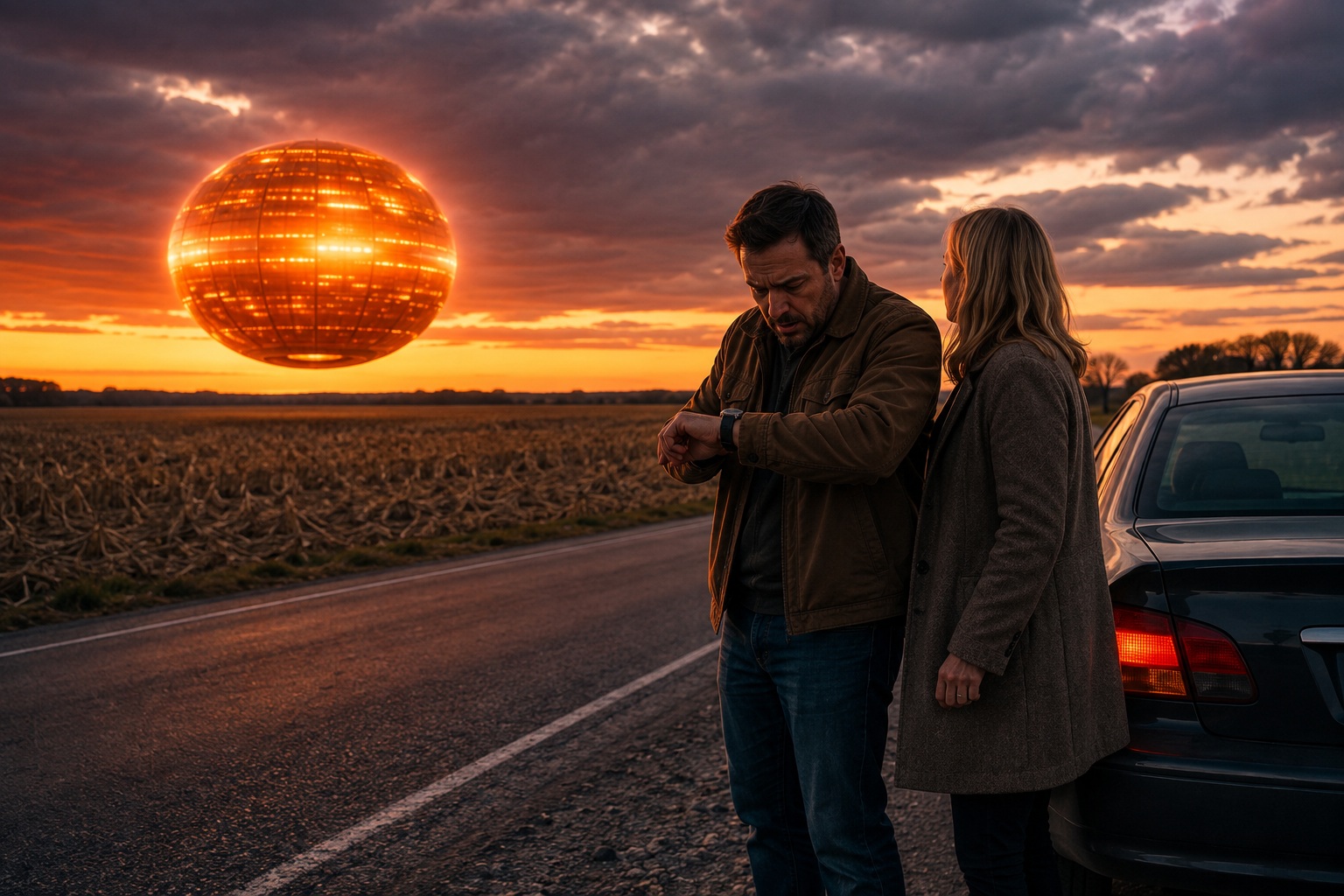
The watch had stopped at 9:43.
That was the first thing the couple noticed after pulling into their driveway. They had been talking the entire drive home, replaying the strange orange object that had drifted silently above an empty hay field a few minutes earlier. It wasn't flashing like an airplane. It wasn't moving like a helicopter. It floated across the road, paused over the field for several seconds, then climbed almost straight upward until it disappeared into low clouds.
They assumed the whole thing had lasted less than a minute. Inside the house, the microwave read 10:18. The kitchen clock agreed. Both phones showed the same time.
But the man's old mechanical wristwatch had frozen at 9:43, exactly when the orange object had been hanging over the road. He wound it again. Nothing. The second hand stayed perfectly still. The next morning, a jeweler opened the case. No broken spring. No obvious damage. After being adjusted, the watch began working normally again.
For the couple, the watch became stranger than the orange object itself. They could explain seeing something unusual in the sky. They struggled to explain why a dependable watch had chosen that exact moment to stop. Stories like this appear again and again whenever people talk about mysterious orange or amber lights. The details change, but the question stays remarkably similar.
Why do some UFO witnesses report that their watches stopped after seeing orange orbs?
The First Time It Happened
Most UFO stories are remembered because of what appeared in the sky. Yet many witnesses spend surprisingly little time describing the object itself. Instead, they remember what happened afterward.
Someone notices their dashboard clock has reset. A digital watch shows impossible numbers. An old wristwatch has stopped completely. A phone battery that was nearly full suddenly seems almost empty.
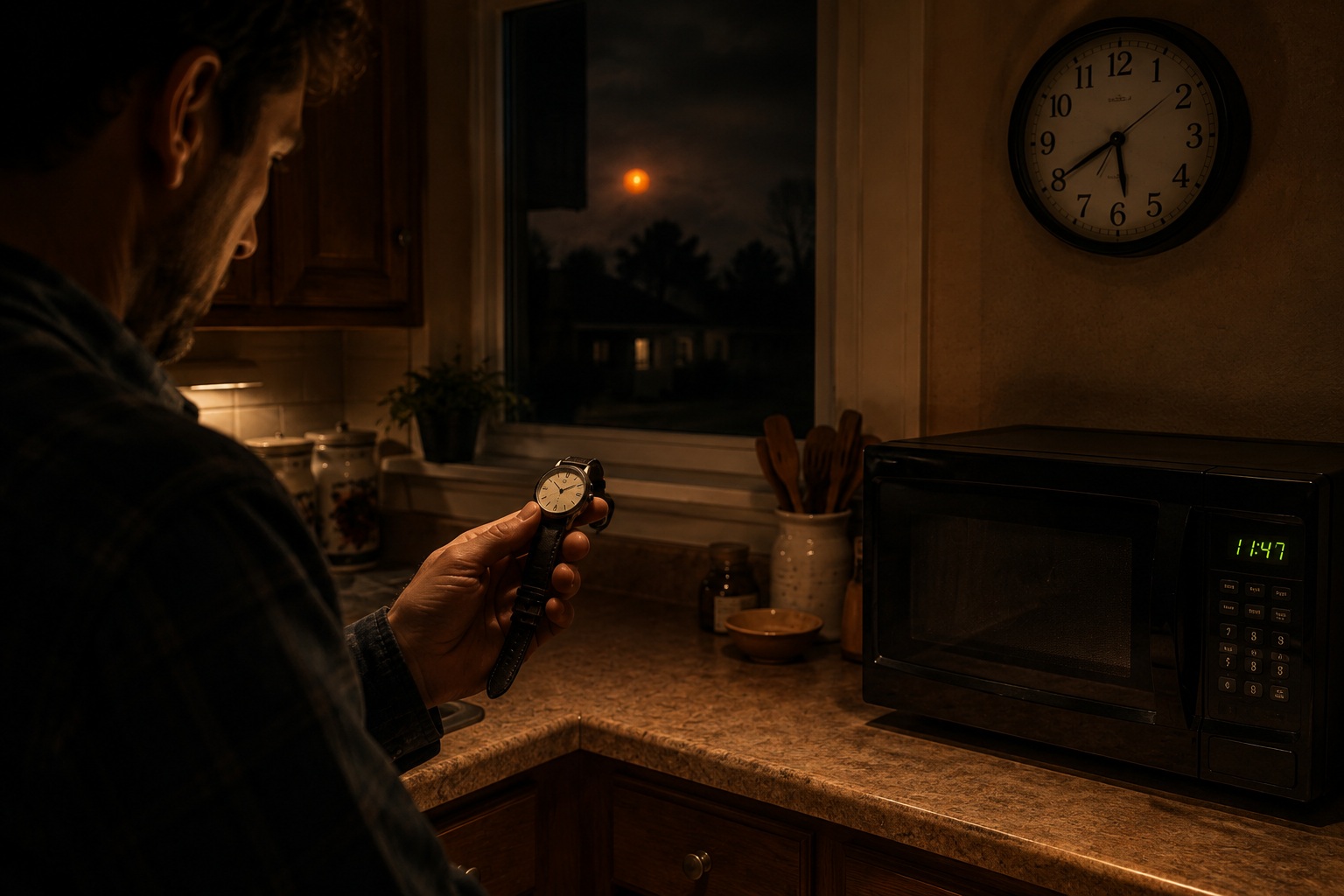
These small details often become more important than the sighting because they are things people interact with every day. You may question your memory of a bright object. You may wonder if distance or darkness fooled your eyes. But when you look down and see your watch frozen on one specific minute, it feels like something physical has changed.
That ordinary object becomes part of the story. Orange orbs appear especially often in these reports because they are usually described as moving slowly and quietly. Witnesses often spend longer watching them than they would a fast-moving streak across the sky. That extra attention gives people more time to notice unusual details around them.
Why The Place Felt Wrong
People report many kinds of unusual lights. Some describe silver discs during daylight. Others describe triangular shapes at night.
Orange or amber orbs form another large group of stories because they often behave differently from familiar aircraft. Witnesses commonly describe them as glowing rather than reflecting light. Many appear to move without obvious navigation lights. Some drift against the wind before changing direction smoothly.
Others remain completely still before accelerating away. Whether these descriptions have ordinary explanations or not, they create a strong emotional reaction because the movement seems calm instead of dramatic. A bright meteor lasts only seconds. A passing airplane follows a predictable route.
An orange orb that quietly hovers over an empty road gives people time to study it. That extra observation also means people are more likely to notice changes in themselves or in the objects around them.
After reaching safety, people often begin checking simple things.
The Detail Nobody Could Explain
How much time has passed? Did anyone else see it? Is the car working normally? What time is it?
The watch becomes important because it offers an immediate comparison. If every clock agrees except one, it naturally attracts attention. Mechanical watches create one kind of mystery. Quartz watches create another.
Digital watches can reset after losing power. Mechanical watches can stop if something interrupts their movement or if they were already close to winding down. Because different types of watches fail in different ways, witnesses often describe exactly what kind they were wearing. That detail matters because people are trying to understand whether the timing was coincidence or something stranger.
Sometimes they also compare watches between two people standing only a few feet apart. Those comparisons become memorable even when nothing unusual is ultimately found. The Ordinary Reasons A Watch Can Stop Before jumping to mysterious conclusions, there are plenty of normal possibilities worth considering.
Mechanical watches depend on tiny moving parts working together with remarkable precision. A watch that is running low on power might stop unexpectedly. An older watch may have dried lubricants or worn components. A sudden impact could interrupt its movement.
Quartz watches depend on batteries. A weak battery may finally fail at an inconvenient moment. Temperature changes can also affect accuracy in some situations. Human memory adds another complication.

What They Checked Afterward
People naturally connect unusual events. If someone experiences something frightening, they often pay closer attention to nearby details that would normally go unnoticed. A watch stopping during an ordinary evening might be forgotten by the next morning. A watch stopping immediately after an unforgettable light in the sky becomes a permanent memory.
That doesn't mean witnesses are inventing what happened. It simply shows how powerful context can be when people reconstruct unusual experiences.
Despite those ordinary explanations, some stories continue bothering witnesses for years.
The timing feels too exact. The watch had worked reliably for years. It stopped only once. After servicing, it never failed again.
Other reports describe several unrelated devices behaving strangely at the same moment. A wristwatch stops. A dashboard clock resets. A flashlight suddenly dims.
A portable radio produces only static. Each item alone has an ordinary explanation. Together, people feel they form a pattern. Whether that pattern reflects coincidence, environmental conditions, memory, or something not yet understood is impossible to determine from individual stories.
The Moment It Became Harder To Ignore
That uncertainty is exactly what keeps these accounts circulating. People are not always fascinated by the object overhead. Sometimes they become fascinated by what happened to the ordinary things they trusted every day.
The stopped watch belongs to a larger group of stories involving time. Some witnesses believe only a few minutes passed. Later they discover much more time has gone by. Others remember driving familiar roads that somehow seemed much longer than usual.
Some describe clocks disagreeing with each other. Others say they reached home much later than expected. Many of these reports probably have ordinary explanations involving stress, distraction, unfamiliar routes, or simple mistakes in estimating time. Yet the repeated appearance of clocks, watches, and missing time has become one of the most recognizable parts of UFO folklore.
Time is deeply personal. We rely on it constantly. Anything that appears to interrupt it feels more disturbing than an unusual light alone. A bright object disappears.

Why People Avoided That Spot Later
A stopped watch remains on your wrist. It keeps reminding you that something strange happened during a specific minute you cannot fully explain.
Ask witnesses years later what stayed with them.
Many no longer remember the exact size of the light. They cannot agree how high it was. They may struggle to estimate distance. But they remember the watch.
They remember trying to wind it. They remember tapping the glass. They remember comparing it with the clock in the kitchen. Those actions anchor the memory.
Instead of becoming an abstract story about something in the sky, the experience becomes connected to a physical object they still own. That ordinary object carries emotional weight because it seems independent of memory. Whether the watch stopped because of age, coincidence, or something else, it feels like a silent witness that was present during the same strange moment.
Why The Story Still Gets Shared
People often keep those watches for decades, even after replacing them. Not because they believe the watch contains answers. Because it represents the exact minute their ordinary evening stopped feeling ordinary.
The Mystery That Keeps Returning
Reports of orange orbs and stopped watches continue to appear because they combine two unsettling ideas. The first is seeing something that doesn't fit everyday expectations. The second is discovering that an ordinary object behaved unexpectedly at the exact same time. Either event alone might eventually be forgotten.
Together, they become difficult to separate. Most stories never reach a definite ending. The light disappears. The witnesses return home.
Life continues. But every time they glance at that repaired watch resting in a drawer—or remember the minute frozen beneath its glass—they return to the same unanswered question. Did the watch simply choose the worst possible moment to fail? Or did the strange orange light overhead happen to coincide with a brief moment when something else, however ordinary or unusual, interrupted the steady rhythm of time they thought they could always trust?
That uncertainty is why these stories continue to be shared. Not because they offer easy answers, but because they leave behind one stubborn detail that feels harder to dismiss than the glowing object itself: a watch that stopped at exactly the wrong moment, then quietly started counting the hours again.