The Blackwater logging road did not look like the kind of place that could keep a secret. In daylight it was only mud, gravel, slash piles, and a locked forestry gate with a warning sign bolted crookedly to the bar.
The road ran three miles into company timber, climbing through pine and alder before dropping toward a swampy creek bottom that gave the area its name. Trucks used it during harvest season. Hunters parked near it in the fall. The rest of the year, rain worked on the ruts and the woods took back the shoulders.
A gate camera was installed after the chain kept getting bothered. At first, everyone blamed people. Someone was cutting around the lock, leaving fresh tire marks beyond the gate, and dumping beer cans near the turnoff. The forestry crew swapped the lock, tightened the hinge bolts, and mounted a small cellular camera high in a cedar across from the entrance.
It was aimed to catch license plates and late-night trespassers.
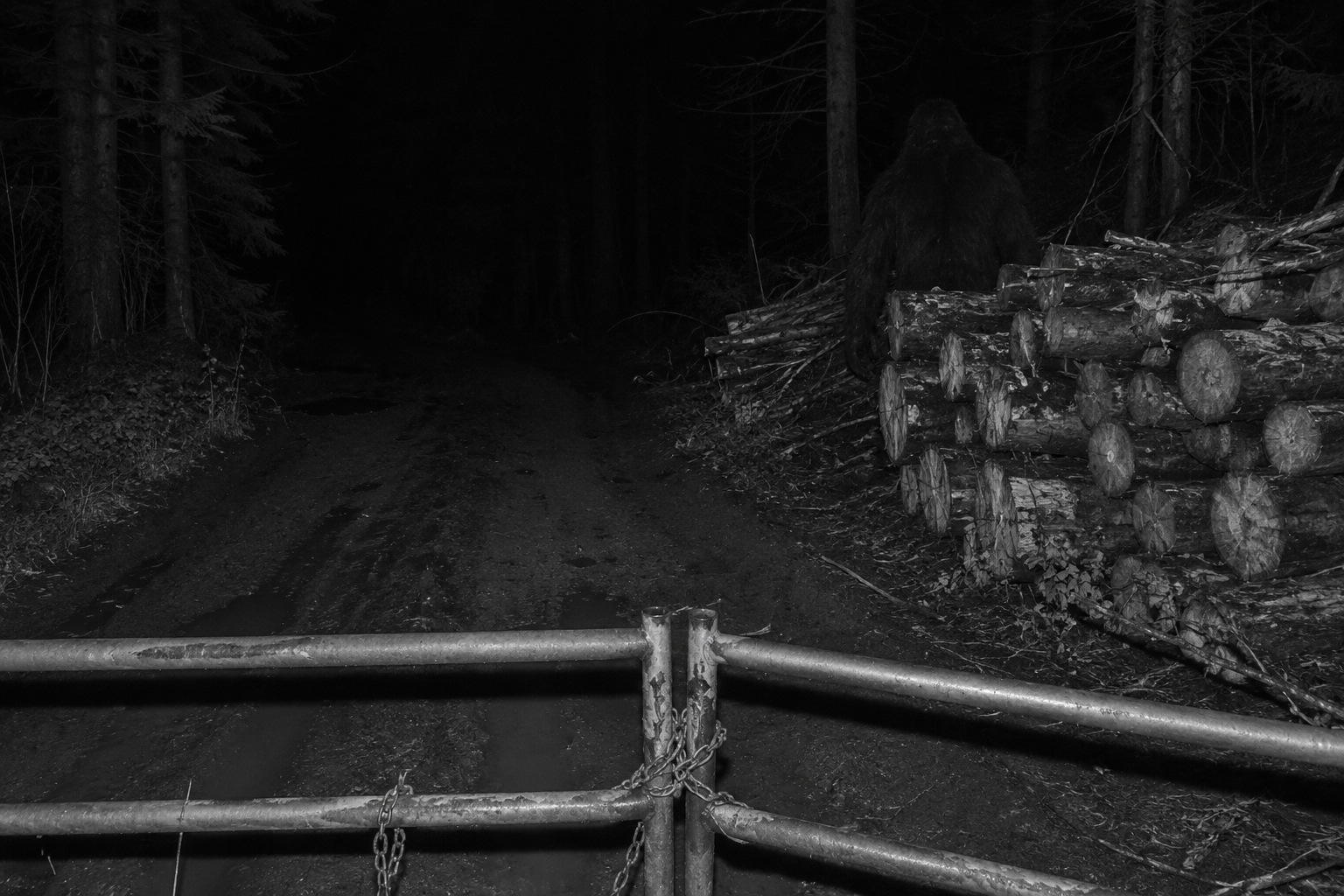
What it caught instead was a dark figure large enough to make the stacked timber beside the road look suddenly small.
The Camera At The Gate
The gate sat at the beginning of a long curve where the road narrowed between a ditch and a pile of cut logs left from a thinning operation. The logs were stacked shoulder-high to a worker, bark stripped in pale scars, their wet ends facing the camera like rows of dark coins.
Behind them, the trees closed in fast. Young pines stood in tight ranks, with blackberry canes and fern mats filling the gaps. On wet evenings, mist collected there before it reached the open road, turning the background into a gray wall.
The camera was not fancy. It took short bursts when motion crossed the gate and sent stills when the cell signal cooperated. Most images showed expected things: raccoons on the ditch bank, deer nosing the mud, a coyote slipping under the bottom bar, headlights washing the lens white.
The strange image came just before midnight after a day of steady rain.
There were no headlights. No truck. No visible person standing at the gate.
There was only the slick road, the closed bar, the dark log pile, and something huge moving out of the open.
A Shape Behind The Cut Logs
In the first frame, the scene looks almost empty. The gate runs across the foreground. Rain beads on the metal. The chain hangs from the hasp in a heavy loop, catching a faint flash from the infrared.
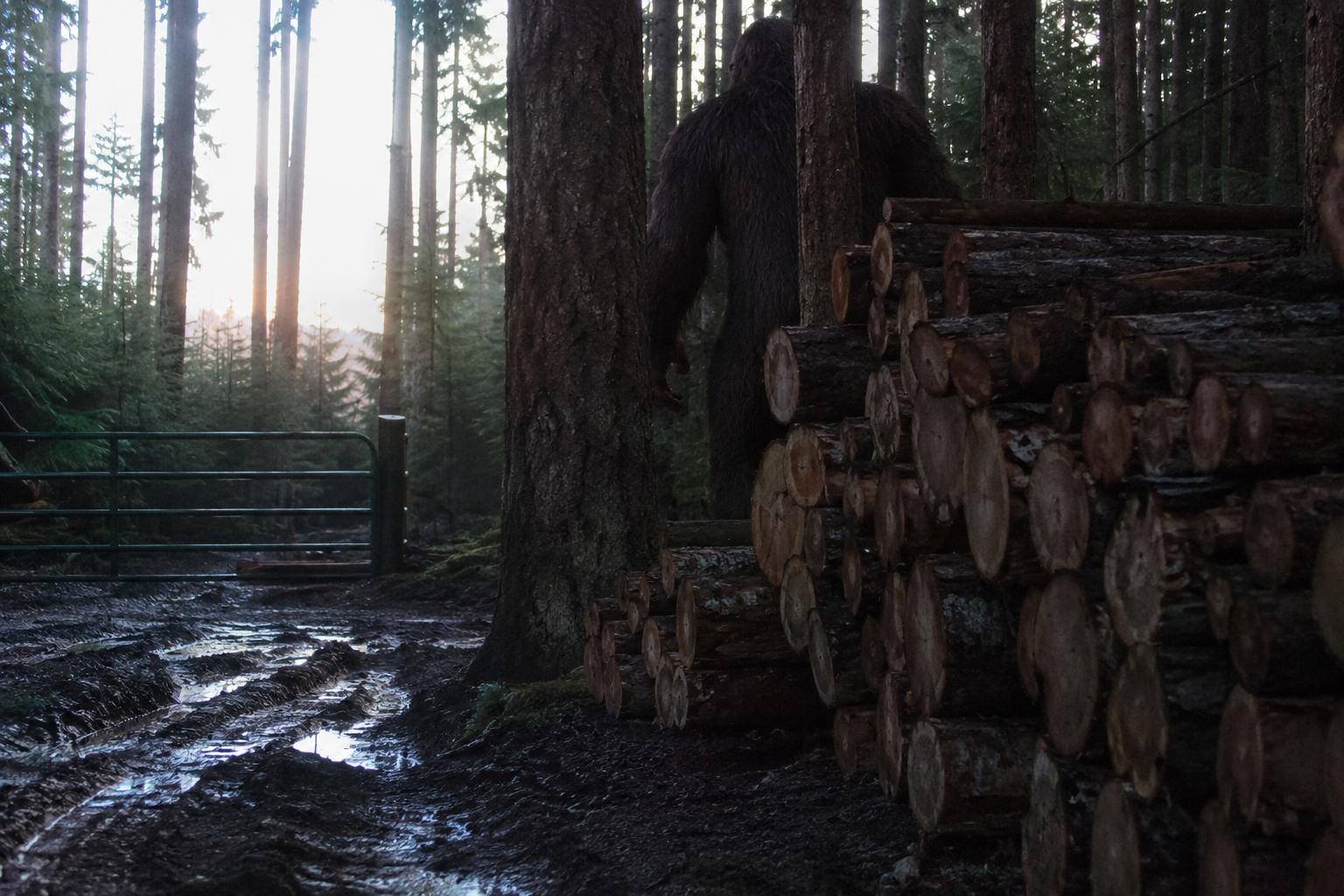
Then the eye reaches the stacked logs.
Behind the far end of the pile, a black mass breaks the regular line of timber and trees. It is not centered, and it is not clean. The shape is partly hidden by the log stack, partly lost against the pines, as if it had stepped sideways at the exact wrong moment and left only its upper body exposed.
The visible portion is broad and upright. A rounded shoulder rises well above the top row of logs. Above that is a darker knob or head shape, sloped forward slightly, with no face visible and no bright eye shine.
One side appears to taper downward behind the logs, like an arm hanging close to the body. The other side is swallowed by brush. It is the kind of detail a person might miss on a phone screen. On a larger monitor, it becomes difficult to stop seeing.
The figure looks less like it is posing for the camera than trying not to be in the frame at all.
The Step Nobody Saw Finish
The camera only captured a fraction of a second. That is part of why the image feels so unfinished. The dark figure is neither fully entering nor fully leaving. It is caught mid-concealment, behind the timber stack, with the road open in front of it and the woods waiting behind.
If it was an animal, it was moving with strange timing. Bears can rise up, appear enormous, and vanish quickly when brush and darkness line up in their favor. But this shape does not look low or hunched in the way a bear often does when crossing. The upper mass is vertical. The shoulders seem squared. The head sits high enough that whatever stood behind it would have been far taller than a man standing in the mud.
No second clear frame showed the figure walking away. The next image sent by the camera came four minutes later, triggered by rain or swinging brush. In that one, the log pile was empty.
Something had been there. Then it was not.
The Chain In The Morning
The next morning, a forestry supervisor drove out to check the gate because the camera had sent several late-night alerts. He expected to find teenagers, tire tracks, or maybe a bear that had nosed around the road.
He found the chain twisted.
It had not been cut. The lock was still closed. The gate had not been opened, and there were no fresh vehicle tracks past it. But the chain itself was warped in a way that looked hard to explain casually.
Two links near the lock had been pulled out of line, as if the loop had been torqued hard and then released. The chain no longer hung evenly. It kinked against the hasp, tight on one side and slack on the other.
A person can twist a chain with tools. A truck can strain one by pushing the gate. Weather can make metal look worse than it is after years outside.
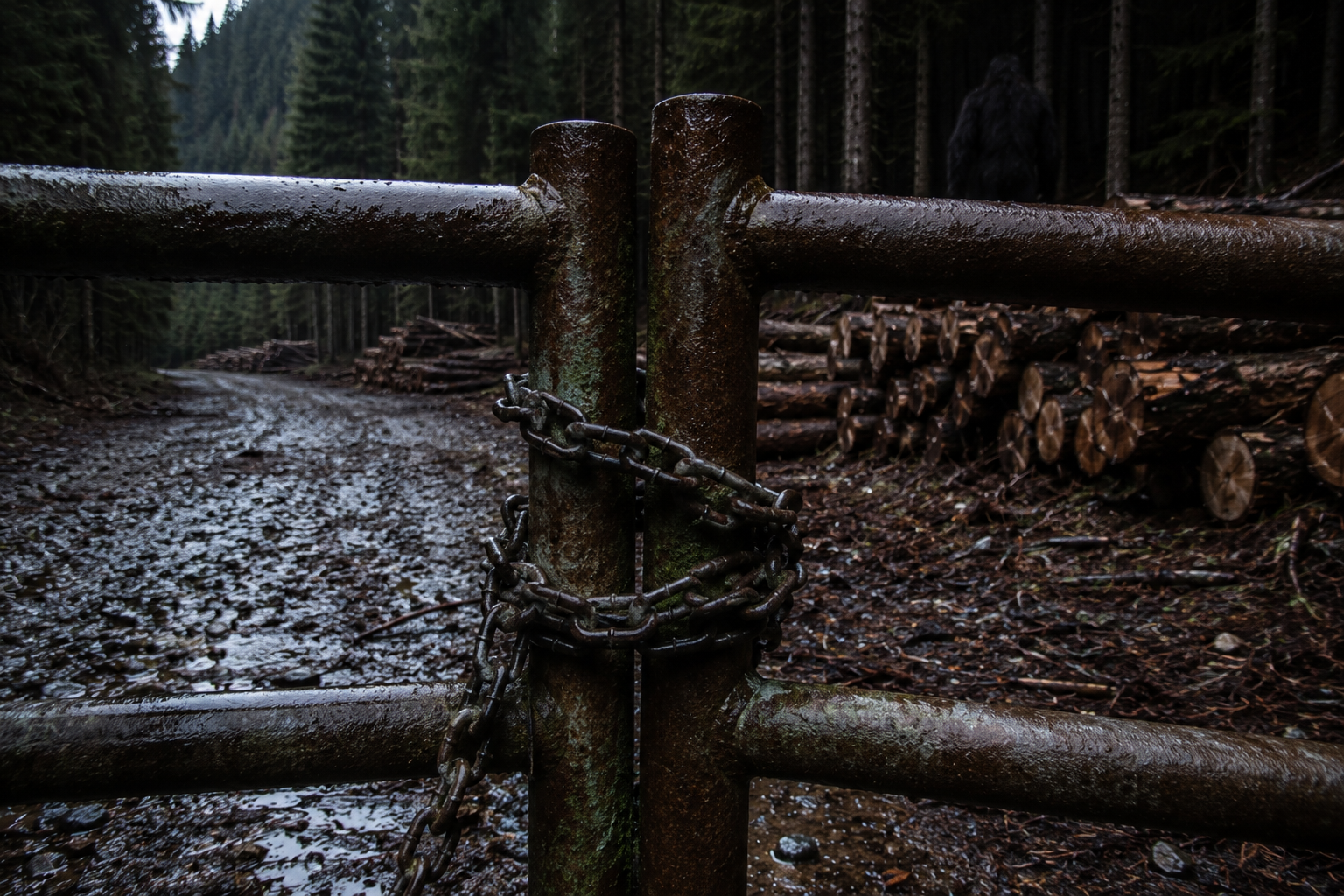
Still, the supervisor reportedly stood there longer than he meant to, looking from the twisted links to the log pile and then to the dark gap behind it.
The camera had recorded the shape before anyone saw the damage. That order is what made the story travel.
Mud, Tracks, And Rain
The road should have offered answers. Mud remembers weight. The ditches held standing water, and the ruts near the gate were soft enough to take prints from deer, boots, or tires.
But rain had been falling for hours. By morning, the surface was a mess of washed edges and overlapping marks. There were deer tracks near the ditch, boot prints from the supervisor, and several broad depressions near the log pile that could have been anything after the storm softened them.
One mark drew attention because it was large and oval, pressed deep at the edge of the road where gravel turned to mud. It might have been the heel of a boot sliding sideways. It might have been a section of bark dropped from the log stack. It might have been the rear pad of a bear stepping in slop.
No one measured it properly before more rain came.
The mud did not solve the image. It only gave the image a place to stand.
What Else Could It Have Been?
The sensible explanations are still on the table. The dark form could be a bear partly upright behind the logs, especially in infrared, where wet fur and shadow merge into one heavy shape.
It could be a person in dark rain gear moving around the timber stack. A trespasser who knew the camera was there might have ducked behind the logs and later used a bar or tool on the chain without ever opening the gate.
It could be a trick of alignment: black brush, wet bark, and the end of the log pile combining into a humanlike mass for one frame. Cameras at night flatten distance and make ordinary woods look staged for fear.
The twisted chain has its own ordinary routes. Someone might have tried to force the gate earlier. A vehicle could have bumped it days before. A falling limb may have pulled tension through the bar in a way that kinked the links.
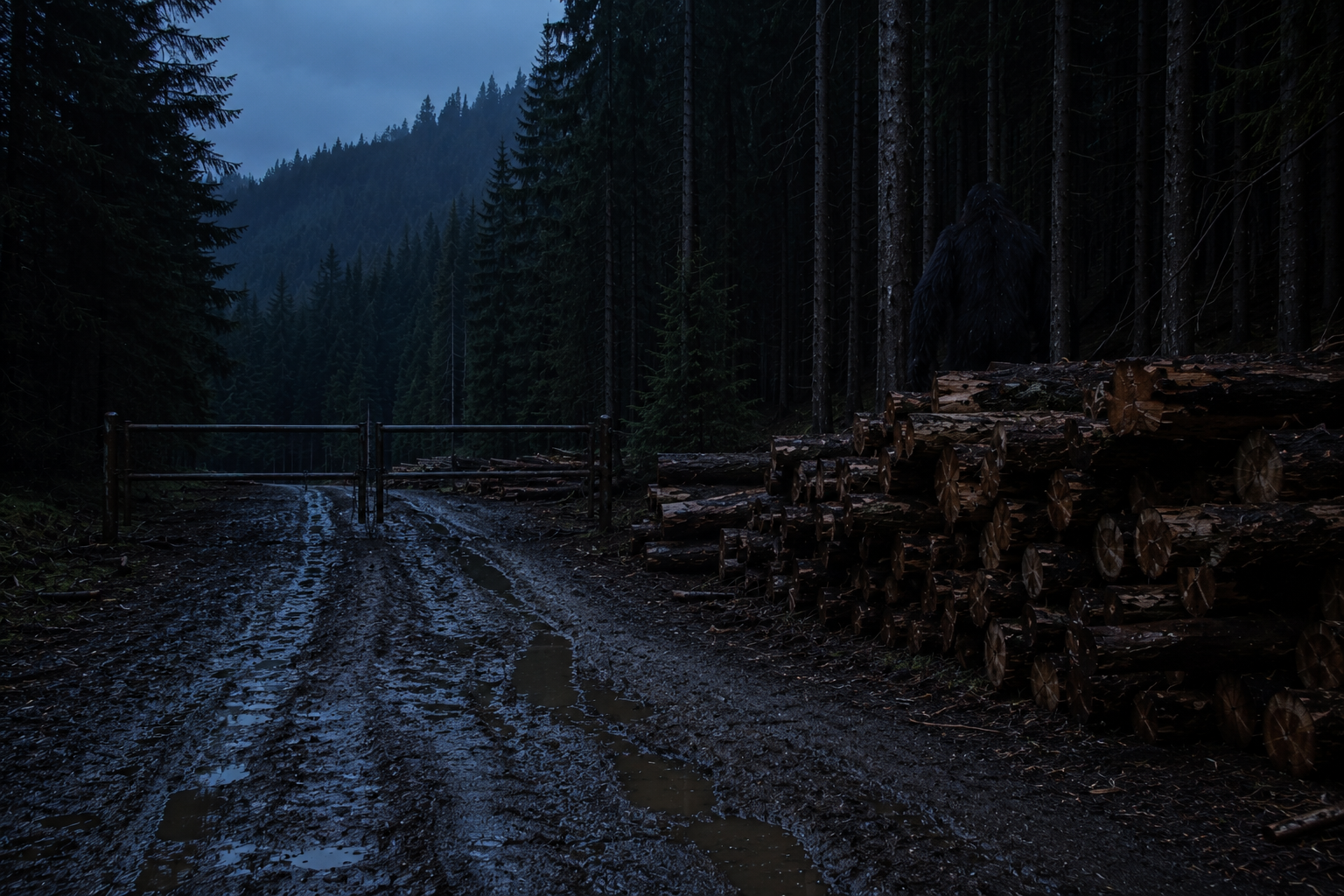
None of that requires a Sasquatch on the Blackwater road.
But the image does not feel like a simple stump once the chain enters the story. The mind keeps tying the two together: the hidden figure behind the logs, the gate in the foreground, the metal found twisted in the morning.
It becomes hard not to imagine something testing the boundary after the camera stopped watching.
The Gate That Looked Different Afterward
After the chain was replaced, the camera stayed up. The crew adjusted the angle, added a second lock, and cleared some brush around the gate. Nothing similar appeared in the following weeks.
That did not make the original frame easier to forget.
During the day, the site still looked ordinary. Mud. Timber. Pine. A road closed to keep people out of active forest land. But after dark, the stacked logs made a black wall beside the gate, and the gap behind them looked too deep for the few yards it actually covered.
A camera can make a place feel safer because it is always watching. This one did the opposite. It suggested the road had been watched back.
Maybe the Blackwater image shows a bear caught at a strange angle. Maybe it shows a trespasser in rain gear slipping behind logs before working on the chain. Maybe it shows nothing more than wet bark and shadow arranging themselves into a familiar nightmare.
Or maybe something massive came down the logging road that night, saw the gate, saw the camera, and stepped just far enough behind the cut timber to become a question instead of an answer.
By morning, the chain was still locked.
But it no longer looked like it had been enough.