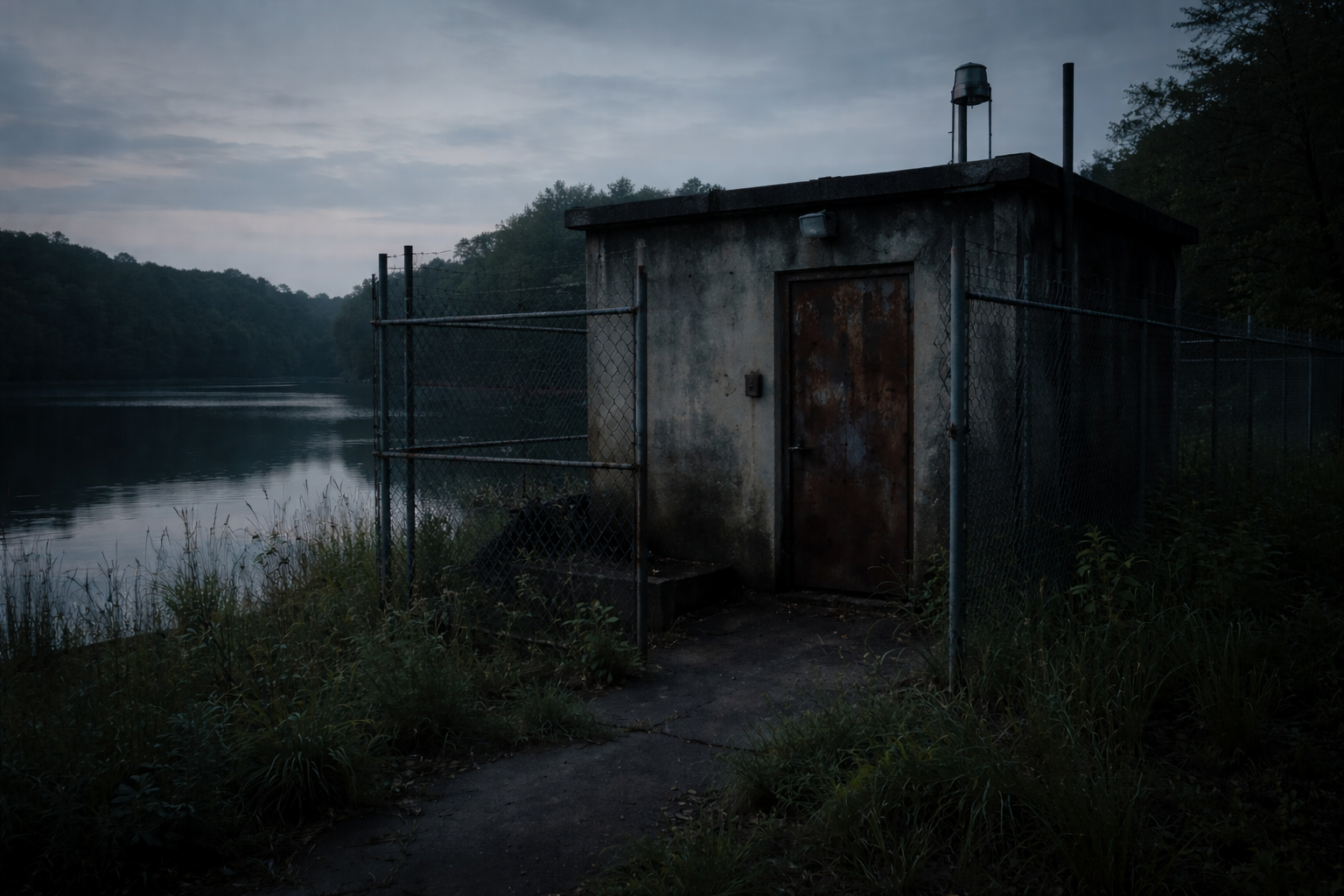
The locked building by Olsen Reservoir
Olsen Reservoir is not the sort of place that usually produces big stories. It sits behind municipal fencing, service roads, and warning signs that make it feel more administrative than mysterious. The old pump house on the east service spur had been taken out of regular use years before the incident, though the town still kept it locked and inspected.
That is why the Olsen Pump House case has stayed interesting to WeirdWitnessed readers. It does not begin with a craft in the sky or a dramatic encounter on a lonely road. It begins with maintenance paperwork, a locked metal door, and three physical details that do not fit comfortably together.
The first was a silent blue flash seen from across the reservoir. The second was a frost outline found on the outside of the pump house door in warm weather. The third was a narrow, almost human-but-not-quite shadow captured at the far rail in a maintenance photo taken inside the building.
None of these details proves an alien visitor. Together, they form a strange little chain of evidence that has resisted easy dismissal.
A silent blue flash with no reported thunder
The earliest witness was reportedly a late-shift water department employee finishing a gauge check near the south access road. He described seeing a flat blue flash reflect across the reservoir surface, low and brief, as if someone had opened a welding arc behind the pump house and shut it instantly.
He did not hear thunder. He did not hear a transformer pop. He did not see a vehicle leaving the service spur. According to the later account, the flash was bright enough to paint the concrete edge of the reservoir blue for less than a second, but it came without the crack, hum, or rolling echo normally attached to electrical trouble.
A silent flash is not automatically paranormal. Distant lightning can be muted by terrain. Security lights can fail oddly. A camera sensor, memory, or retelling can sharpen a vague glow into a crisp event.
Still, the timing matters because the frost was discovered the following morning, and the pump house was still locked.
The frost was on the outside
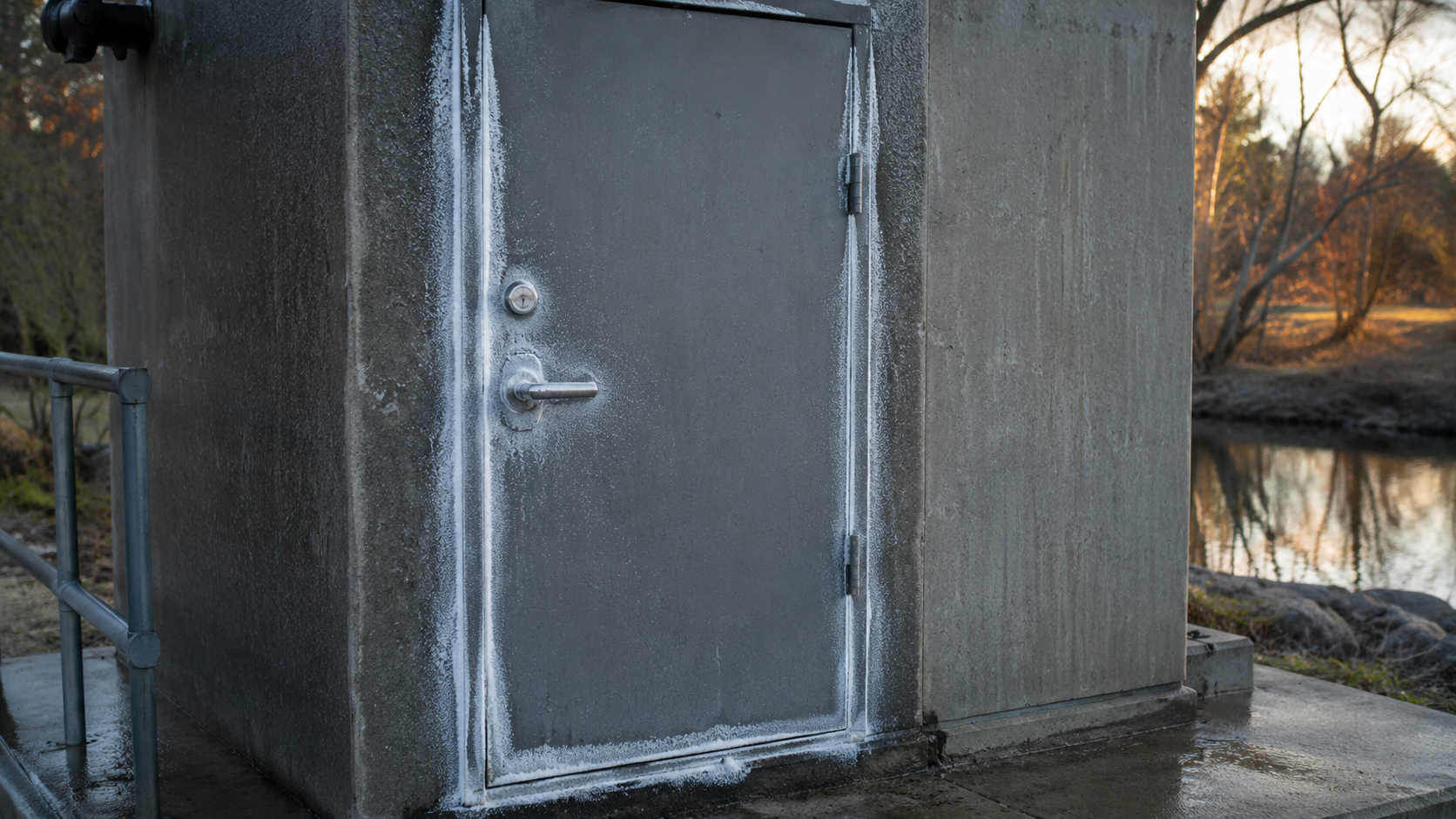
The morning inspection crew expected ordinary nuisance problems: weeds against the wall, possible trespass, maybe a stuck latch. Instead, they found a blue-white frost pattern on the exterior face of the metal door.
The oddity was not simply that frost appeared. Cold surfaces can gather moisture, and metal doors can hold temperature differently than the air around them. The oddity was the shape and location. The outline reportedly traced the outer side of the door around the handle area and lower panel seam, as if a chilled object had been pressed near the door from outside.
The weather had been warm enough that morning for insects to be active along the reservoir bank. No frost was seen on the nearby fence, the concrete threshold, the pipe housing, or the handrail beside the door. The patch was localized.
Workers also said the frost had a faint blue cast before it melted. That description may be subjective. A gray door reflecting sky can make white frost appear bluish. But multiple retellings keep the color because it matched the flash seen the night before.
No clean sign of entry
If someone caused the frost as a prank, the obvious question is how they accessed the site. The pump house sat behind a fence, and the door was secured with a municipal lock. According to the story, the lock was intact. There were no fresh pry marks around the latch. No broken glass was found, and the rear service hatch was still bolted.
None of that makes intrusion impossible. People get into restricted places without leaving theatrical damage. A key could have been copied. A lock could have been opened and replaced. A worker could have staged the scene for attention.
The case also never behaved like a boast or a hoax campaign. It circulated the way municipal weirdness often circulates: first as a staff story, then as a local rumor, then as a scanned image and a few names people would only half-confirm.
The maintenance photo and the far rail
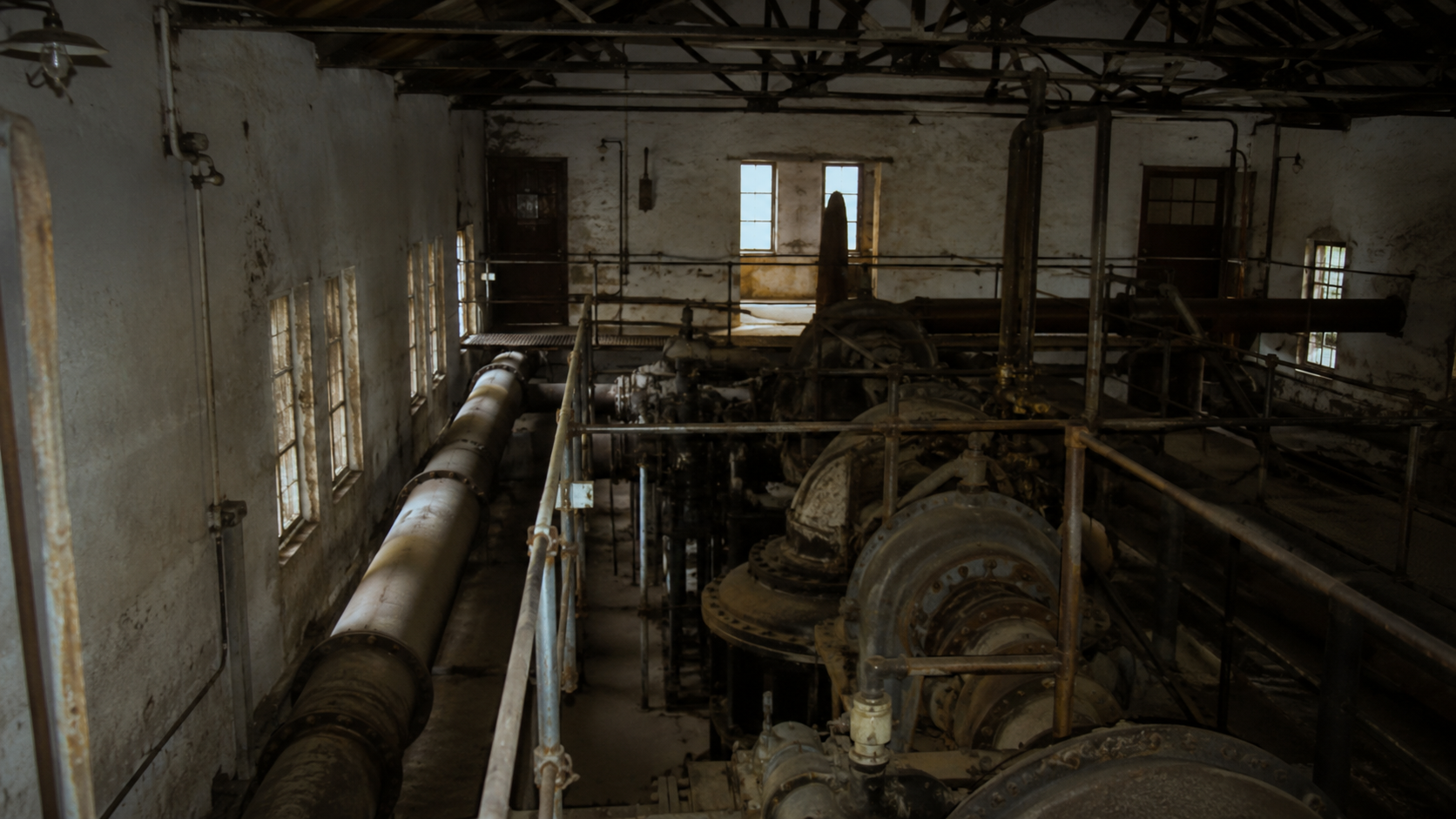
The most debated piece of the Olsen file is a maintenance photo said to have been taken inside the pump house during the inspection. The photograph reportedly shows pipes, a pressure manifold, a low platform, and a waist-high rail near the far wall. At that rail stands a narrow dark form.
It is not a classic gray alien image. There are no obvious eyes, no clear head, no theatrical fingers. The form is thin, vertical, and slightly bent at the top, like a shadow cast by something just outside the frame.
That is the reasonable explanation: a shadow. Pump houses are full of pipes, rails, hanging cables, and irregular surfaces. A camera flash can throw shapes that look alive for one frame. A person partly blocked by equipment can become uncanny in a grainy maintenance shot.
The problem is that the workers connected to the account reportedly did not recognize anyone standing there. The far rail was not a normal place to stand during the inspection, and the figure appears unusually narrow in relation to the rail height.
Condensation that fell in straight lines
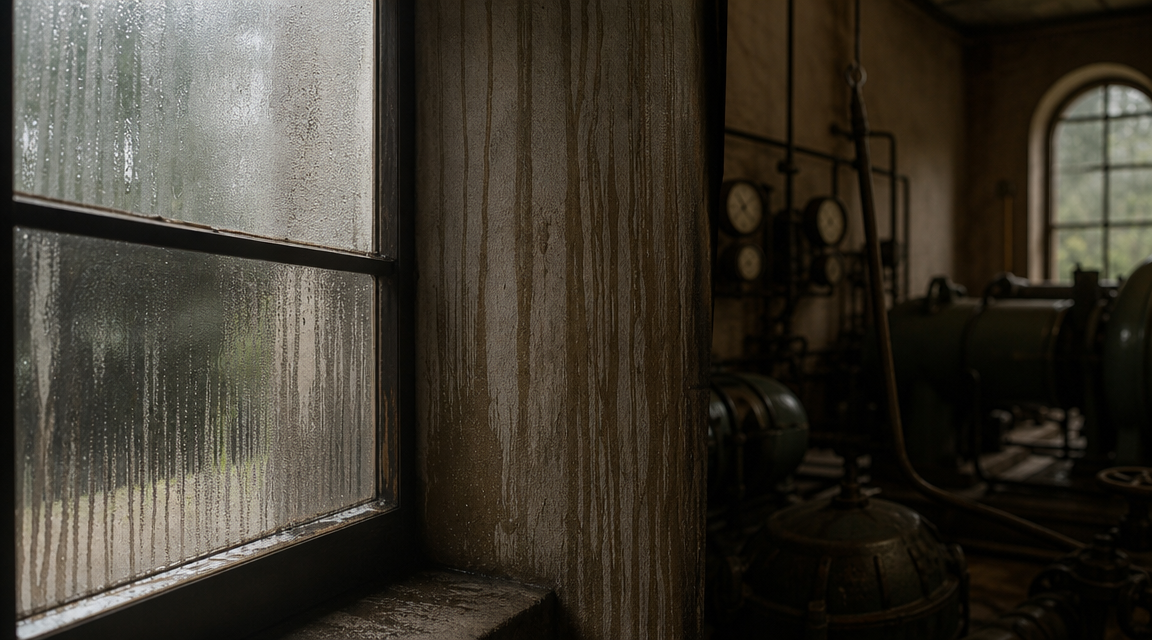
The third physical detail is less famous than the frost or the photo, but it may be the strangest. Inside the pump house, workers reportedly found condensation on the inner wall and window surfaces. That would not be unusual in a damp building beside a reservoir.
What made it notable was the direction and pattern. The moisture had formed in long vertical streaks, running almost ruler-straight down sections of the interior wall. Witnesses described it as if the air had been combed from ceiling to floor.
Warm weather makes the report harder to interpret. Condensation usually asks for a temperature difference. A cold interior surface can gather moisture from warm air, but the building had not been actively cooled. The old equipment was not running. There was no known refrigeration system inside.
Could the streaks have been old leaks? Absolutely. Could dust, paint texture, or previous mineral deposits have guided moisture downward in neat paths? Yes. But the timing after the blue flash and exterior frost is what keeps the detail attached to the larger account.
Why the evidence points sideways, not upward
Many alleged unknown visitor cases push the reader toward the sky. The Olsen Pump House case does something quieter. It points sideways, toward a locked door and a building boundary.
The frost appears to suggest contact or proximity from outside. The condensation suggests a thermal disturbance inside. The photograph suggests, or seems to suggest, a presence near the far rail. If the details are accurate, the event may have involved something interacting with the structure rather than simply passing above it.
That is where caution is necessary. A person can build an alien story by arranging ordinary anomalies in a line. A flash, frost, a photo shadow, and condensation can each have mundane causes. The fact that they occurred near each other does not force a visitor explanation.
But dismissing each item separately may miss why witnesses remembered the morning at all. People who maintain municipal infrastructure are used to odd noises, wet walls, bad wiring, and dead lights. For them to preserve this event as unusual, something about the combination must have felt wrong in person.
Possible explanations still on the table
The most conservative explanation is electrical malfunction. A short, arc, or failing component could create a blue flash and unusual heating or cooling effects. The abandoned status of the pump house complicates this, but old municipal buildings are rarely as dead as they look. Sensors, buried lines, or security circuits may still be present.
Another explanation is chemical or staged. Aerosol discharge, coolant residue, a cleaning agent, or a person with access could have created a localized frost-like deposit and a suggestive photo without requiring anything unknown.
The visitor interpretation is the most dramatic and the least proven. It proposes that something unknown approached the pump house, produced or followed the blue flash, affected temperature across the door boundary, and left ambiguous visual evidence inside.
What would make the Olsen case stronger
The Olsen Pump House case would become far more useful if the original maintenance photo, inspection notes, and weather records were available together. The exact date matters. So do temperature, humidity, electrical service status, and the chain of custody for the image.
A high-resolution scan could reveal whether the far-rail figure is a person, a pipe shadow, a reflection, or a compression artifact. Work orders might show whether anyone had reported electrical faults before the flash.
Until then, this remains a cautious unknown visitor file rather than a solved encounter. Its power is not in spectacle. It is in the wrong-sided frost, the warm-weather streaks, and the thin shape standing where nobody expected a shape to be.
The Olsen Pump House Blue Frost is best understood as a small, stubborn anomaly. It does not ask us to believe in aliens. It asks why a locked municipal building briefly looked as if something cold, silent, and unfamiliar had paused at its door.
Reader Context
This Weird Witnessed story is an editorial reconstruction, written as eerie visual storytelling rather than a verified report. For more context, see UFOs and Unknown Visitors Guide and How WeirdWitnessed Creates Reconstructed Horror Stories.