The flagging that started above the hand line
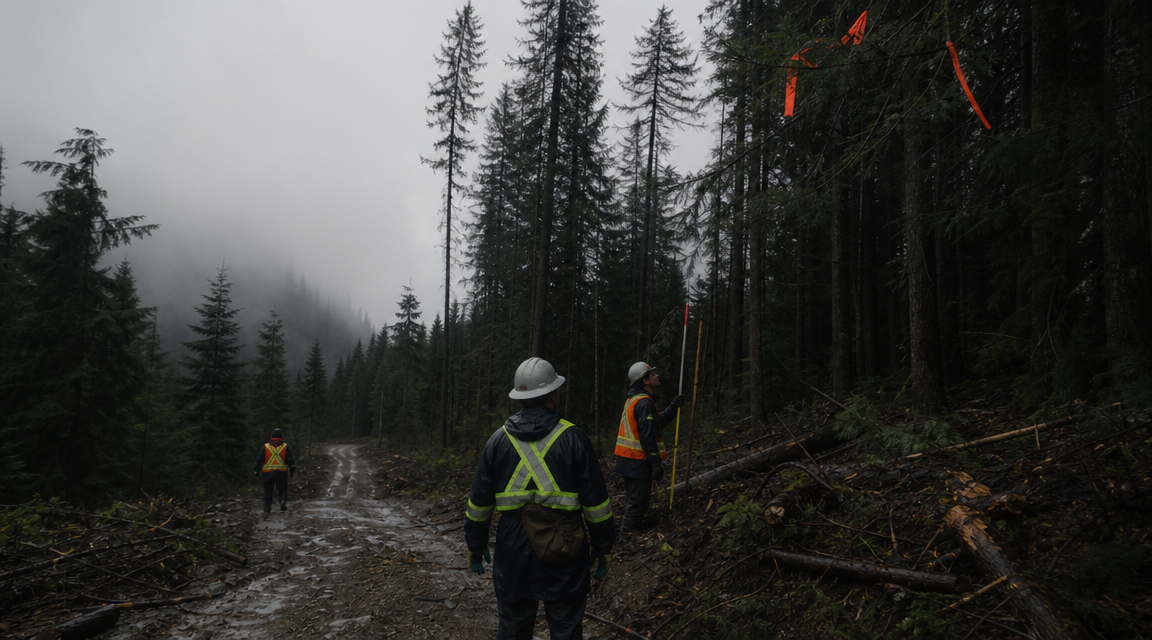
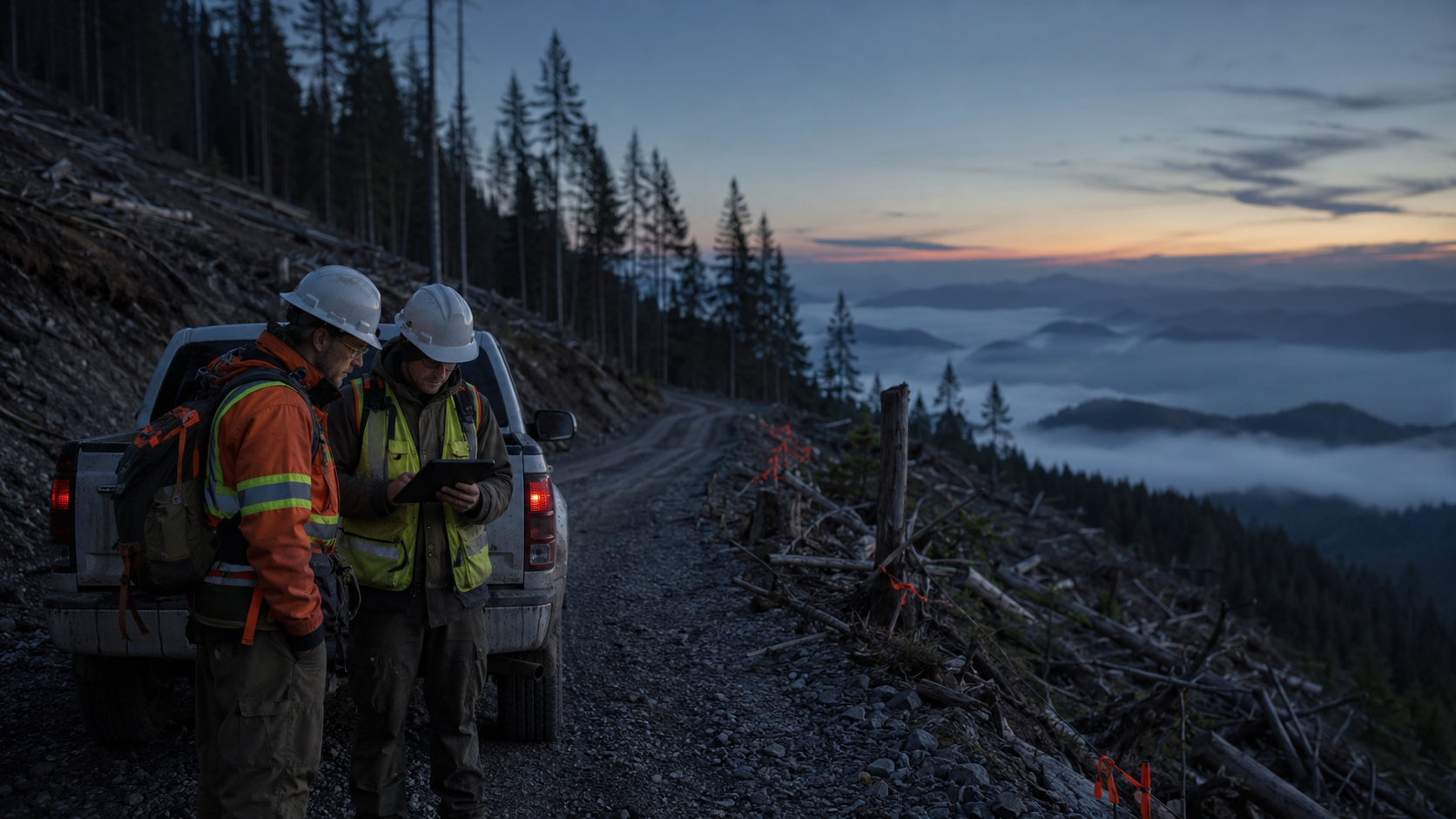
The Sable Ridge incident began as a utility corridor survey, not a monster hunt. The crew was there to mark a proposed service access route across a steep timbered shoulder above an old logging road.
Their work was ordinary: GPS points, slope notes, boundary checks, and orange survey ribbon. By late afternoon, rain had soaked the brush and the light was thinning under the cedars.
Then they found orange ribbon already tied in the trees.
That alone was not strange. Timber units collect old flagging from surveyors, foresters, hunters, and road crews. But these strips were bright, clean, and wet like the ribbon the crew had been using that day. Several were tied ten to twelve feet up, well above normal reach.
The crew lead reportedly wondered whether another contractor had been through with a pole. Then the workers compared torn ends. The high ribbons looked uncomfortably similar to their own roll.
It did not prove anything. It did make everyone stop talking.
A practical crew in impractical terrain
The witnesses were not campers building a campfire story. They were workers trying to finish before dark on a ridge that did not make movement easy.
That matters. Survey crews notice flagging. They know old tape from fresh tape, loose knots from quick field knots, and misplaced marks. Incorrect ribbon can send a later crew to the wrong point, so the first reaction was irritation, not fear.
The high pieces were not arranged like a symbol. They appeared singly, unevenly spaced, sometimes just uphill from the crew’s own marks. One hung above a narrow game trail.
A tall person standing on a stump might reach one or two. But several seemed tied from the brush side of the tree, not from the road side, and no obvious scuffs showed someone had climbed up.
The crew photographed them for the record and kept moving.
Then they found the cedar breaks.
Fresh cedar breaks in the wet draw
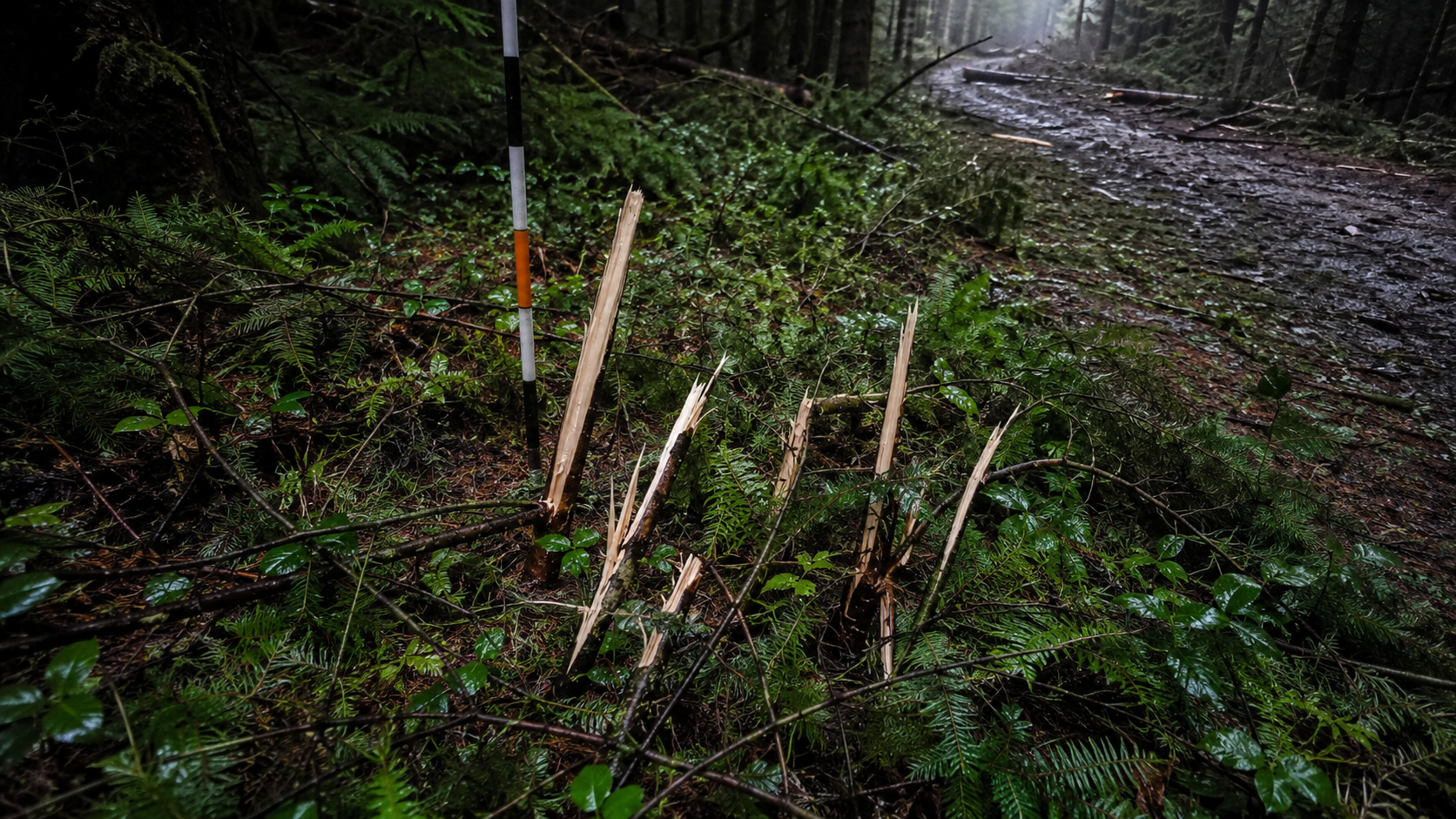
About forty yards upslope from the most obvious high ribbon, the crew entered a shallow draw packed with young cedar, huckleberry, and old logging debris. There they found several saplings snapped and bent in a rough line.
The exposed wood was pale and fresh. Some stems were thumb-thick. Others were closer to wrist-thick. The tops had not been cut. They were twisted, fractured, and left hanging.
Broken saplings are not rare in timber country. Snow load can bend young trees. Elk and bear can push through brush. A falling limb can make a small area look dramatic.
This spot, however, was away from the muddy machine track. The damage sat inside the brush, trending toward the same area where the high flagging had been noticed. One worker reportedly joked that “somebody tall was redecorating.” Another told the crew to keep moving because the slope was getting slick.
That is often how field anomalies begin. The thing is odd, but the schedule is louder.
The picture taken for paperwork
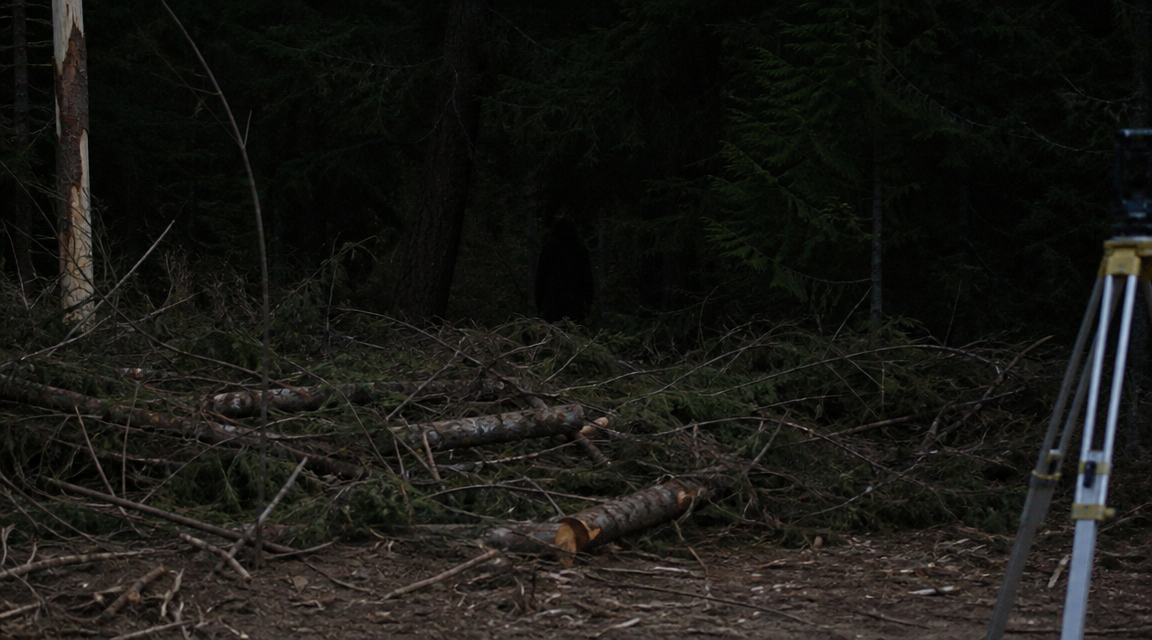
The image now tied to the Sable Ridge story was not taken as a creature photo. It was a worksite reference shot, meant to document where the corridor line met stacked logging slash from an older cut.
The frame shows wet branches, survey gear, and a dark wall of piled limbs. Behind that slash, screened by sticks and shadow, is a broad upright form.
It is not centered. It is not sharp. There is no visible face, no clean shoulder line, and no dramatic stride. Many viewers would miss it if the photo were shown quickly.
Once noticed, though, the shape becomes difficult to ignore. It appears taller than the slash pile and wider than a normal trunk. Its lower part disappears behind branches.
WeirdWitnessed has not independently verified the original camera file, and that limitation matters. Low-light phone images can turn ordinary shadows into solid-looking forms. Overlapping limbs can create humanlike shapes.
Still, the crew’s reaction is part of the chain. The figure was reportedly noticed later, while one worker reviewed photos for notes and asked another: “Was anyone standing back there?”
The answer was no.
Why the ribbons matter more than the shape
Most Bigfoot photographs are judged by the visible figure. This case is different. The dark form is interesting, but it is also the easiest part to dismiss. The ribbons are less dramatic and more useful.
Fresh survey tape tied above reach requires an action. Someone or something put it there. If a person did it, they likely used a tool, climbed, or stood on a log. If an animal carried it, the knot becomes the problem.
There are ordinary answers. Another crew may have used the same brand of tape. A hunter or local prankster may have staged the scene. A worker may have forgotten tying a piece from a higher position during a busy, wet day.
The important point is that the high flagging was noticed before the photo became the focus. In many Sasquatch reports, the strongest details are not the huge figure but the residue around it: moved objects, odd heights, fresh breaks, and witnesses who sound annoyed before they sound frightened.
Sable Ridge has that quality.
The ordinary explanations still count
A cautious read has to begin with non-mysterious possibilities. The ribbons could have been left by arborists, timber cruisers, previous surveyors, or utility workers with poles. The matching appearance may only mean several crews bought the same tape locally.
The cedar breaks could be weather damage. Wet snow bends young conifers in clusters. Elk and bear can break brush while feeding or traveling. Human workers can also damage saplings without realizing how it will look later.
The dark shape could be a stump, root wad, shadow gap, standing worker, or compression artifact from a phone camera in dim conditions.
Any one of those explanations could account for part of the story. Together, they might explain all of it without needing an unknown animal on the ridge.
That is why Sable Ridge should not be presented as proof. It is not a body, not a clear video, not a trackway, and not a recovered sample. It is a cluster of field anomalies documented by people with a practical reason to notice them.
For WeirdWitnessed, that is enough to examine, not enough to declare solved.
The pattern researchers will notice
Researchers who collect Sasquatch reports may recognize several elements here. Survey tape, altered markers, and moved objects appear in many modern accounts. Sometimes flagging vanishes. Sometimes it reappears tied in the wrong place.
Skeptics argue that these cases are usually human pranks, and sometimes they probably are. Bright ribbon is easy to see and easy to manipulate.
But Sable Ridge is not a busy trailhead. The worksite was wet, brushy, and inconvenient. A prankster would need to know the crew’s timing, reach the same slope, tie multiple pieces high, and leave without being noticed or leaving an obvious path.
The snapped cedar line adds familiar texture. Bigfoot witnesses often report broken saplings or twisted brush near alleged activity. That does not make every broken sapling evidence. It places the detail in a recurring category of claimed sign.
The photo becomes a third point, not the whole case. A dark upright shape behind slash is easy to overread. A dark upright shape near high fresh ribbons and fresh breaks is harder to throw away immediately.
What would make the case stronger
The strongest next step would be original files and measurements. A camera file with metadata could establish time, device, and exposure. Extra frames could show whether the shape was stationary, absent, or just a stump from another angle.
Measurements would matter even more. The ribbon height should be recorded with a pole or tape. The distance from camera to slash pile should be measured. Known objects in the frame could help estimate the dark form’s size.
A return visit in similar light would help too. If the shape lines up with a stump or root mass, the mystery shrinks. If the area behind the slash is open and no matching object exists, the photo becomes more interesting.
The snapped cedars should be mapped with scale. Break height, direction, and freshness can sometimes separate snow load from impact or deliberate bending. Soil impressions would be useful, though rain and crew traffic may have erased them quickly.
Without those follow-ups, Sable Ridge remains suggestive rather than evidentiary.
A ridge marked by something, or someone
What remains is an uncomfortable sequence: bright orange ribbons tied higher than expected, fresh cedar breaks in a wet draw, and one low-light photograph that appears to show a broad dark shape behind stacked slash.
No single part demands a Sasquatch explanation. Taken together, the details create the kind of case researchers tend to keep in a file instead of throwing away.
The most responsible conclusion is also the least sensational. Something interfered with a normal survey day on Sable Ridge. Whether that something was another crew, a prankster, weather, wildlife, or an unrecognized animal remains open.
The orange ribbons are the lingering detail. They do not roar, stare, or chase anyone down a road. They simply hang too high in the wet timber, bright against the dark cedar, asking who had the reach to tie them there.
Reader Context
This Weird Witnessed story is an editorial reconstruction, written as eerie visual storytelling rather than a verified report. For more context, see Bigfoot and Sasquatch Stories Guide and How WeirdWitnessed Creates Reconstructed Horror Stories.