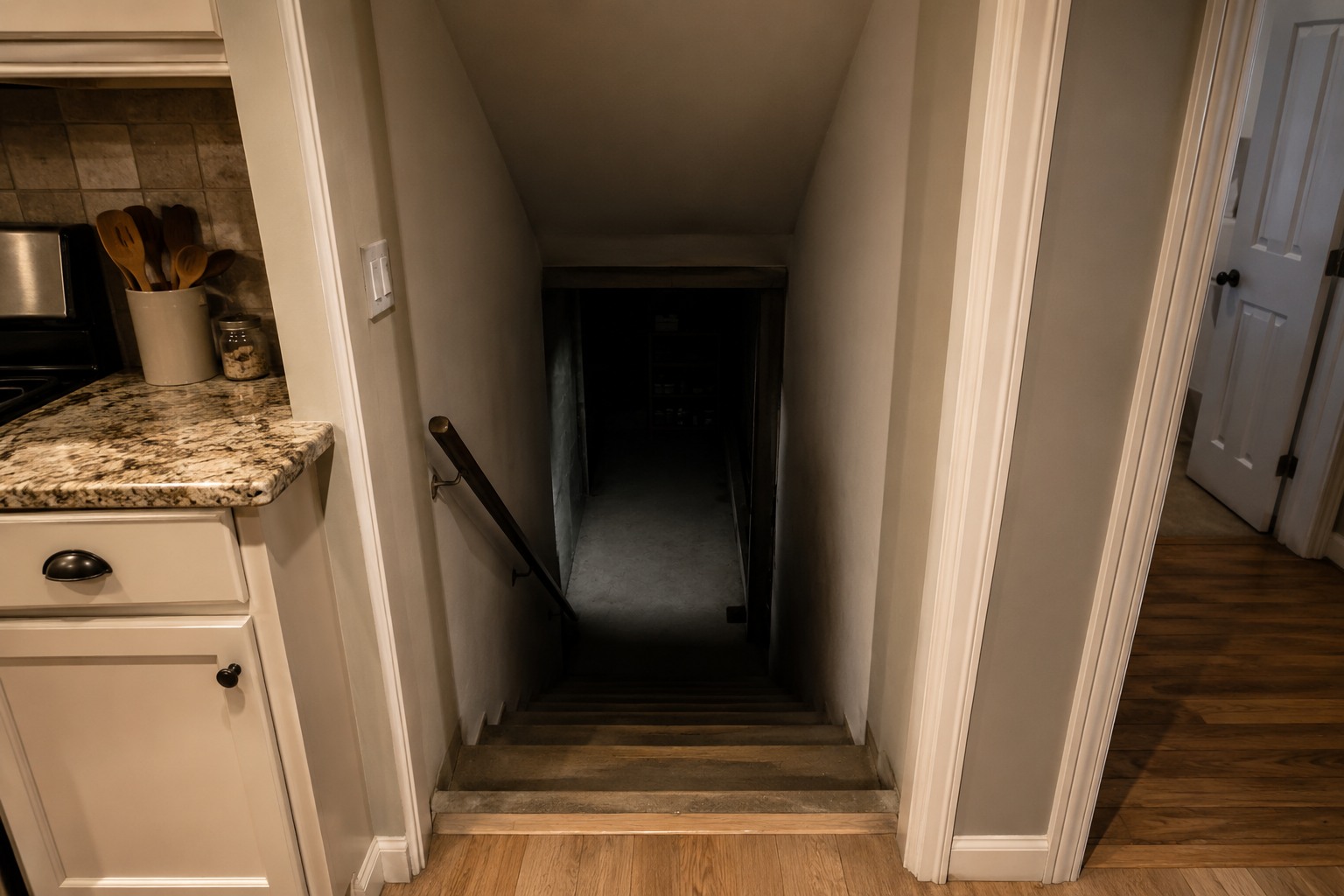
The third step sounded wrong. Not louder exactly. The basement staircase had always creaked, especially near the bottom where the wood was older and the supports met the concrete wall. But this sound came after the man standing in the kitchen had already stopped walking. He had gone down to move laundry into the dryer, climbed back upstairs, and shut the basement door behind him. Then, while filling a glass at the sink, he heard a slow wooden groan beneath the floor. One step. A pause. Then another creak from slightly higher on the staircase. He stood still and listened. The next sound came from the middle step. That changed everything. A settling house can crack. Pipes can knock. Old stairs can complain when temperatures shift.
But three separate creaks, apparently moving upward through an empty staircase, sound less like a building and more like someone climbing. He opened the basement door. The light was still on below. The staircase was empty. Nothing moved. Yet stories about basement stairs often contain exactly this detail: during the day they are ordinary, noisy pieces of a house. At night, the same stairs seem to acquire a different voice. They pop under invisible weight, creak one step at a time, or make a sound that seems to stop just before the basement door. So why do basement steps sound different at night? Part of the answer is surprisingly physical. Part of it happens inside our own perception.
And a small part is why basement stair stories remain so unsettling even after the obvious explanations have been checked. Why basement stairs become louder after dark. Basement stairs are unusually good at producing frightening noises. Unlike many finished staircases in the main part of a house, basement steps are often exposed underneath. Their boards, supports, nails, screws, and framing may all be connected directly to unfinished walls and floor joists. When one piece moves slightly, the sound can travel.
The Moment It Became Harder To Ignore
That changes how large they seem. A staircase may have been making occasional pops all day. Nobody noticed because someone was walking through the kitchen or music was playing in another room. At 1:30 in the morning, the same pop happens inside a nearly silent house. Now it sounds important. Basements make this effect stronger because they often act like crude echo chambers. Concrete walls, exposed joists, utility rooms, hollow stair cavities, and unfinished surfaces can bounce or carry noises in unexpected directions. The result is a sound that seems closer, heavier, and more deliberate than its source really is. Usually that movement is too small to see. It is not necessarily too small to hear. A tread can rub against a riser. A nail can move inside old wood.
A stair stringer can shift against framing. The movement may release suddenly instead of gradually, producing the familiar sharp pop or drawn-out creak associated with someone putting weight on a step. That last part matters. When people hear a stair creak, they already know what normally causes that sound: a foot. The brain does not hear "wood moving against wood." It recognizes the sound pattern it has heard thousands of times while people were climbing stairs.
Why The Story Still Gets Shared
That is why an empty staircase can feel occupied almost immediately. There is also no rule saying every part of the staircase must move simultaneously. Different joints can respond at different moments. One step may creak. Thirty seconds later, another may shift. Then a third. Purely by chance, those noises can happen in an order that resembles footsteps. And once that pattern begins, it becomes extremely difficult not to listen for the next step. Why the Creaks Can Seem to Climb Toward You A single unexplained creak is easy to dismiss. A sequence is different. Imagine lying upstairs and hearing a noise from the basement. Then another from the lower staircase. Then something near the top. Even if the sounds have unrelated causes, their order creates movement.
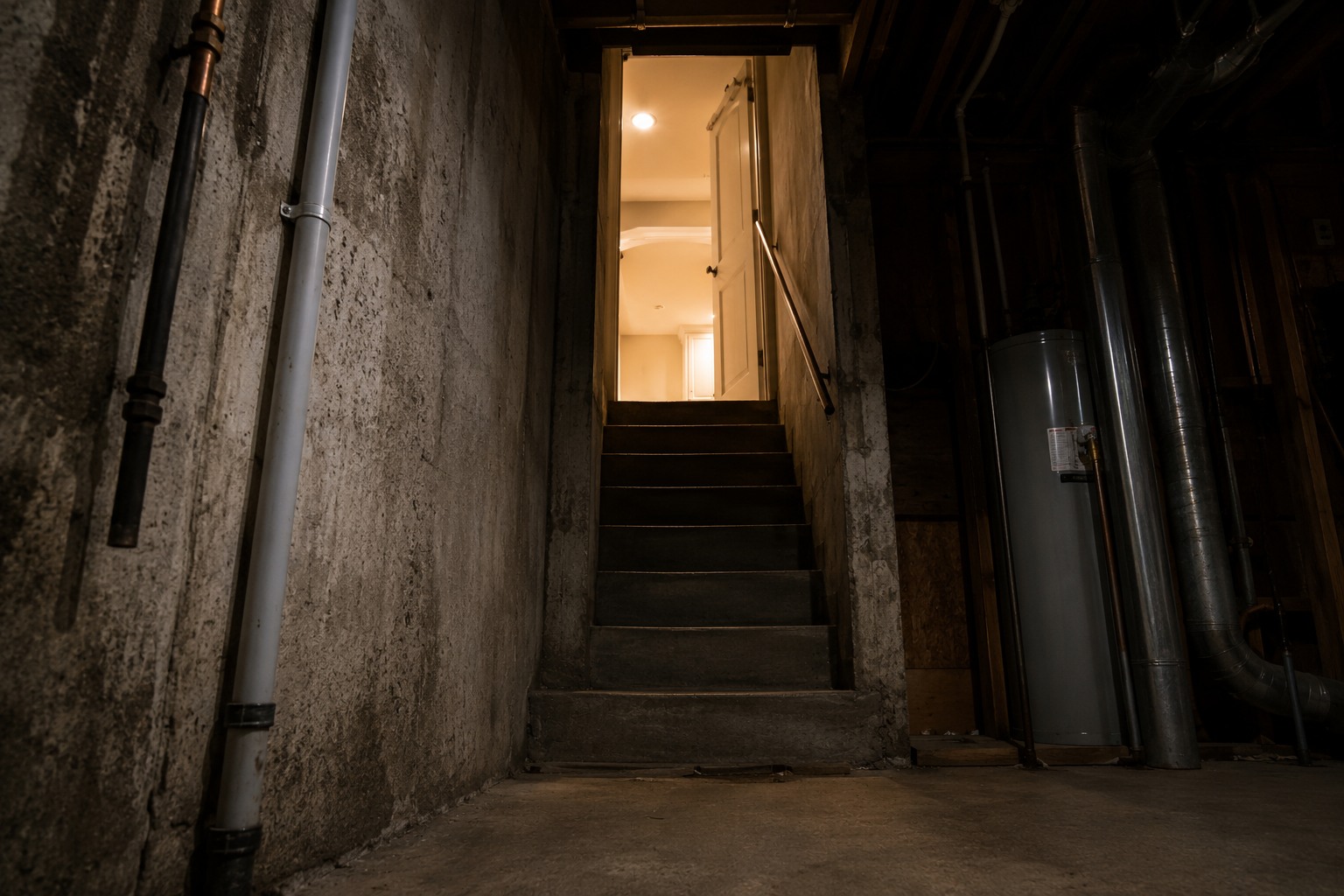
Humans are extremely sensitive to patterns that suggest another person is nearby. We notice footsteps, voices, door movements, and changes in rhythm because those sounds often matter more than random background noise. That sensitivity becomes especially powerful when we cannot see the source. A basement staircase creates almost the perfect conditions. The listener is usually above it. Much of the staircase may be hidden behind a wall or closed door. Sound travels through the stair frame, surrounding floor, and joists. The person listening therefore has incomplete information about exactly where each noise began. A creak transmitted through framing can appear to come from a different tread. A pipe expanding beside the stairs can sound as though it came from underneath them.
Ductwork can pop inside a wall and seem to move as the metal changes temperature along its length. Even small animals can complicate things. A mouse inside a wall sounds insignificant when you know it is a mouse. Before you identify it, scratching or movement amplified through hollow construction can seem strangely substantial.
The First Time It Happened
The frightening version occurs when several ordinary noises accidentally arrange themselves into a familiar rhythm: Creak. Pause. Creak. Pause. Creak. Instead of hearing three pieces of wood move, the listener hears three steps. And if the last sound comes from the top of the staircase, the imagined movement has arrived exactly where a person would arrive. The basement door: Makes the Last Step Worse Many basement stair stories become frightening at the same location: the door at the top. There is a simple reason for that. A staircase disappearing into darkness is unsettling, but it still gives the listener distance. Whatever made the sound seems to be downstairs. A creak near the top removes that distance. The basement door also creates a visual boundary.
If it is closed, the person upstairs cannot immediately check what is happening without physically opening it. That small action can suddenly feel enormous at night. This is where ordinary house sounds can produce a remarkably specific illusion. Suppose a heating duct contracts in the basement. A lower stair shifts shortly afterward. Then the floor beside the basement doorway pops. Those are three different sounds from three different parts of the structure. To someone standing in the kitchen, however, they can form one simple story. Something came upstairs. That interpretation becomes even stronger if the noises stop afterward. Silence feels like an ending.
What They Checked Afterward
If random house noises continued indefinitely, they would often become easier to ignore. But when the final creak occurs beside the door and then everything becomes quiet, the sequence seems complete. The listener starts waiting for the doorknob. Usually, nothing happens. That waiting period is one reason people remember these moments so clearly. The frightening part is no longer the sound itself. It is the expectation created by the sound. When someone repeatedly hears strange movement on basement stairs, the best place to begin is with the staircase itself. Does a particular tread creak whenever someone steps on it? Can the same sound be produced by pressing on the edge of the board? Does the noise happen around the same time the furnace turns on or off?
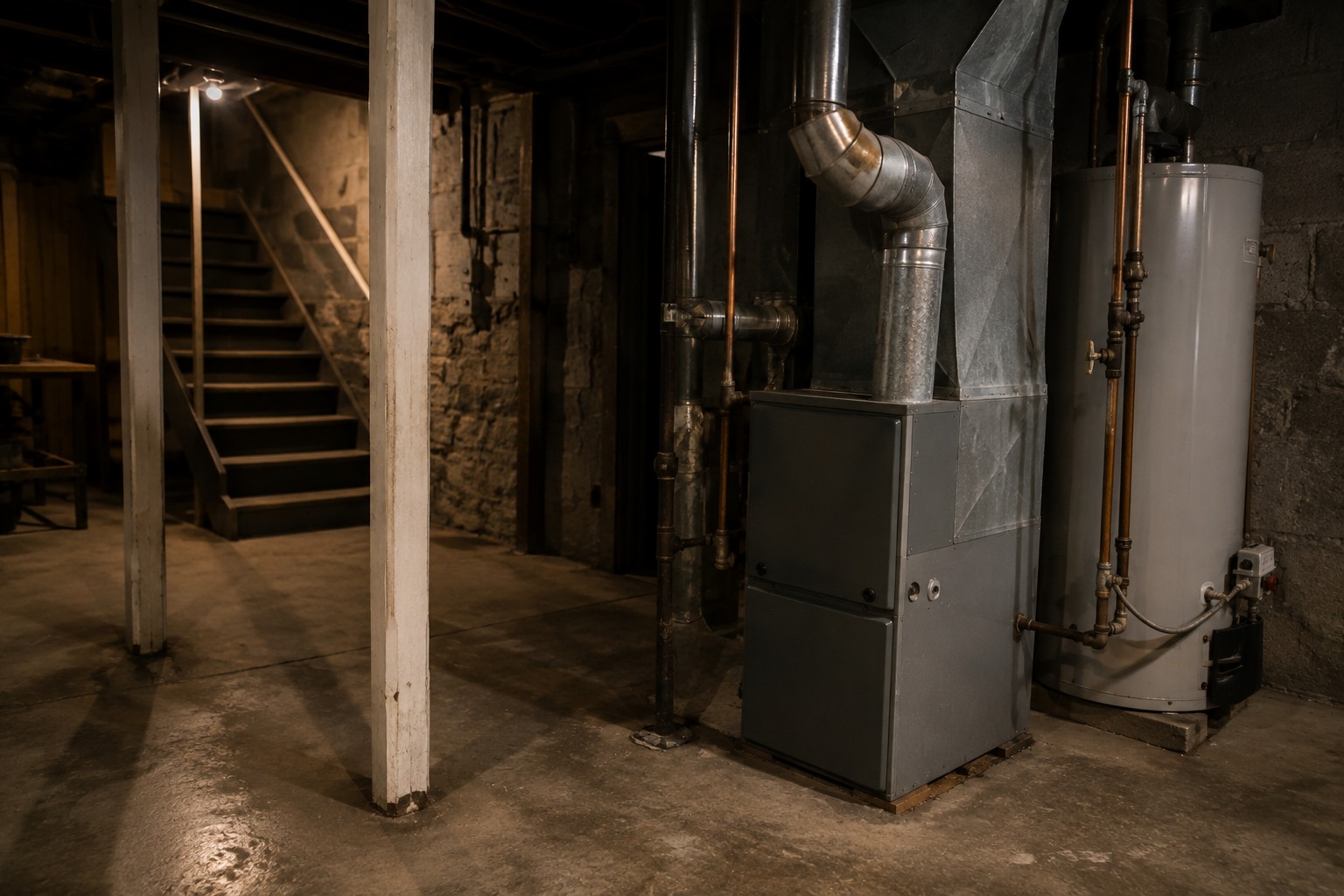
Those details can quickly make a mysterious sound much less mysterious. Heating and cooling equipment deserves special attention because basements often contain furnaces, boilers, water heaters, pumps, ducts, and pipes. A mechanical cycle can create noises several minutes apart, making them seem unrelated when they actually share one cause. Plumbing is another common source. Water moving through pipes can create knocks and ticks. Pipes can also expand against wood or brackets after hot water has been used elsewhere in the house. Because those pipes frequently run beneath floors or beside stairwells, locating the sound by ear can be surprisingly difficult. Outside conditions matter too. Wind can slightly flex parts of a house. Changes in humidity can affect wood. A strong temperature drop can make an older building noticeably noisier. Then there are animals.
Basements provide shelter for mice and occasionally larger visitors depending on the house and location. Movement behind walls, beneath stairs, or above basement ceilings can create sounds that seem to come from exposed steps. A useful test is repetition. Ordinary causes often develop habits. The strange creak happens after the heat shuts off. The tapping begins after someone showers. The same stair pops on cold evenings. The scratching returns near the same wall. Once a pattern connects the noise to something physical, the feeling that an unseen person is using the staircase usually fades.
The Detail Nobody Could Explain
Not every frightening stair sound is equally interesting. A random creak at midnight is extremely easy for an old house to produce. Even several creaks are not especially surprising. What makes people hesitate is usually added structure. For example, the sound repeatedly seems to begin at the lowest tread and progress upward at roughly walking speed. Or the stairs remain silent for hours until someone says something, after which a single heavy creak comes from the landing. Sometimes a person hears what sounds like weight moving up several steps and immediately checks the staircase while the sequence is still happening. Nothing is there. That still does not automatically require a paranormal explanation. Sound localization indoors is imperfect, especially around enclosed staircases.
A noise that seems to come from one step may actually be traveling through connected framing. But repetition makes the question more interesting. If someone can identify the exact stair that seems to creak on its own, they can test it during daylight. If that board requires substantial downward pressure to reproduce the noise, yet the same distinctive groan repeatedly happens in an empty basement, there is at least a more specific puzzle to investigate. The strongest strange stories usually include something beyond "I heard a noise." They include timing, direction, repetition, or another sensory detail. A person hears five slow steps ascending, then sees the basement door move slightly. A dog wakes before the first creak and stares at the stairwell. The sounds stop whenever the basement light is switched on.
Again, none of those details establishes what caused the event. They simply make the easy explanation less satisfying, which is exactly where basement stories tend to linger. Why Nighttime Changes the Way We Hear a House
Why The Place Felt Wrong
There is another explanation that has nothing to do with loose boards. We change at night too. Vision becomes less useful in darkness, so hearing becomes more important. When we cannot immediately see the source of a sound, uncertainty grows. Basements add several familiar fears at once. They are below us. They contain hidden corners. Their stairs often disappear from view. They may have different temperatures, smells, acoustics, and lighting from the rest of the home. Most importantly, we know people make stairs creak. That makes the sound socially meaningful in a way that a refrigerator hum is not. A creaking staircase asks an automatic question. Who is walking there? Once that question enters the listener's mind, later sounds are interpreted through it. A second pop becomes another step.
A floorboard settling near the doorway becomes the arrival at the top. This does not mean frightened people are imagining noises. The sounds may be completely real. What changes is the interpretation connecting them. That distinction explains why two people can hear the same nighttime creaks and react very differently. One hears an old staircase cooling down. The other hears someone slowly coming upstairs. Both heard the wood. Only one heard footsteps. Basement-Step Stories Last The most memorable basement stories rarely involve a dramatic apparition.
Why People Avoided That Spot Later
They involve almost nothing happening. Someone hears the steps. They wait. The sounds rise toward the door. Then they stop. That unfinished moment gives the imagination more room than a visible monster ever could. There is also something deeply familiar about the setting. Almost everyone who has lived around an older staircase knows that certain steps have recognizable voices. You learn which one squeaks, which one groans, and which one can be avoided when you are trying to move quietly. So when that exact sound occurs without visible weight on the stairs, recognition becomes part of the fear. You are not hearing an unfamiliar bang somewhere in the house. You are hearing the third step. You know what normally makes the third step sound like that.
In most homes, the answer will still be ordinary: shifting wood, changing temperature, pipes, ducts, animals, or sound traveling through connected framing. Nighttime silence simply exposes noises that daytime activity hides. But the reason basement steps sound so different after dark is not only that the house becomes quieter. The meaning of the sound changes. During the day, a creak is part of the building. At night, when the rooms are still and the staircase is empty, that same creak can sound exactly like weight settling onto a wooden tread. And if another step answers above it, followed by another closer to the door, knowing how houses move does not necessarily stop you from listening. Especially when the next step should be the one directly outside the room. And it never comes.