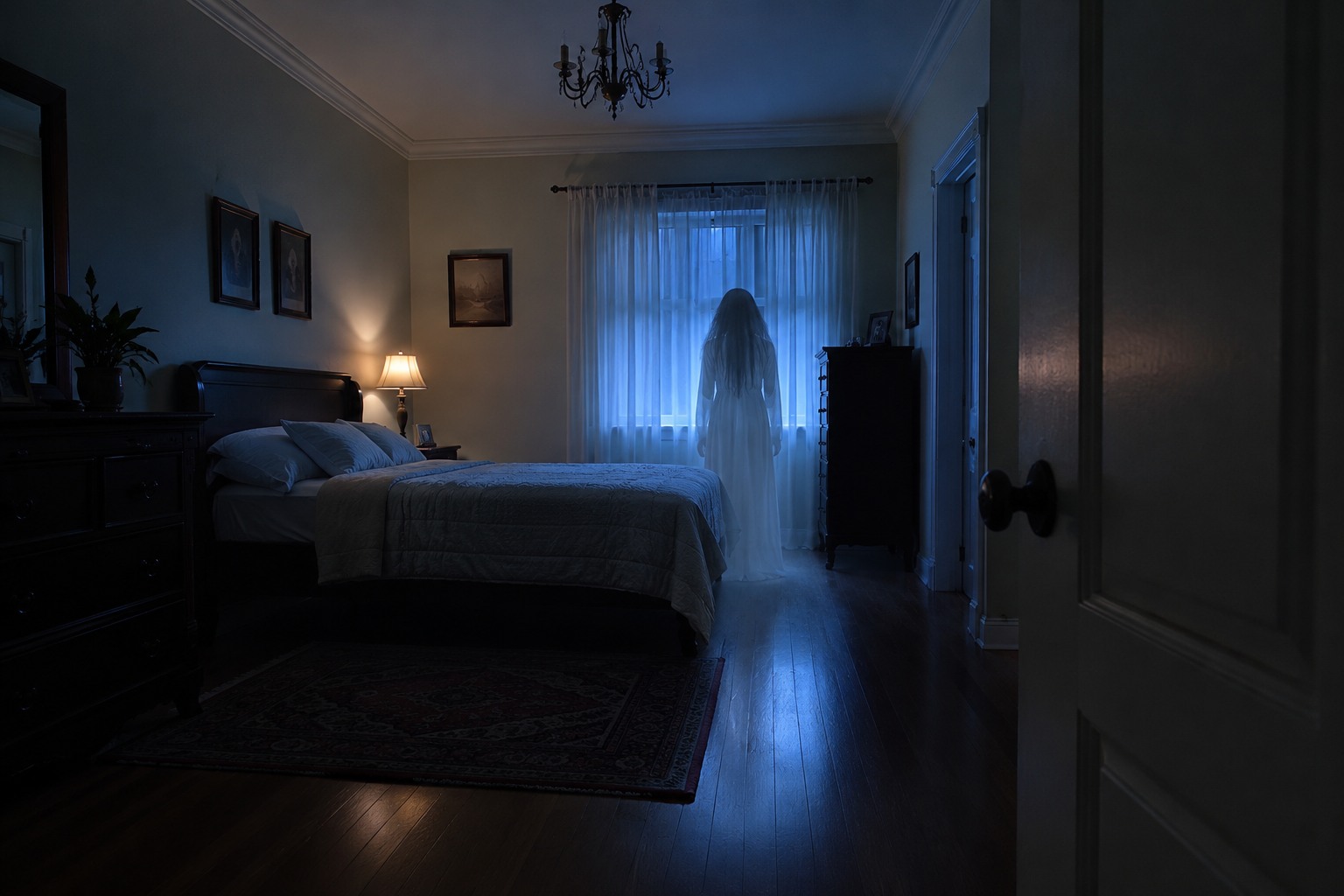
The figure was standing at the foot of the bed, but its legs were in the wrong place. A woman wakes sometime before dawn and sees what looks like a person in the dark bedroom. At first, her half-awake mind gives it ordinary explanations. A coat on the chair. Her husband getting up. A trick made by the curtains and the weak streetlight outside. Then she notices the bottom of the figure. The bed frame should hide its legs below the knees. Instead, the dark shape continues straight through the wooden footboard, fading somewhere inside it. Above that, something resembling shoulders and a head remains perfectly still. She reaches toward the lamp. The figure does not run. It does not turn.
It simply becomes thinner as the room brightens, until she can see the bedroom wall through the place where its chest had been. Stories like this appear again and again in ghost folklore, personal experiences, horror fiction, and reports of frightening events around sleep. The details change, but the basic scene is remarkably familiar: someone wakes in bed and realizes that a human-shaped presence seems to be standing nearby, often directly at the foot of the mattress. Why that particular place? The answer sits somewhere between the strange way the sleeping brain handles darkness, the frightening vulnerability of waking in bed, centuries of supernatural storytelling, and a simple fact about bedroom geometry: the foot of the bed is almost the perfect place for a human shape to appear.
The foot of the bed is where a person should not be. A bedroom contains plenty of places where seeing a shape is understandable. A doorway can contain someone entering. A window can frame movement outside. Clothes can hang from a chair. A closet can be partly open. The foot of the bed is different. When someone wakes and sees a person-sized shape there, the brain immediately understands its position in relation to the sleeper. The figure is not passing through the room. It appears to have deliberately stopped where it can look directly down the length of the mattress. That makes the scene feel personal. Imagine waking and seeing a shadow near the bedroom door. Your first thought might be that somebody just entered.
The First Detail People Remember
Move the same shadow two meters closer and place it directly beyond your feet. Now it looks like somebody has already entered, crossed the room, and chosen a place to stand. That implied history is part of what makes these stories frightening. Nothing needs to move. The position alone suggests that something happened while the sleeper was unconscious. There is another uncomfortable detail. A person lying down has a terrible defensive position. Getting out of bed requires pushing away blankets, sitting up, finding the floor, and orienting yourself in darkness. Meanwhile, the standing shape already appears awake and balanced. The fear comes before anyone has time to decide whether the figure is really there.
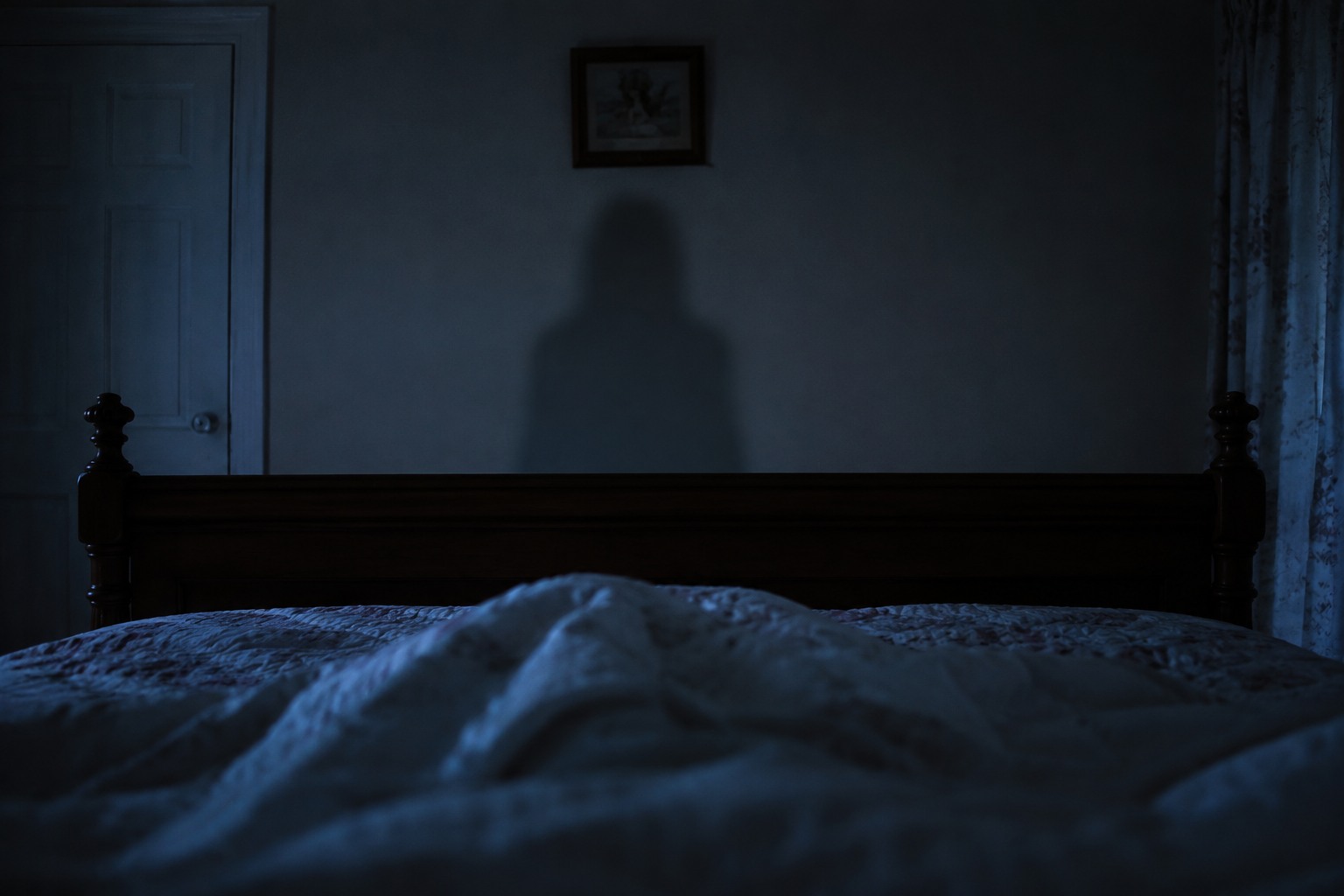
Waking up does not always happen all at once. One of the strongest normal explanations for bedside figures is the strange transition between sleeping and waking. People often imagine consciousness like a light switch. You are asleep, then you are awake. The brain does not always work that neatly. Parts of the experience of dreaming can briefly continue after someone becomes aware of the bedroom. A person may recognize the ceiling, mattress, lamp, and doorway while still experiencing an image that feels as though it belongs physically inside the room. That image can be remarkably convincing. It might be a face, a person beside the bed, an animal, an insect-like shape, or simply a dark human form. Sleep paralysis can make the experience even more frightening.
During REM sleep, the body normally prevents most dream movements from becoming physical movements. Occasionally, awareness returns before that temporary muscle inhibition has fully disappeared. Someone opens their eyes. The bedroom is visible. But moving may be difficult or impossible for several seconds or longer. Add a human-shaped image to that moment and the classic ghost-story scene almost builds itself: the witness is trapped in bed while something appears to stand nearby. Not every story about a figure at the foot of the bed involves sleep paralysis. Some people say they could move immediately, switch on a light, speak, or even get out of bed.
Why The Scene Feels Wrong
But the connection helps explain why so many frightening human-shaped sightings happen specifically in bedrooms and around waking. Why the figure often looks human but wrong. People rarely describe these nighttime figures with the detail they would use for an ordinary visitor. That matters. Instead, descriptions often focus on incomplete features: a dark head, shoulders, a long body, an unclear face, clothing that cannot quite be identified, or a shape that seems solid until the light changes. Sometimes the wrong detail is more disturbing. The figure appears unusually tall. Its face seems blank. Its edges fade into the wall. It stands partly inside furniture. Its posture is too straight. Or the witness can see the room through part of its body. Those qualities fit both sides of the mystery surprisingly well.
From a sleep-and-perception perspective, the brain does not need to construct a detailed stranger. It only needs enough information to decide, there is a person standing there. Human beings are exceptionally sensitive to other human shapes. A few dark areas in approximately the correct arrangement can become a head and shoulders. A hanging robe can become a woman. A narrow bookcase topped with an object can become a tall man. In dim light, the brain fills gaps quickly. But that same incompleteness is exactly what gives ghost stories their power. A perfectly ordinary-looking man at the foot of the bed raises questions about burglary. A faceless man whose lower body fades into the footboard raises very different questions. Many stories contain the same immediate reaction.
The witness reaches for a lamp. This is more useful than it sounds. Dark bedrooms are excellent environments for visual mistakes. Light coming through blinds, moving tree branches, LED indicators, passing headlights, piles of clothing, mirrors, curtains, furniture, and open doors can combine into surprisingly convincing shapes.
What Witnesses Usually Check First
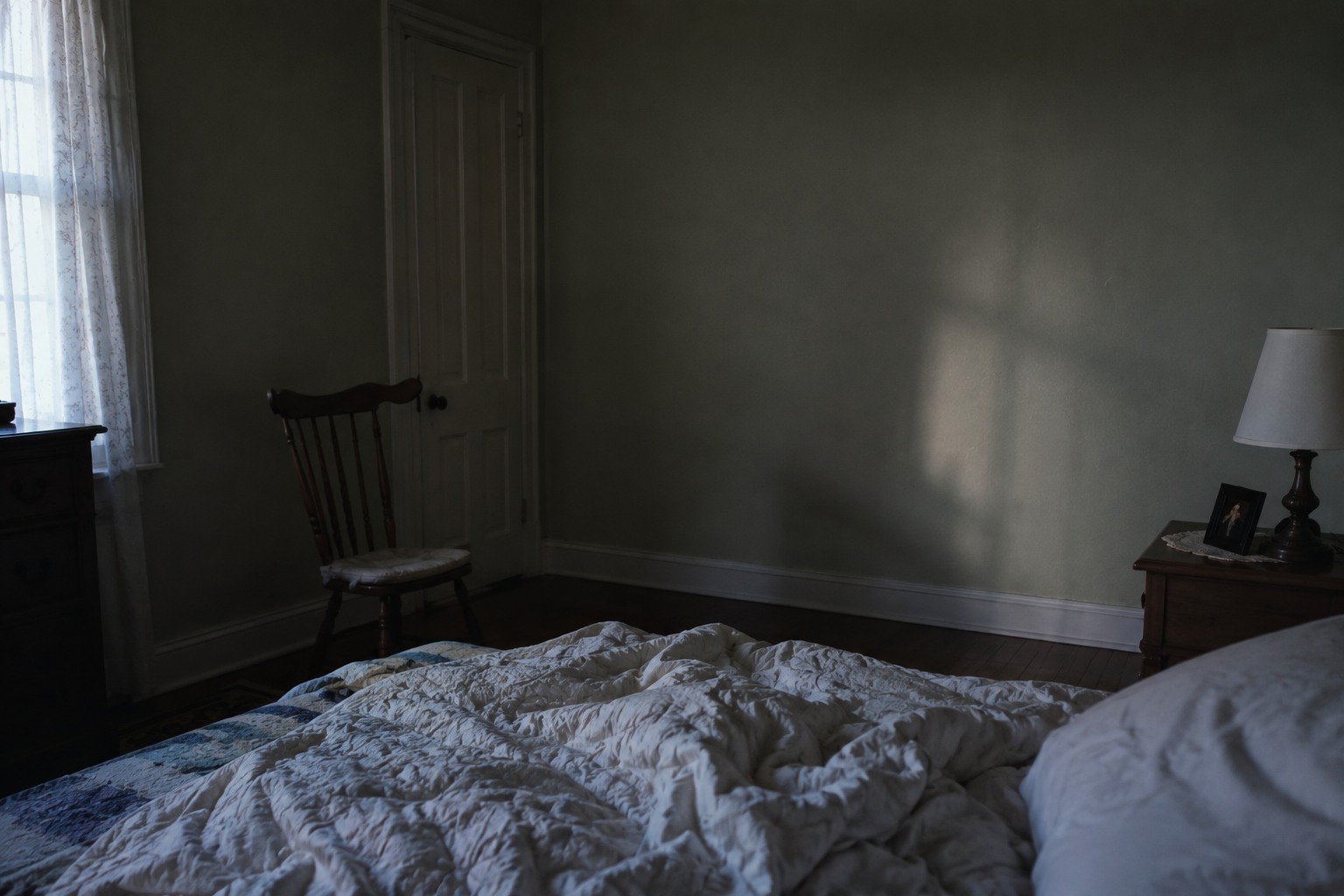
The eye is also working with limited information. When a person has just awakened, even familiar objects may take a moment to recognize. A coat does not initially look like a coat. It is simply a tall dark shape occupying part of the room. Turning on a lamp gives the brain more information. The frightening person becomes a jacket hanging from a wardrobe door. The pale face becomes reflected light on a mirror. The shoulders become the top corners of a chair. This is probably the end of many experiences that never become ghost stories. Someone gets frightened, switches on the light, recognizes a pile of clothes, mutters something about needing more sleep, and goes back to bed. The stories people remember are naturally the ones where that simple test feels less satisfying.
When the easy bedroom explanation gets weaker. Suppose the light comes on and there is nothing standing there. That alone does not make the experience supernatural. A waking image can disappear quickly. A visual mistake can collapse as soon as lighting changes. The brain can correct an incorrect interpretation almost instantly. More interesting stories usually contain another detail. Perhaps the witness says the figure remained visible while they sat upright. Perhaps they watched it move rather than simply disappear. Perhaps two awake people reacted to the same area of the room. Or perhaps the shape appeared somewhere that does not match an obvious piece of furniture. Even these details have possible ordinary explanations. Memory changes, especially around frightening experiences. Two people can influence each other's interpretation. Shadows move. Tired people misunderstand distances.
The Ordinary Explanations That Come Up
Still, these are the details that make a story harder to dismiss with the classic "coat on a chair" answer. Consider the difference between two scenes. In the first, someone wakes, sees a tall black shape, turns on the lamp, and discovers a dressing gown hanging from the door. In the second, someone wakes and sees a pale, human-shaped form beyond the mattress. They sit upright. The shape remains. They reach for the lamp, and as the room brightens, the wall becomes visible through the figure before it fades. The second scene is memorable because the ordinary explanation has to do more work. That does not tell us what happened. It explains why the story survives.
There is also an extremely practical reason figures keep appearing at the foot of beds. That is where sleepers are looking. Most beds point the body toward a relatively narrow field of view. When someone opens their eyes and raises their head, the foot of the mattress becomes the natural foreground. Beyond it may be a wall, dresser, television, window, chair, or doorway. All of those objects can create vertical shapes. The bed itself also provides scale. A dark patch near the ceiling is just a dark patch. A dark patch rising immediately beyond a familiar footboard can suddenly look five or six feet tall. Then there is distance.
A figure directly beside someone's face might reveal enough detail to be recognized as a pillow, curtain, partner, or piece of furniture. A figure several feet away remains ambiguous. It is close enough to look human but far enough for the darkness to hide its features. That is almost the ideal distance for fear.
The Detail That Keeps The Story Alive
The position also gives the imagined figure a full view of the sleeper. A shape standing along the side of the mattress might seem to be moving past. At the foot, its body naturally faces the person's head. The bedroom has unintentionally staged the scene. The frightening bedroom visitor did not begin with modern paranormal stories. Beds have long been important settings in folklore because sleep itself was mysterious. For most of human history, people had little understanding of dreaming, REM sleep, sleep paralysis, or the neurological reasons someone might wake unable to move. Yet people still had those experiences. Different cultures explained nighttime pressure, frightening visitors, witches, spirits, demons, dead relatives, and other beings in different ways.
The details were not identical, and it would be misleading to force every tradition into one modern explanation. But the basic human experience underneath many stories is recognizable: waking in darkness, sensing or seeing someone nearby, and feeling unable to respond normally. Modern culture then adds its own imagery. People have seen bedside ghosts in films, read about shadow people online, heard family stories, and encountered illustrations of pale figures watching sleepers. That does not mean every witness consciously copies a story. It means the image already has meaning. If someone wakes from a frightening half-dream and sees an unclear human shape at the foot of the mattress, the mind does not encounter that image without context. It resembles something people have been afraid of for generations.
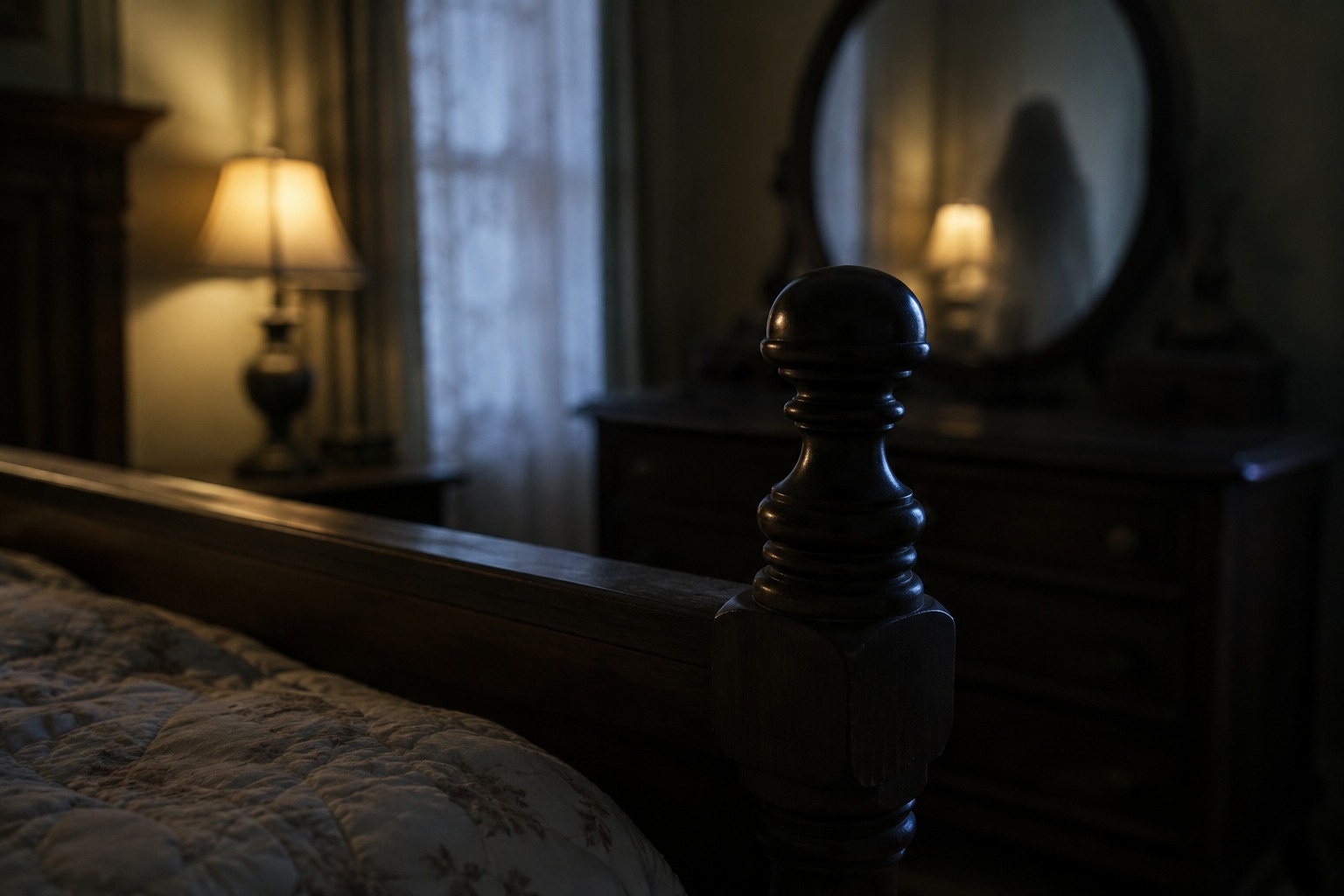
And once the experience is retold, familiar details make it easier for listeners to picture. Everyone knows what a dark bedroom looks like. Everyone knows the helpless feeling of waking suddenly. Everyone can imagine opening their eyes and realizing they are no longer alone. Why the figure is remembered even when nothing else happens.
Why People Retell This Version
One of the strangest things about these stories is how little action they often contain. The figure does not attack. It may not speak. Sometimes it does not even move. It just stands there. In ordinary storytelling, that should be boring. In a bedroom, stillness makes the scene worse. If the figure rushed toward the door, the witness could interpret it as an intruder fleeing. If it searched drawers, there would be an understandable purpose. If it shouted, the event would become chaotic. Instead, the motionless figure seems focused entirely on the person in bed. That creates the impression of watching. Humans pay enormous attention to whether another person is looking at them. Even when a dark figure has no readable eyes, its body position can suggest attention. The sleeper supplies the rest.
This may also explain why the most effective versions have only one impossible detail. A completely monstrous creature gives the imagination too much information. A nearly human figure with no face is simpler. A woman-shaped form that fades below the waist is simpler. A man standing partly through the footboard is simpler. The room remains ordinary. The bed remains familiar. Almost everything makes sense.
What Makes The Question Linger
One thing does not. That small contradiction is what follows the witness into daylight. The most careful answer leaves two different questions. So why do ghost stories mention a figure at the foot of the bed? Because several powerful ingredients overlap there. People frequently experience unusual perceptions while moving between sleep and wakefulness. Dark bedrooms encourage mistaken shapes. Human brains recognize possible people extremely quickly. The layout of a bed naturally places a human-sized area directly in front of a waking sleeper. Sleep paralysis can add the terrifying feeling of being unable to escape. Folklore then gives that experience a supernatural vocabulary. Those explanations can cover a great deal without requiring a ghost. But they do not automatically settle every individual story.
Someone who says they were fully awake, moving normally, looking at a clearly visible figure for an extended period is describing something different from a two-second shadow seen immediately after waking. A story involving multiple people also raises different questions from a solitary nighttime experience. Those differences deserve careful attention rather than one automatic answer. And perhaps that is why the figure at the foot of the bed remains such an enduring ghost image. It occupies the narrow space between dreaming and the room we trust most. You wake. You recognize the ceiling. You recognize the window. You recognize your own blankets. Then you look toward your feet and see the shape of someone who should not be there. For a few seconds, the most familiar room in the world has one extra person in it.