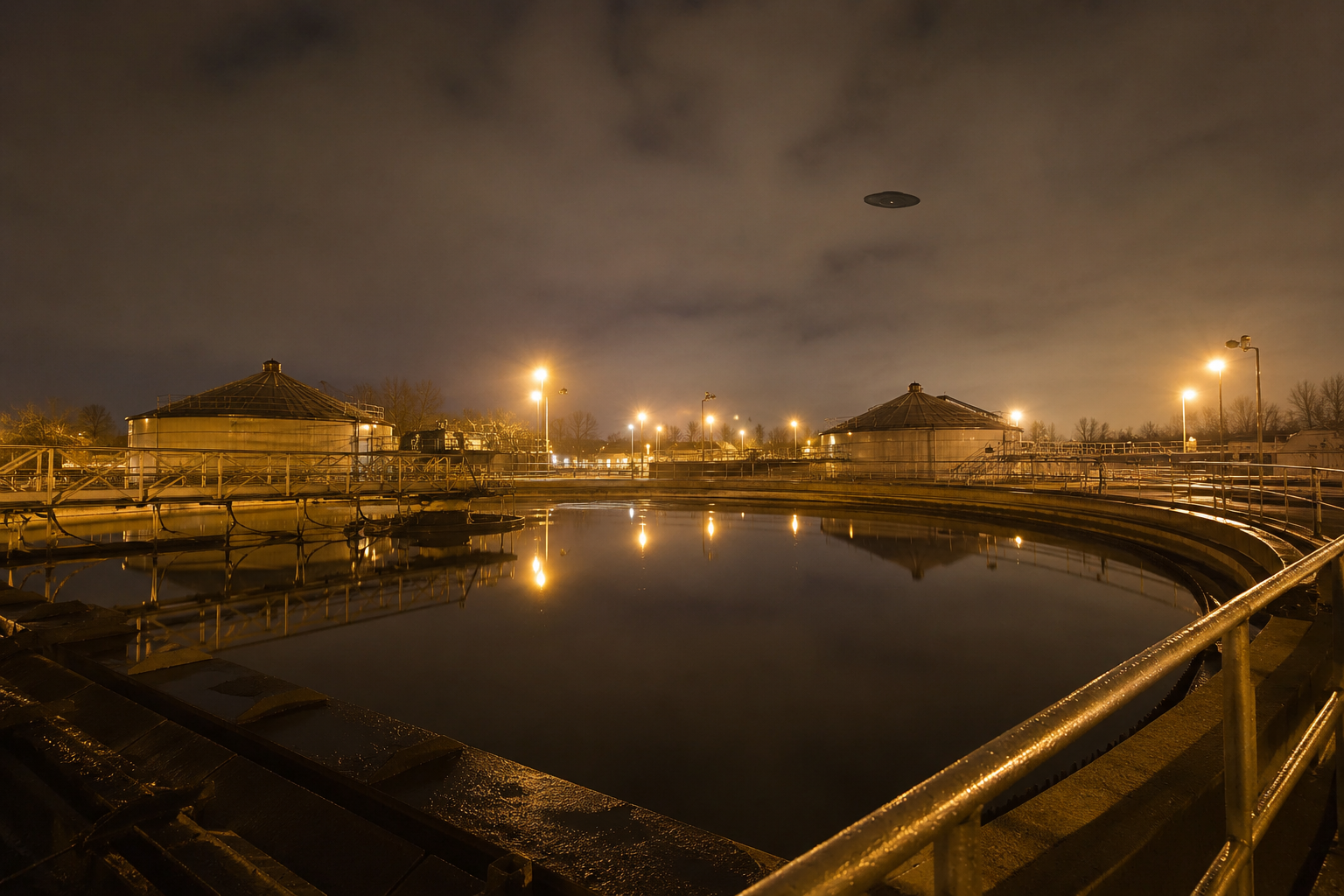
The night photo was supposed to document a false pump alarm, not anything in the sky.
In the recreated version, a maintenance worker at a municipal water-treatment plant stepped onto the service walk, photographed the quiet settling basin, and sent the image to a supervisor as routine confirmation that nothing had overflowed.
Only later, after the image was brightened, did a dark oval appear above the settling tanks.
The strangest part was not the shape alone. It was the sensor export beside it: one line in the basin log reportedly went blank for 47 seconds, then resumed as if nothing had interrupted the system at all.

WHAT THE NIGHT PHOTO SHOWS – A dark oval shape above the open settling tanks – No visible aircraft lights on the object – A false pump alarm with no matching mechanical failure – A sensor log gap lasting 47 seconds – A worker who said he was photographing the basin, not the sky
This is not presented here as a detail people read as a visitor, aircraft, drone, or anything else. It is a local-style account built around one odd maintenance photo and a short missing line in a municipal record.
What makes it linger is how small the event was: water, sodium lamps, a tired worker, and a dark shape where no one expected to look.
1. The False Alarm Came First
The account begins with a pump warning shortly after midnight.
At a treatment plant, that is not automatically strange. Pumps complain, floats stick, old contacts chatter in damp weather, and operators learn not to panic until the second reading confirms the first.
The worker reportedly checked the panel, walked the basin edge, and found no obvious spill, foam surge, or flow problem.
That is why he took the photo.
It was meant to be practical: a timestamped view of the settling tanks under the yard lights, useful for showing that the alarm had not become an emergency.
At first glance, the image was boring: still water, wet railings, and yellow reflections from the lamps.
The possible anomaly arrived only after the fact, when someone increased the exposure on the sky above the tanks. The worker was not, according to the story, trying to photograph a UFO. He was trying to close a work order.
2. The Oval Was Above the Tanks
The reported object is described as a dark oval, slightly flattened, positioned above the open basin area.
It was not said to be standing near the clarifier, reflected in a doorway, or moving along the fence line. The account keeps the unknown shape in the sky.
That makes the image different from visitor-at-the-window stories, and it also makes the mundane explanations narrower.
A bird might cross a frame. A drone might hover over utility property. A bug near the lens can become a blurred smudge.
All of those are possible.
Still, people who found the photo interesting pointed to the oval’s placement. It appeared above the tanks but not mirrored clearly in the water, at least not in the version described.
If it were a lamp reflection, one might expect a matching glare trail. If it were an insect close to the phone, one might expect softer edges.
The available description does not settle that argument. It only explains why the shape became the focus.
3. The 47-Second Blank Line
The strongest hook in the story is the sensor log.
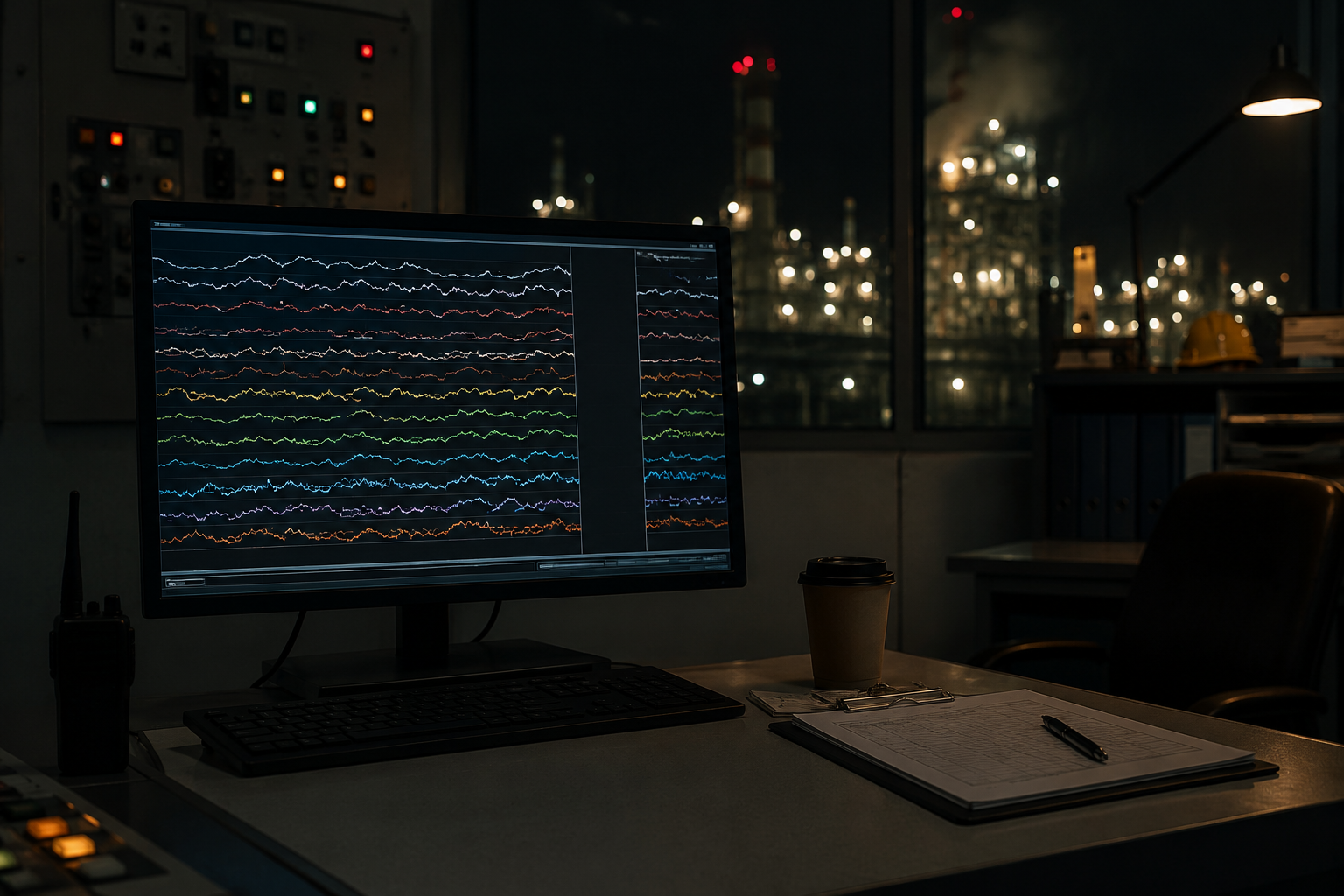
According to the account, one exported line from the basin monitoring system went blank for 47 seconds around the time of the false alarm and photo.
Not a full system crash. Not hours of missing data. Just a short empty stretch, after which the readings resumed in their expected format.
That is exactly the sort of detail that sounds too technical to be cinematic, which may be why it works on the imagination.
A missing 47 seconds is not much. It is shorter than a coffee refill.
But in a plant log, a blank line can feel different. Industrial systems are supposed to be dull, repetitive, and complete.
When one line disappears, people start asking whether the equipment failed, whether the export corrupted, whether a sensor timed out, or whether someone is reading meaning into a normal database hiccup.
The unsettling part is that the blank line and the oval happened close enough together to be remembered as one incident.
4. The Basin Lights Could Explain More Than They Reveal
Water-treatment plants are full of visual traps.
The lighting is harsh. The surfaces are wet. Mist can hover above warm process water on cool nights. Metal rails catch highlights. Phones struggle with dark sky beside bright lamps.
A dark oval in that setting does not automatically mean something was in the air.
It could be a lens artifact made visible by exposure adjustment. It could be a near-lens insect rendered as a shadow. It could be a bird, bat, small drone, balloon, or background object misread after cropping.
The false pump alarm has practical explanations too.
Moisture in a junction box, electrical noise, a sticking float, a communications timeout, or a software export issue could create confusion without leaving obvious damage.
That is the grounded side of the case, and it should stay in view.
What keeps the account from becoming forgettable is the combination: a routine alarm, a quiet basin, a photo taken for documentation, a dark sky shape, and a sensor gap just long enough to bother the people who noticed it.
5. The Worker Reportedly Did Not Notice It Outside
One of the more believable parts of the account is also one of the strangest.
The worker did not reportedly look up and react to a craft hanging over the plant. He did not describe a beam, a sound, or a sudden wind over the water.
He took a phone photo, checked the scene, and moved on.
That restraint makes the story feel less like a staged sighting and more like the kind of oddity people discover afterward, when routine documentation becomes uncomfortable.
It also raises a practical question: if the object was really large and overhead, why did no one see it directly?
Maybe because there was nothing there.
Maybe because the shape was small, close to the lens, and invisible in the moment.
Maybe because the worker’s attention was exactly where the alarm told him to put it: on the pumps, the waterline, the panel, and the walkway under his boots.
In strange accounts, missed attention can be more convincing than panic. People working nights often do not scan the sky unless something makes them.
The Most Reasonable Theory
The most reasonable reading is not a hidden visitor over public infrastructure.
It is a stack of ordinary failures that happened to line up: a nuisance pump alarm, a phone camera struggling in low light, a processing artifact in the sky, and a short sensor export gap that looks more meaningful after the photo is examined.
That explanation is not weak. It is probably where any serious review would begin.
Municipal systems are complicated. Small errors appear without becoming mysteries. A single odd log line can come from maintenance, network lag, polling intervals, or a reporting tool that skipped a value.
Phones create their own ghosts, especially at night.
But the account remains interesting because the ordinary explanation has to cover two separate oddities at once.
Together, they create the little knot that WeirdWitnessed stories often turn on.
How the Story Changes Without the Blank Log
Remove the 47 seconds and the account becomes much thinner.
A night photo with a dark oval is interesting, but not unusual enough by itself to carry much weight. The internet is full of sky shapes that become less strange once the frame widens.
The blank sensor line gives the story its second anchor.
It does not prove the oval was external. It does not prove interference. It does not even prove the timing was exact.
It simply gives readers another thing to compare against the photo.
That is why cautious wording matters. The account does not need to become a claim that something disabled the plant. It is more effective, and more honest, as a record of a coincidence people could not quite forget.
The photo says something may have been above the basin. The log says something briefly failed to appear where data should have been.
Between those two gaps, the story finds its unease.
The Detail People Return To
The detail people return to is not the oval’s shape.
It is the worker’s purpose.
He was documenting nothing.
A false alarm had asked a human being to verify an absence: no overflow, no visible breakdown, no emergency at the tanks.
In trying to prove the scene was normal, he may have preserved the only frame that made it look otherwise.
That reversal is what gives the account its staying power. A photo taken to close a minor maintenance note became the reason the note remained open in local memory.
Maybe the object was a bug. Maybe the missing log line was a polling issue. Maybe both details would dissolve under access to the original file and full export history.
Or maybe the reason people keep discussing the basin photo is simpler.
For 47 seconds, a system designed to measure the ordinary went quiet, and in the same small window, the sky above the water looked wrong.
Would you dismiss the two details as a coincidence, or would you keep the photo saved just in case?
Reader Context
This Weird Witnessed story is an editorial reconstruction, written as eerie visual storytelling rather than a verified report. For more context, see UFOs and Unknown Visitors Guide and How WeirdWitnessed Creates Reconstructed Horror Stories.