The payphone is the detail people remember first, even though the light is what started the argument.
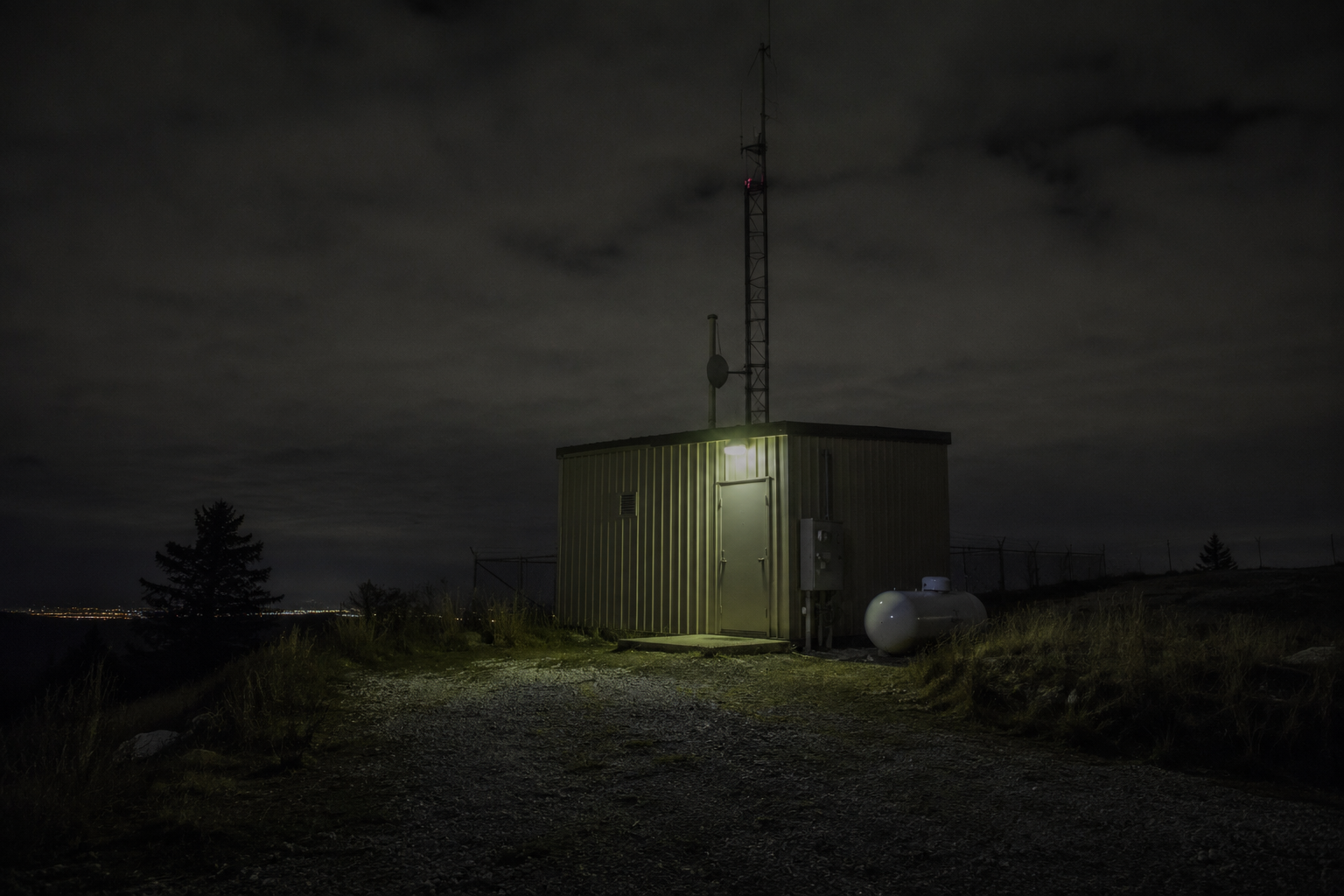
According to the local version, the photo was taken at a mountain lookout after the access road had been closed for the evening or season. The old roadside payphone still stood near the pullout. Farther back, a radio tower rose from the ridge.
In the image, a small bright light appears over or just beside that tower.
That is all. No craft shape. No beam. No dramatic movement captured in a sequence. Just a quiet ridge, an outdated phone, a road people were not supposed to drive, and one point of light that did not look right to the person who took the picture.
It should not be treated as a detail people read as alien activity. Mountain ridges collect aircraft lights, tower beacons, stars, drones, reflections, and camera artifacts. But the photo has enough atmosphere to keep people discussing it.
WHAT THE PHOTO IS SAID TO SHOW
- A mountain lookout pullout with an old payphone.
- A closed access road or gate nearby.
- A radio tower on the ridge after sunset.
- One bright light appearing above or near the tower.
- No obvious traffic or people in the scene.
1. The Payphone Makes The Scene Feel Out Of Time
A payphone at a mountain lookout already feels like a leftover from another version of travel. It suggests paper maps, roadside emergencies, and a time when losing signal meant looking for a metal box with a receiver.
That is why it works so well in the image. The photo is not just a sky shot. It is a place shot. The payphone gives the viewer something familiar, worn, and human before the eye moves to the ridge.
If the same light appeared over a grocery store parking lot, it might feel less strange. Over a mountain lookout with an old phone, the light seems to belong to a story already in progress.
The payphone does not prove anything. It simply changes the mood. It makes the scene feel abandoned, quiet, and slightly behind the present.
That mood is part of why the photo spread.
2. The Closed Road Raises The Stakes Without Proving Anything
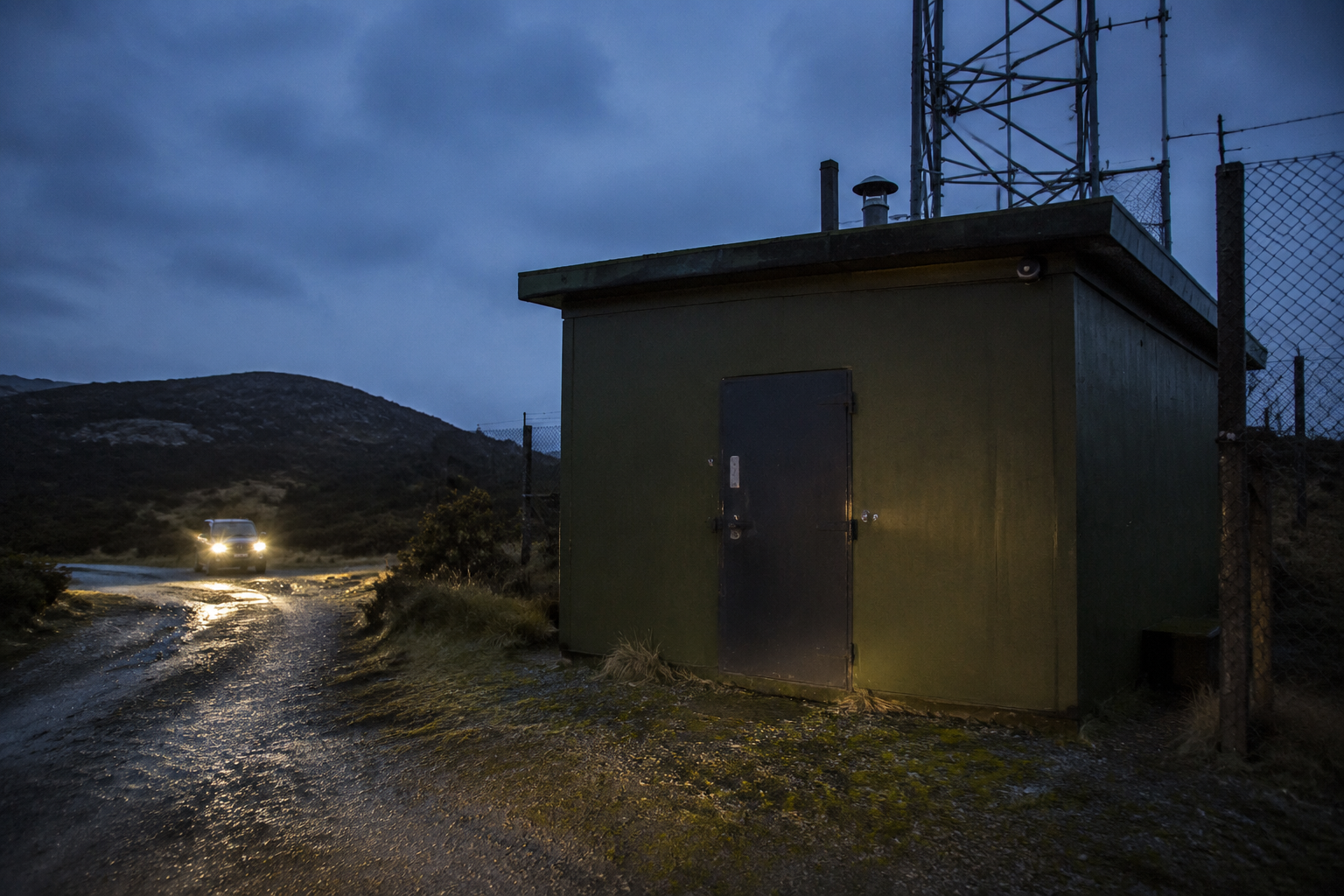
The road closure is the second detail people bring up. In the retelling, the access road beyond the lookout was closed, either by a gate, seasonal notice, weather restriction, or maintenance barrier.
A closed road makes viewers ask who could have been up there.
That question can be misleading. A closed road does not mean a mountain is empty. Workers may still access towers. Hikers may be nearby. Service vehicles may use side routes. Aircraft can cross the sky regardless of road status. A drone operator might launch from a legal spot below.
Still, closures change how a place feels. They create a boundary. The viewer sees the gate and understands that ordinary traffic should not continue past it.
So when a light appears over the ridge, it feels less like background activity and more like an intrusion into a restricted quiet.
That feeling is not evidence, but it is powerful storytelling.
3. Radio Towers Already Have Their Own Lights
Any careful look at the photo has to start with the tower itself. Radio towers often have steady or blinking lights for visibility. They may include red beacons, white strobes, maintenance lamps, or reflections from metal structures.
A tower light can look detached from the tower in a photo, especially at dusk. If the camera moves slightly, the bright point may smear upward. If the sky is hazy, a beacon can bloom and appear larger than it is. If the tower is partly hidden by trees or ridge shadow, the light may seem to float above it.
That explanation is ordinary and very possible.
The reason people hesitate is that the reported light appears offset from the expected beacon position. Some say it sits above the tower instead of on it. Others say it looks too white, too round, or too separate from the structure.
Those impressions can come from a phone camera. They can also come from a viewer trying to solve an image with limited information.
The tower is both the likely explanation and the reason the photo feels interesting.
4. Dusk Is The Worst Time For Certainty
The photo reportedly happened around dusk or early night, which is exactly when certainty becomes difficult. The sky still holds light, but the ground darkens. Phone cameras boost exposure. Bright points become exaggerated.
At that hour, a star can appear suddenly as clouds thin. A plane can seem motionless if it is coming toward the camera. A helicopter can hover near a ridge. A drone can look larger or smaller than expected depending on distance.
Even insects or moisture near the lens can catch light and create an odd glowing spot.
Dusk also changes human perception. Our eyes search for contrast. We notice lights more sharply because the world is losing detail. A small dot over a ridge can feel important simply because everything else is fading.
That does not make the witness foolish. It makes the timing tricky.
The image lives in that tricky hour.
5. The Road Closure Creates A Before-And-After Feeling
What makes the story different from a normal tower-light photo is the idea that the road had already closed. The lookout is imagined as a place after access, after visitors, after the day has moved on.
That gives the photo a before-and-after feeling. During the day, the payphone might be a quirky roadside object. The tower might be utility equipment. The ridge might be scenery.
After the road closes, those same objects become markers in a quiet zone.
People respond strongly to places that should be inactive. A closed pool, a dark school hallway, a locked fairground, or a gated mountain road all create the same expectation: nothing should be happening here now.
The light breaks that expectation.
Maybe it was only a beacon. Maybe it was a plane. Maybe it was lens flare from the setting sun or a vehicle headlight hidden below the frame. The closure does not rule those out.
It just makes the ordinary explanations feel like they need to work harder.
6. Lens Flare Is A Real Possibility
Phone cameras can make small mysteries quickly. A bright tower beacon, low sun, reflective payphone glass, or even a dashboard light from a nearby vehicle could create a flare. That flare might appear in the sky where nothing actually was.
The payphone itself may matter here. Glass, scratched metal, and reflective surfaces can bounce light toward the lens. If the photographer framed the phone and tower together, the camera may have caught multiple reflections at once.
Lens artifacts often look too clean. They can be round, pale, and separate from the objects that caused them. Viewers may read that separation as distance in the sky.
A good skeptical reading should keep flare near the top of the list.
But flare explanations are not always emotionally satisfying because they remove the light from the landscape. People want the dot to be somewhere. They want it to have a position, height, and purpose.
The photo frustrates that desire.
7. Why Some Viewers Read It As UFO Evidence
When people call this UFO or alien evidence, the most careful version of that claim should be understood as uncertainty, not proof. UFO simply means the object or light is unidentified to the viewer. It does not automatically mean extraterrestrial.
The image invites that label because of the combination: isolated lookout, closed road, old payphone, radio tower, and one bright light in the wrong-feeling place.
There is also a cultural association between radio towers and signals. Even if it is not logical evidence, it shapes interpretation. A light over a tower feels more meaningful than a light over a random hill because towers already suggest transmission, reception, and invisible communication.
That symbolism does a lot of work.
A cautious article should not turn symbolism into a conclusion. The stronger approach is to say the photo has a UFO-shaped question inside it, while still allowing ordinary answers.
That balance is why people can debate it without needing a final verdict.
8. The Best Explanation May Be The Least Exciting One
The most likely explanations are not dramatic. A tower beacon photographed at a misleading angle. A plane aligned with the ridge. A drone or maintenance light. A lens reflection from the payphone glass. A bright planet or star appearing as the sky darkened.
Any one of those could account for a single light in a single photo.
What they do not fully explain is why the image feels so specific. That is where the human part enters. The payphone, the gate, and the ridge tower create a scene that looks like it was waiting for an odd detail.
The light may be ordinary. The setting makes it memorable.
That is often how these stories survive. They are not built on certainty. They are built on a photo that gives viewers enough to doubt, enough to explain, and enough to keep one question open.
If the road was closed, who was up there?
Maybe nobody.
Maybe the light was never on the road at all.
Maybe it was just above the tower, exactly where the camera made it look hardest to ignore.
Reader Context
This Weird Witnessed story is an editorial reconstruction, written as eerie visual storytelling rather than a verified report. For more context, see UFOs and Unknown Visitors Guide and How WeirdWitnessed Creates Reconstructed Horror Stories.