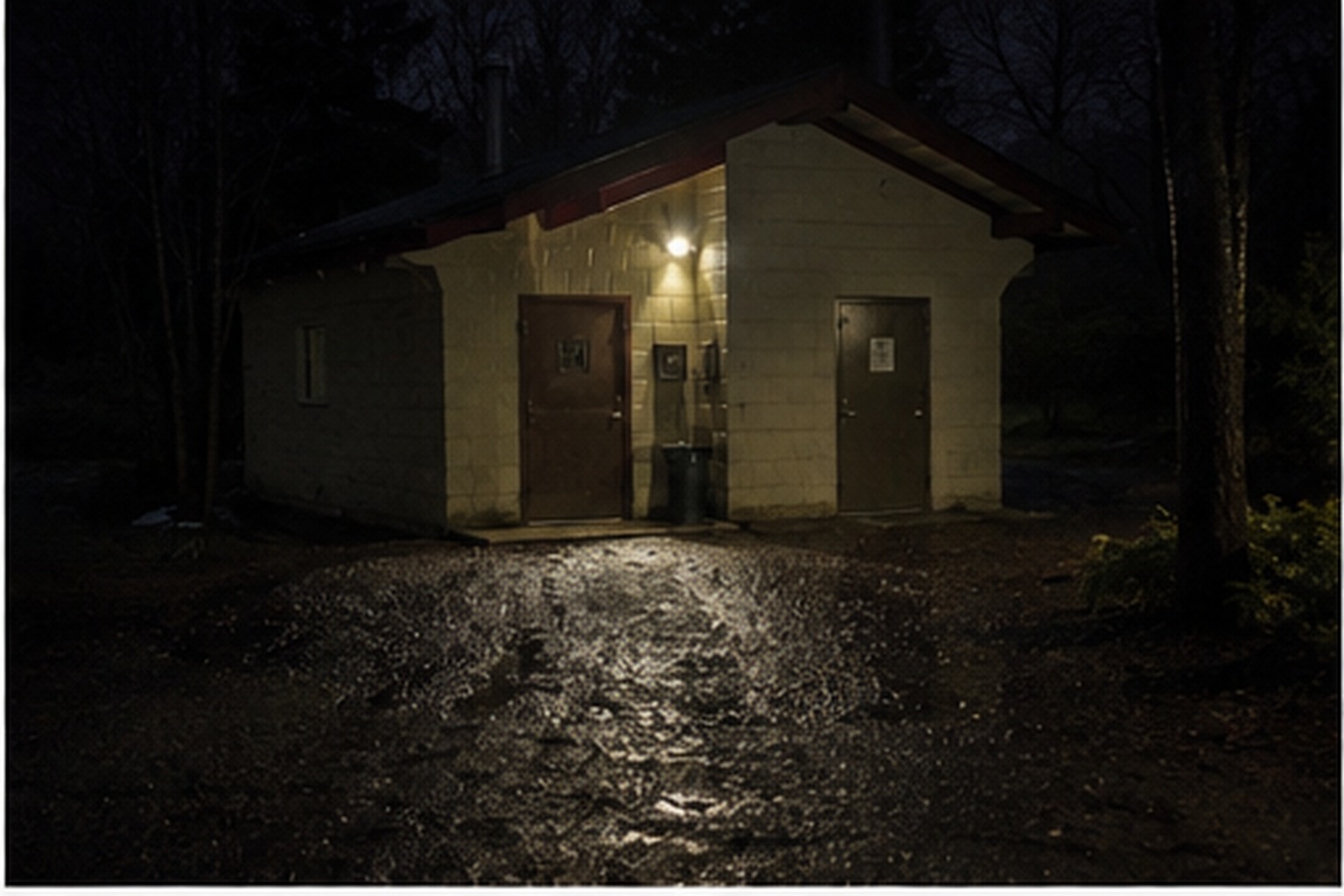
The mud was eight feet up the shower house wall.
The first detail did not sound like a monster story.
It sounded like property damage.
That is why people around the campground shower house treated it like a practical problem at first. Something had leaned, dragged, pressed, or stepped where it should not have been able to. Something had left a mark too high, too wide, or too heavy for the easy animal explanations.
Nobody needed Bigfoot for that. Not at the beginning.
The Place Was Too Ordinary For A Legend
the campground shower house was not the kind of place people imagine when they picture a creature in the woods.
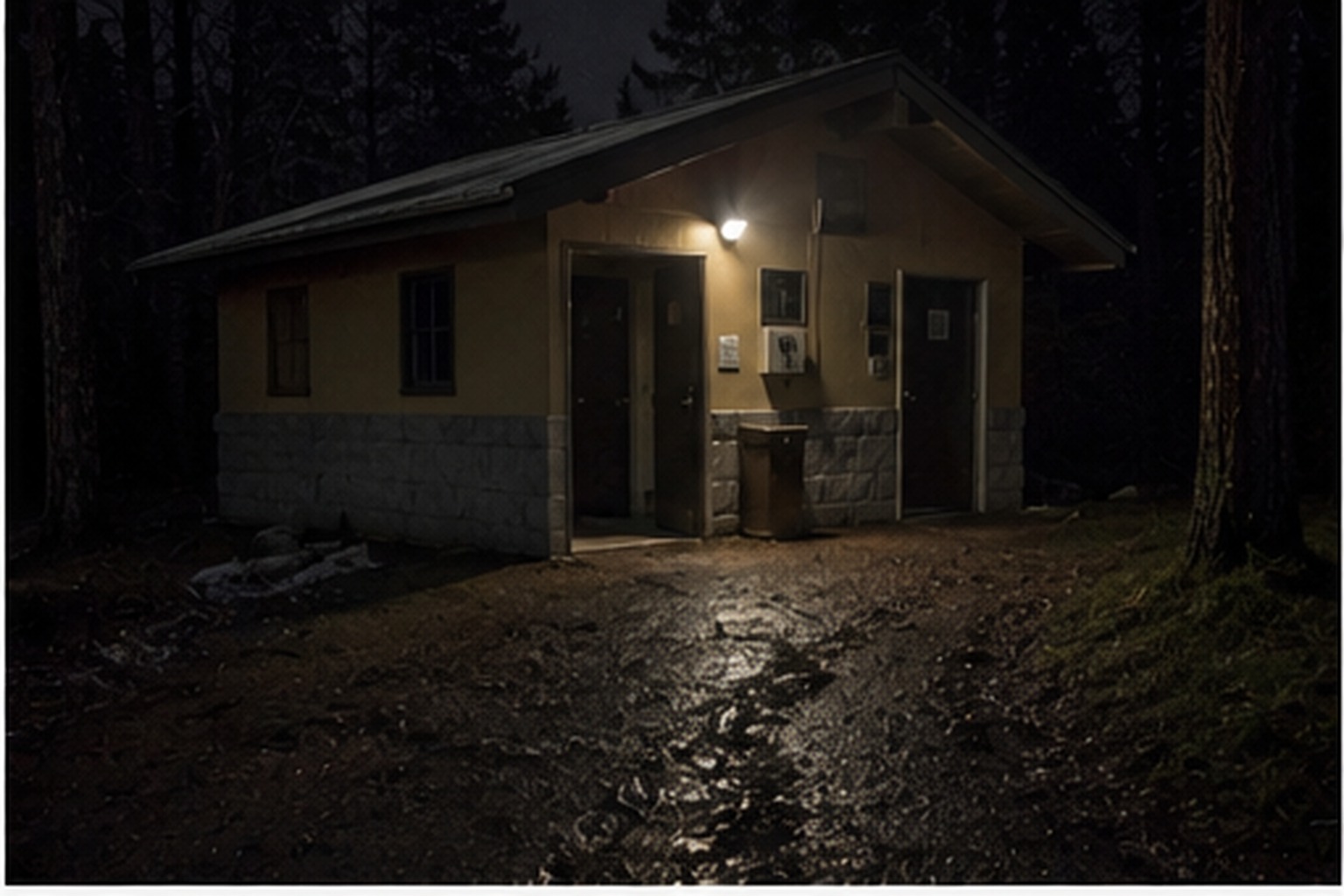
It was functional. Gravel, posts, tin, wet leaves, old light fixtures, and the dull smell of treated wood. People used it and forgot it. The scary part was not mystery at first. It was how normal everything looked around the wrong mark.
The first person to notice the high muddy prints above the small window tried to make it fit a bear, a deer, a loose strap, or teenagers messing around after dark.
Those answers were reasonable.
They just did not stay reasonable for long.
The Marks Were The First Problem
The mark was not only big.
It was placed wrong.
A bear could scratch. A raccoon could climb. A deer could knock something over. A bored person could leave mud and dents anywhere if they wanted to scare the next person who came along.
But this mark had weight behind it.
It sat at a height that made people stand under it and reach up without touching the top edge. It had smears beside it, not like claws, not like fingers exactly, but like something broad had pressed against the surface while shifting its balance.
The ground underneath was worse.
One deep track. Then another. Then nothing clear enough to settle the argument.
The Camera Was Supposed To End It
The owner or caretaker set a cheap trail camera facing the damaged area for the simple reason people set cameras anywhere: to stop guessing.
If it was a bear, they would know.
If it was a person, they would know.
If it was wind, rain, or equipment vibration, the camera would make the whole thing embarrassing in the best possible way.
The first night showed nothing.
The second night showed rain.
The third night showed a shape in the wrong part of the frame.
The Shape Was Not Standing In The Open
That mattered.
A fake monster steps into the middle of the picture.
This thing did not.
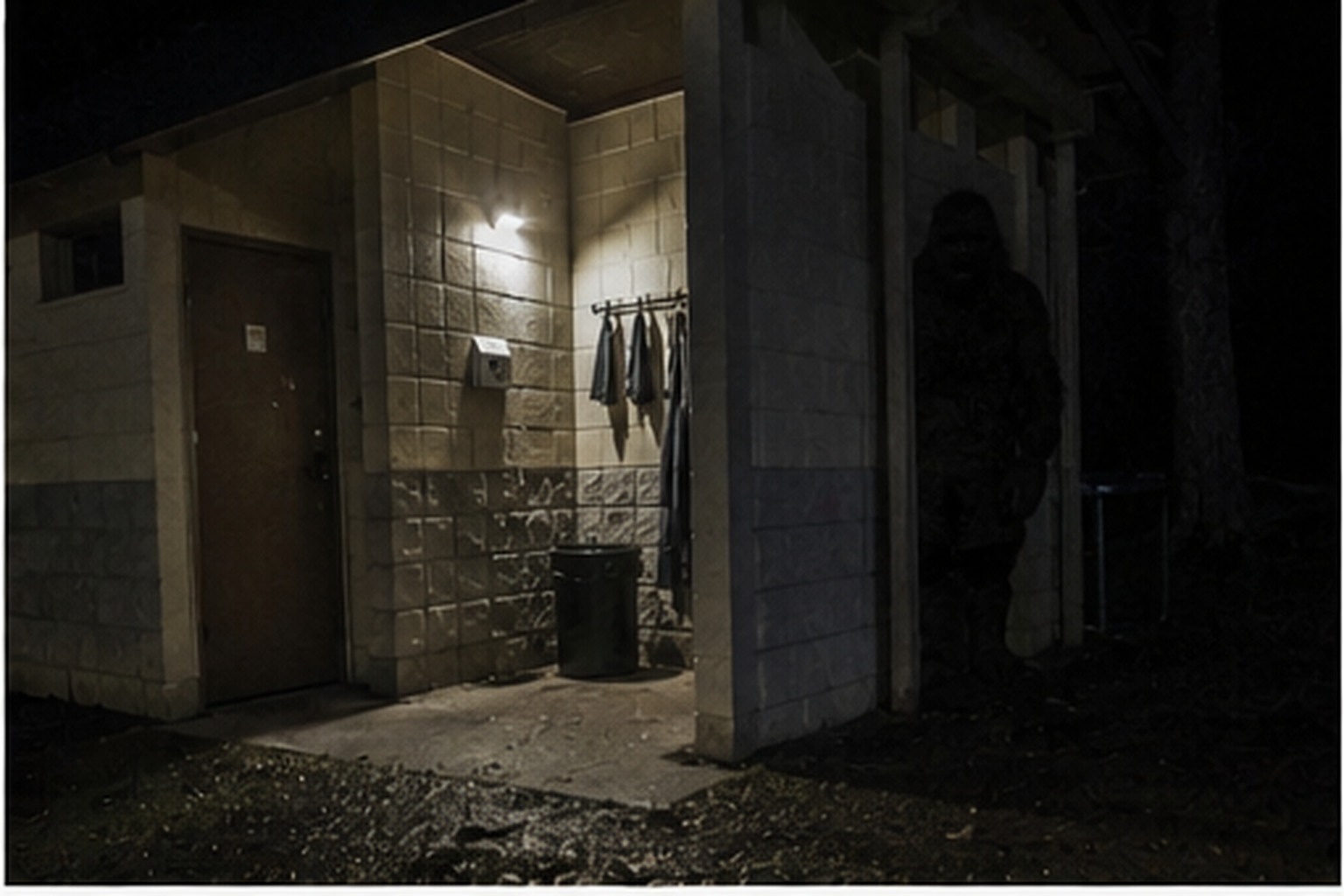
It stayed near the towel hooks and corner posts, partly covered by dark boards, brush, posts, or shadow. Only pieces of it were easy to see: a heavy upper body, a shoulder line that did not match a person, and a head set lower than expected between the bulk of the shoulders.
It did not glow. It did not fade. It blocked what was behind it.
Whatever else anyone wanted to call it, the shape looked solid.
The Normal Explanations Came First
The best explanation was still a bear.
Bears stand. Bears lean. Bears push things. Bears leave strange partial tracks when the ground is wet and uneven. A large bear at night, half hidden behind posts, can look almost human to a cheap camera.
A person was possible too.
Someone in dark clothing could have stepped into frame, damaged the property, and left before the camera got a cleaner angle. People stage strange things online every day.
Those explanations kept the story grounded.
They also left pieces behind.
The Part That Did Not Behave Like A Bear
The shape did not move on all fours before or after the visible frame.
It shifted sideways in a way that made the posts disappear behind its body, then reappear as it moved away. The camera caught only a few seconds clearly, but in those seconds the body seemed too tall in the wrong places and too narrow in others.
The track line did not lead to food.
It led past the high muddy prints above the small window, paused there, and moved away from the easiest path back into cover.
That was the uncomfortable part: the motion looked less like an animal feeding and more like something inspecting.
People Remembered The Sound
The camera had poor audio, but it caught one low knock before the shape appeared.
Not a roar.
Not a howl.
A single dull impact, as if a heavy hand or shoulder had struck wood.
Then came a pause.
Then the shape stepped into view.
Stories like this often become ridiculous when people add too much noise to them. Screams. glowing eyes. dramatic footprints lined up like movie props.
This one stayed with smaller details.
The knock. The high mark. The solid body behind the posts.
The Damage Looked Different In Daylight
In the morning, the place did not look theatrical.
It looked wet, plain, and slightly damaged. The kind of scene you could photograph and still have half the viewers say nothing was there.
That is part of why the story works. It does not ask for a monster in a perfect spotlight. It asks why several ordinary details all pointed in the same uncomfortable direction.
The mark was still there.
The ground was still soft.
And one broken piece of wood had a strip of dark hair caught along the edge.
Why The Story Was Hard To Shrug Off
The strongest Bigfoot stories are not usually the ones where the creature is standing perfectly in the open.
Those are too clean. They feel staged before anyone has time to be afraid.
The ones people remember are messier. A mark too high on a wall. A roof bent in a direction that does not make sense. A row of trees shifted before the body appears. A track that starts clearly and then breaks apart in gravel, roots, or wet grass.
That is what made this story uncomfortable. The image alone could be argued with. People can argue with any dark shape in a bad camera frame. But the image did not arrive by itself. It arrived after the damage, after the marks, after the odd sound, and after the normal explanations had already been tried.
Maybe every detail had a separate ordinary answer.
Maybe a bear made one mark, wind moved one object, a person caused one dent, and the camera turned a shadow into a body.
That is possible.
It is also why the story keeps working. The more explanations it needs, the less settled the ordinary answer feels.
The Last Frame Made People Keep Looking
The final clear frame was not the one with the body.
It was the frame after.
The shape was gone. The posts were visible again. The damaged area was empty.
But one towel hook was bent outward as if something had brushed past it at shoulder height
That one small change made the scene feel less like a passing animal and more like something had stopped, turned, and decided whether to come closer.
Maybe it was a bear.
Maybe it was a person in the worst possible place at the worst possible time.
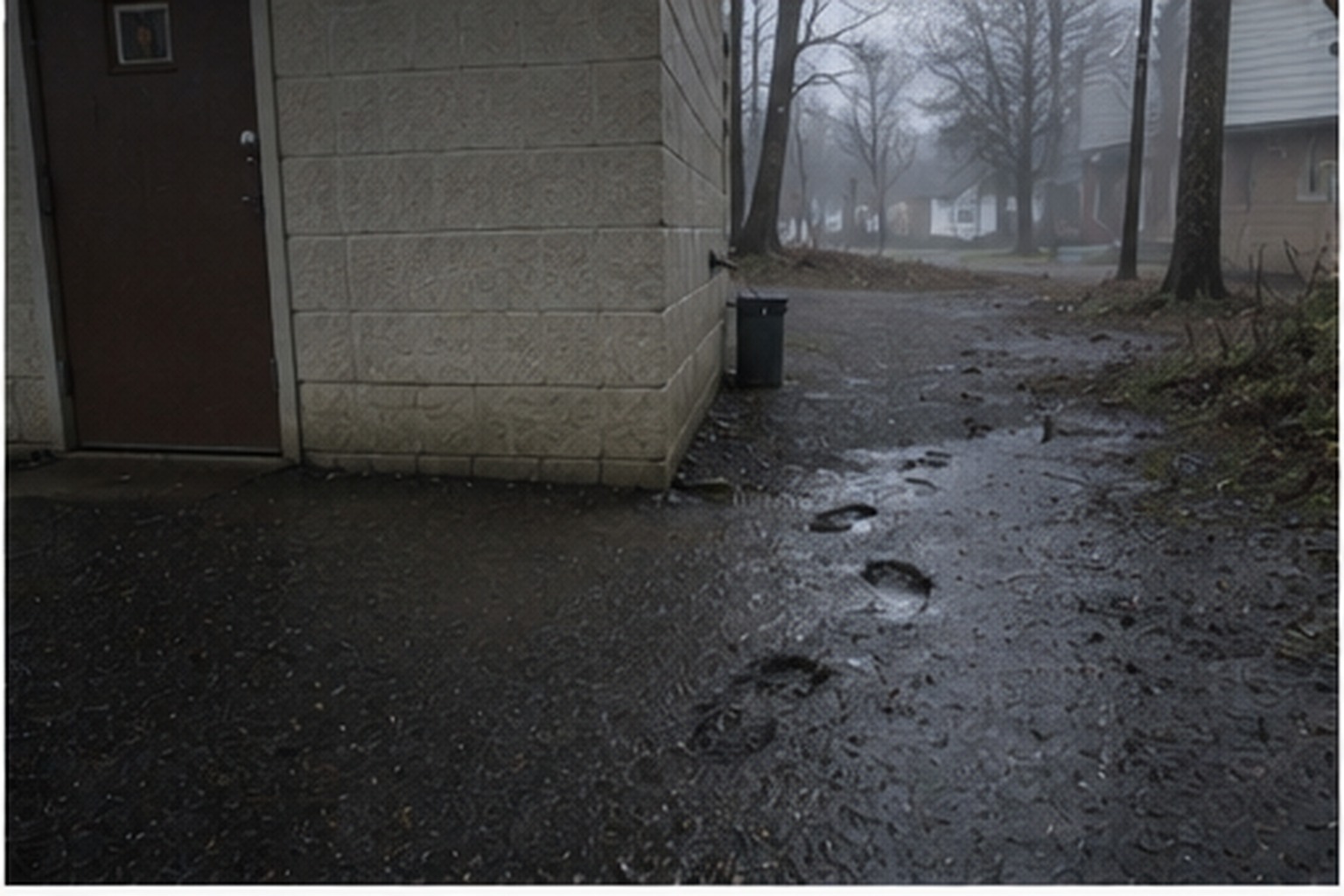
Or maybe the reason people keep returning to the image is that the thing in it never looked like it wanted to be seen at all.
That is also why the safest version of the story is not the one that says the strangest answer must be true.
The safer version is simply that the scene never settled. It kept offering enough ordinary pieces to stay believable and enough wrong pieces to stay awake in the mind after the lights were off.
For WeirdWitnessed, that is the line that matters. Not proof. Not certainty. Just a recreated moment where a person tries to make a normal explanation fit and slowly realizes the normal explanation has to bend around too many corners.