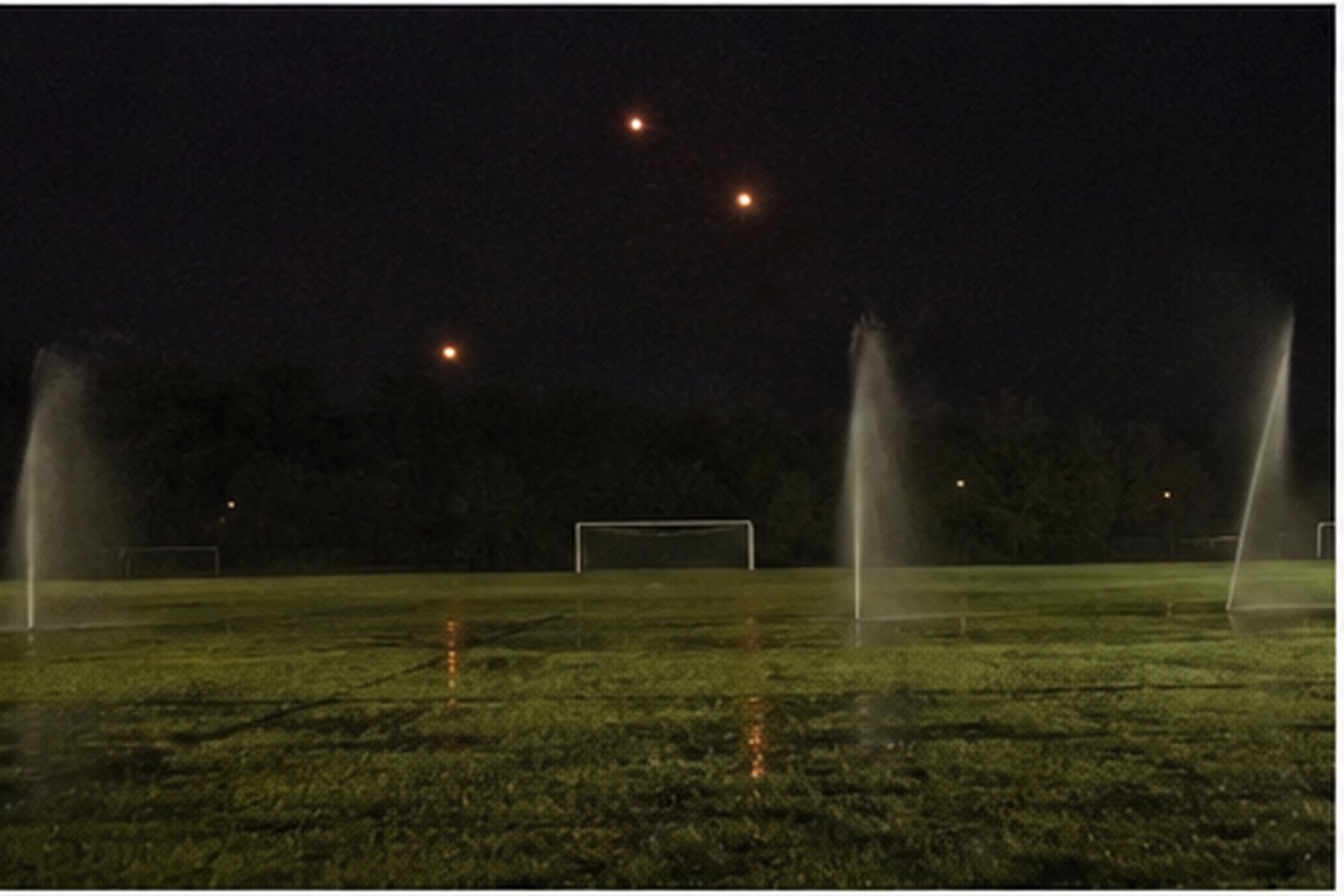
He did not stop because of the lights.
He stopped because of the sprinklers.
The soccer field behind the middle school was usually the least interesting part of his late walk. It sat between the bus loop and a row of back fences, flat and open, with two white goals that looked ghostly under the park lamps. His dog liked the path because rabbits came out near the storage shed after midnight.
That night, the rabbits were gone.
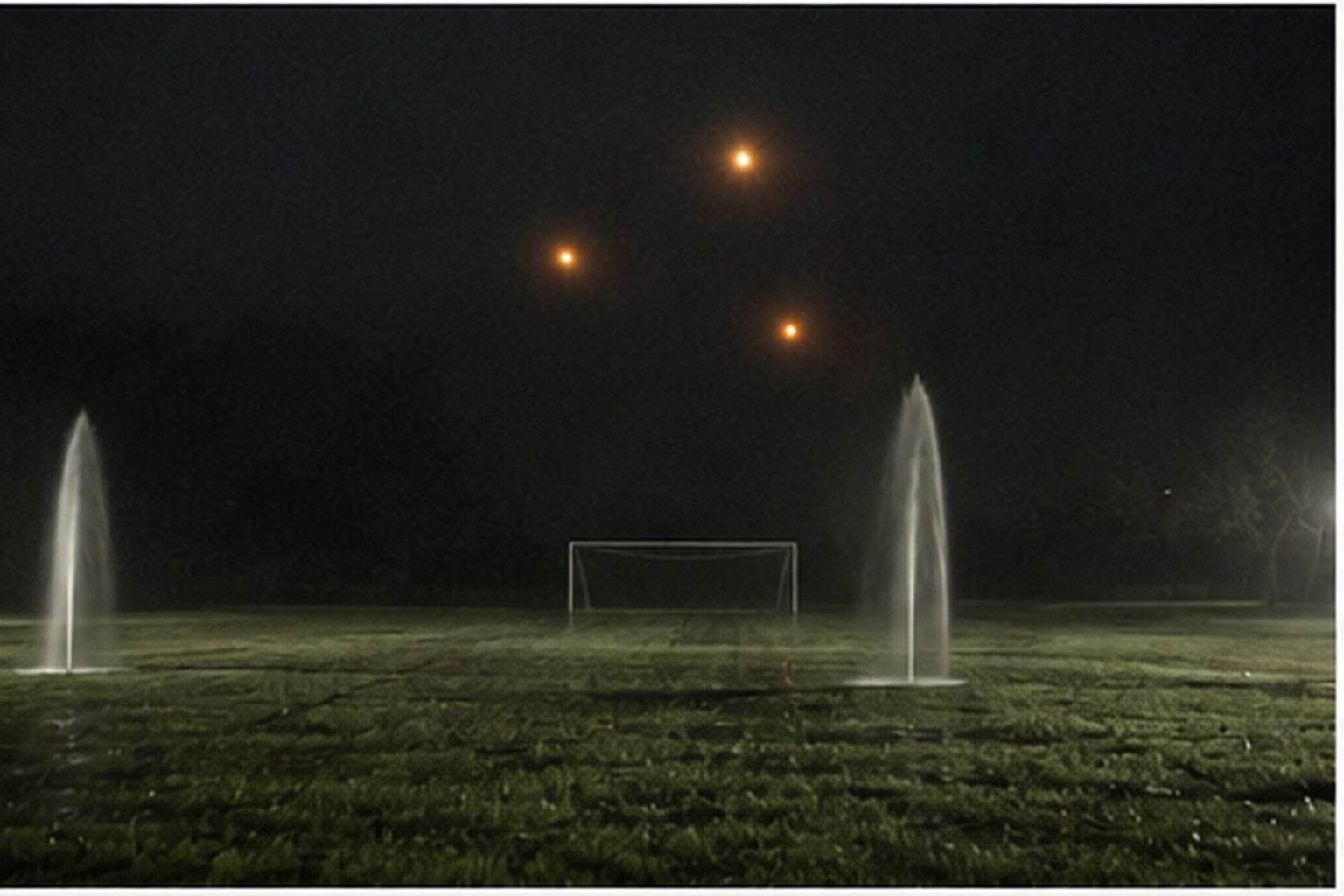
The sprinklers were on, but they were not watering the grass. Every head along the near sideline had lifted and tilted almost straight up, sending thin columns of water into the dark. Instead of sweeping back and forth, they held still. The spray rose, broke into mist, and fell back over the field like cold rain.
His dog stopped at the fence and refused to keep walking.
The Field Looked Like It Was Signaling Something
At first he thought the timer system had broken. Public fields always had something wrong with them: locked bathrooms, crooked nets, lights that buzzed, irrigation heads that snapped off when a mower hit them.
Still, the sight bothered him.
The sprinklers were not random. They were all aimed the same way, toward the middle of the field and upward, as if a whole row of metal throats had turned toward one point in the sky.
He took out his phone to send a picture to his brother, who coached weekend soccer there. The joke was going to be simple: your field is trying to grow clouds.
He held the dog leash under his elbow, raised the phone through the fence, and tapped the screen.
The first photo came out smeared with mist.
The second photo showed the lights.
There were three of them, orange and round, hanging above the far goal in a loose triangle. They were not bright like stadium lamps. They looked softer, like coals seen through smoke. One sat higher than the other two. All three were exactly over the wet center stripe, where the sprinkler spray climbed highest.
He lowered the phone and looked with his eyes.
For a second he could not find them.
Then the mist thinned, and the three orange points were there.
Nothing About Them Behaved Like Drones
The easiest answer was drones. He thought of it immediately, because anything weird in the sky becomes a drone if you stare at it long enough. Teenagers. Survey equipment. Somebody testing a camera over the school field.
But drones make sound when they are that low.
The field was quiet except for water hitting grass and his dog making a tight whining sound in the back of his throat. No buzzing came from above the goal. No propeller chatter. No shifting lights. No small corrections in the air.
The three orange lights did not drift.
They held their positions over the field as if attached to invisible poles.
He filmed a short camera file. In it, his hand shakes, the chain link fence cuts the image into diamonds, and the water spray flashes when it crosses the phone lens. The lights remain steady for twenty-two seconds.
At the end of the camera still, the sprinklers stop all at once.
That was the moment he almost ran.
Not because the lights moved. They did not. But when the water shut off, the whole field went silent so suddenly that the silence felt switched on. His dog backed into his leg, nails scraping the path.
Then the orange lights dimmed together.
They did not blink out. They faded, like someone turning down a lamp behind a curtain. The highest light vanished last.
The Picture Looked Worse The Longer He Studied It
He walked home faster than usual and tried to make himself laugh about it. The photo was probably glare. The lamps around the field were old sodium lights, orange already. Mist could reflect them. A wet lens could multiply them. The fence might have bent the light into shapes.
At home, under the kitchen light, he zoomed in.
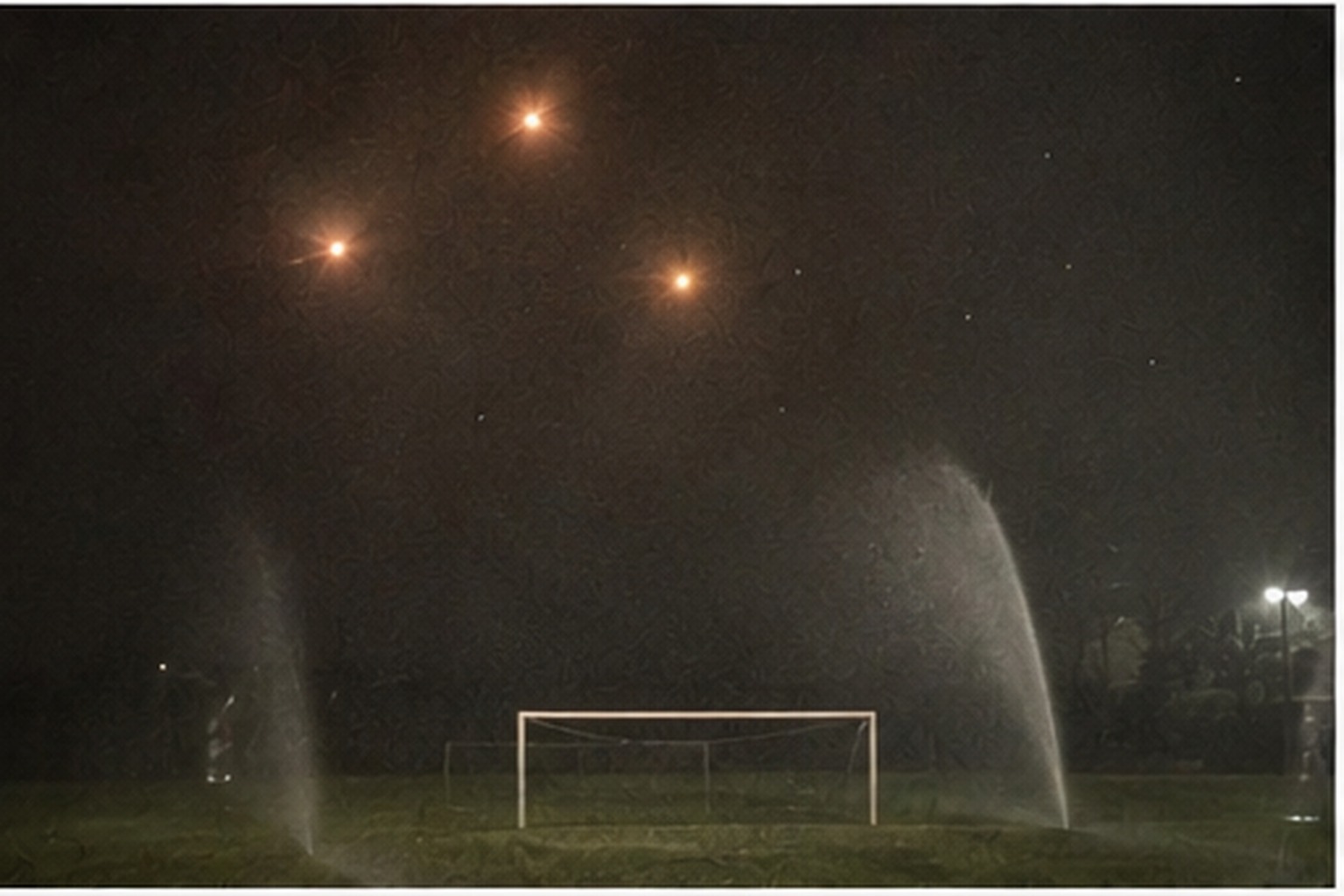
The field lamps were visible in the picture. They sat on poles at the left edge, each with a hard white-orange bloom. The three hovering lights did not match them. They were higher than the pole tops and centered above the far goal, where there was no lamp, no building window, and no street behind the field at that angle.
He checked the timestamp. 12:38 a.m.
The school did not run field lights after ten. In the photo, the only light on the grass came from the path lamps and the strange orange points. Under the three lights, the sprinkler mist looked brighter, almost amber, like dust in a projector beam.
The dog appeared in the lower corner of the image, half blurred by movement. Its head was turned not toward the field but upward.
That detail made him close the photo for a while.
The Normal Explanation Was Good, But Not Complete
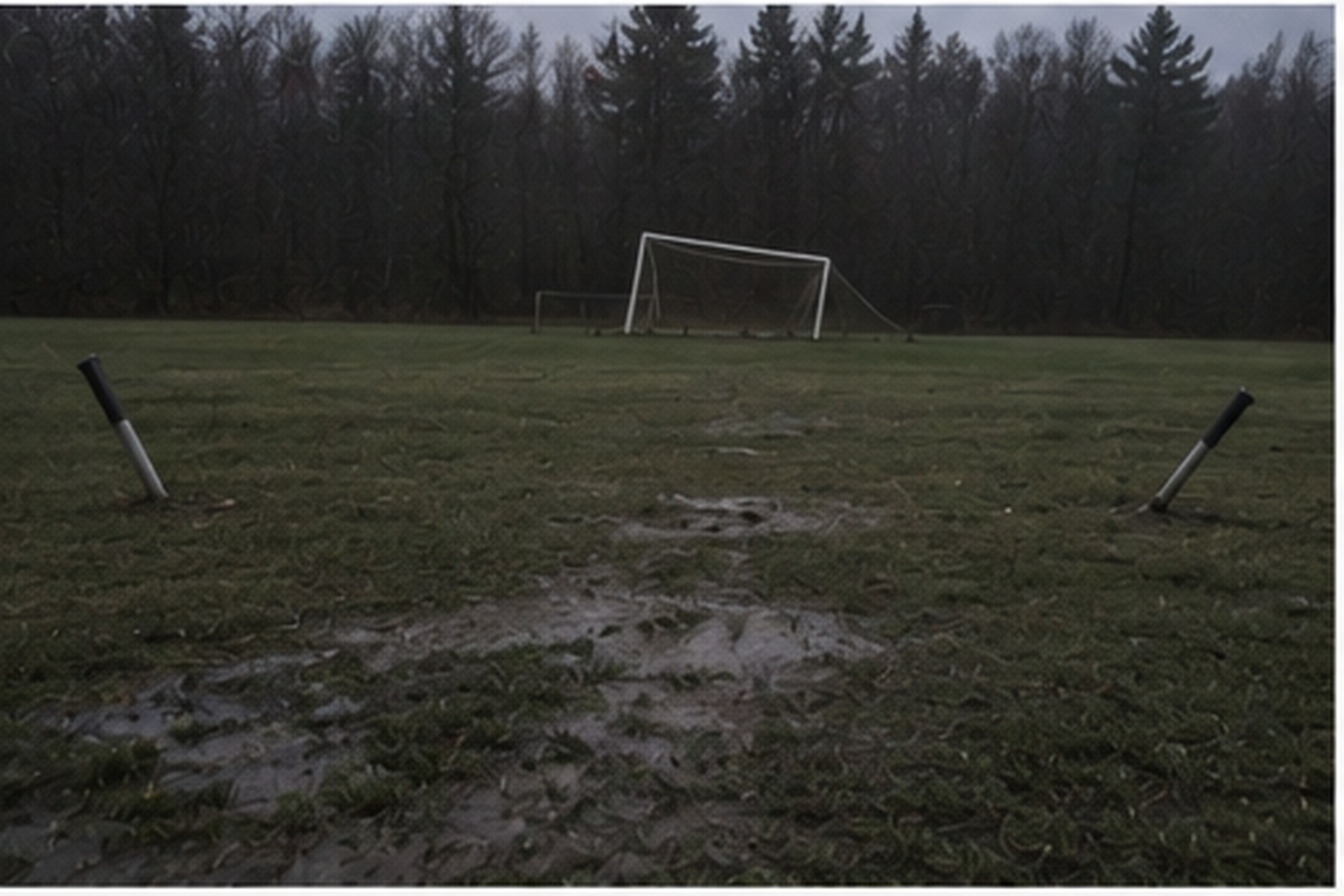
The next afternoon he went back. In daylight, the whole place looked harmless and a little ugly. The grass had muddy patches. The goals were chipped. The sprinkler heads were low black caps in the turf.
He found the maintenance worker by the equipment shed and asked if the system had malfunctioned.
The worker shrugged. Sprinklers could stick. Pressure could surge. Heads could be adjusted badly by kids kicking them. As for orange lights, the worker pointed toward the road and said planes line up over that part of town sometimes.
That explanation helped until he stood where he had stood the night before.
The flight path was farther right.
Cars on the road were hidden behind the school building.
The stadium lamps were on the wrong side.
And the sprinkler heads along the sideline had not merely stuck. Several were still angled upward, their nozzles tilted beyond the normal watering arc. The worker frowned when he noticed that. He said they would have to be reset by hand.
He also said something the dog walker wished he had not said.
The irrigation controller showed no scheduled run at 12:38.
He Kept The Photo But Stopped Showing It
For a few days, he sent the picture to people who would give him sensible answers. One friend said lens flare. Another said Chinese lanterns. Someone online said drones with orange navigation lights. A photographer explained that water droplets can create false points of light when a phone sensor struggles in darkness.
All of those answers were possible.
None of them explained why the points stayed fixed for the entire camera file.
None explained why the sprinklers shut off at the same instant before the lights faded.
None explained why his dog, normally fearless around traffic and garbage trucks, refused to pass that field for the next week.
The strangest part was not even in the photo. It was what he remembered from the moment after the sprinklers stopped. The three orange lights had seemed to hang over a field that was waiting for instruction. No wind. No insects. No distant highway noise. Just three dull points above wet grass and two empty goals.
He knew memory could add things later. Fear edits scenes. Darkness makes patterns. A person alone at night can turn a broken sprinkler into a message.
That was the explanation he preferred.
He still changed his walking route.
On clear nights, if he passed within two blocks of the school, he could see the field through gaps between houses. Usually there was nothing there but grass and metal frames.
Once, nearly a month later, he saw the sprinklers come on again.
They swept normally, left to right, low over the turf.
His dog watched them from the sidewalk without concern.
That should have ended it for him. Instead, he stood there until the cycle finished, staring above the far goal, waiting for orange light to gather in the dark.
Nothing appeared.
But when the sprinklers clicked off, the dog looked up anyway.