The Detail That Made The Story Hard To Ignore
The county had abandoned the logging road years earlier, but the culvert still carried mountain runoff beneath the gravel grade as faithfully as it always had. Hunters used the road in autumn. Mushroom pickers parked there in spring. During dry summers, local teenagers drove as far as the washed-out bridge just to watch sunsets over the timber cuts. Aside from those brief visits, the road belonged to alder thickets, moss, and silence.
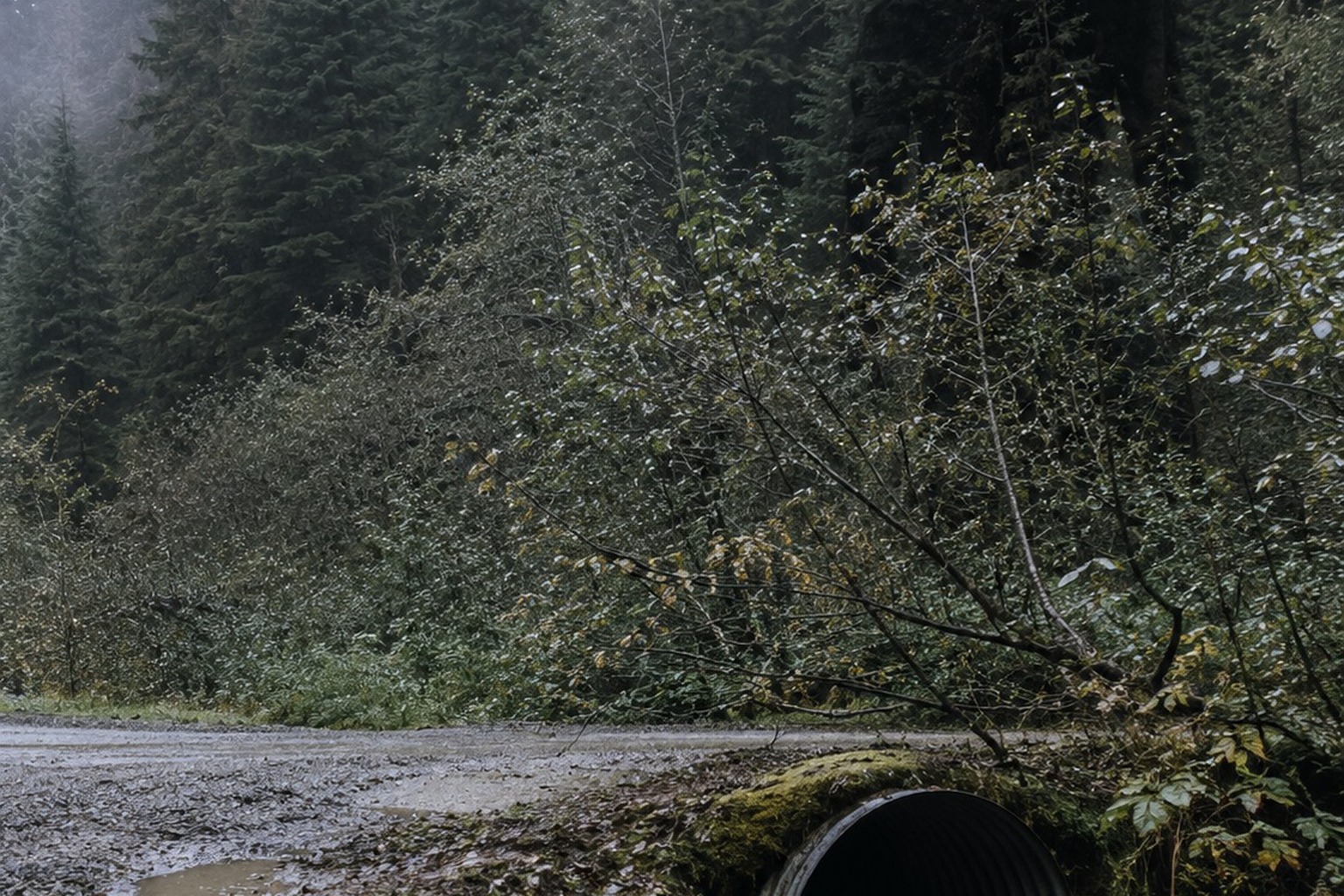
One overcast October afternoon, a man walking the old road stopped near the largest drainage culvert because something about the place looked strangely photogenic. The rain had ended less than an hour earlier. Water dripped steadily from spruce branches overhead. Wet alder leaves glistened beside the steel culvert pipe, and fresh tire tracks had already begun filling with brown water. The road itself disappeared around a gentle bend where young firs had reclaimed both shoulders.
Nothing looked unusual. The man lifted his phone and snapped a single landscape photo simply because he liked the way the mist settled between the hills. He never noticed anything standing behind the alder brush. Not while he was there.
Not while taking the picture. Only later, sitting in his truck miles away, did he zoom into the photograph. The shape wasn't centered. It wasn't posed.
It occupied a place the eye naturally skipped—a dark wall behind overlapping branches where every viewer assumed the forest simply became denser. Except the darkness wasn't forest. It had edges. At first he thought the image compression had merged several tree trunks together. Then he noticed one pale vertical strip running through the darkness.
It resembled the side of a face. Not detailed. Not expressive. Just enough contrast to separate itself from the surrounding brush.
What The Camera Or Witnesses Noticed First
He zoomed further. The shape behind the alders appeared impossibly broad. The visible section alone looked wider than the culvert opening beside it. The shoulders—if they were shoulders—continued beyond branches on both sides. The upper portion vanished into cedar limbs while the lower half disappeared behind salmonberry and alder stems that reached chest height.
It wasn't standing in front of the brush. It was somewhere behind it. Far enough away that perspective became confusing. Yet somehow still enormous.
The stranger he showed the picture to immediately asked the question he had been avoiding. "How tall would that have to be?" He returned the next morning carrying a printed copy of the photograph. The weather had changed overnight.
Heavy fog rolled low across the road, muting every sound except water flowing through the culvert beneath his boots. He walked to the exact spot where he'd stood the previous afternoon. Using the printout, he aligned nearby trees with the image until everything matched.
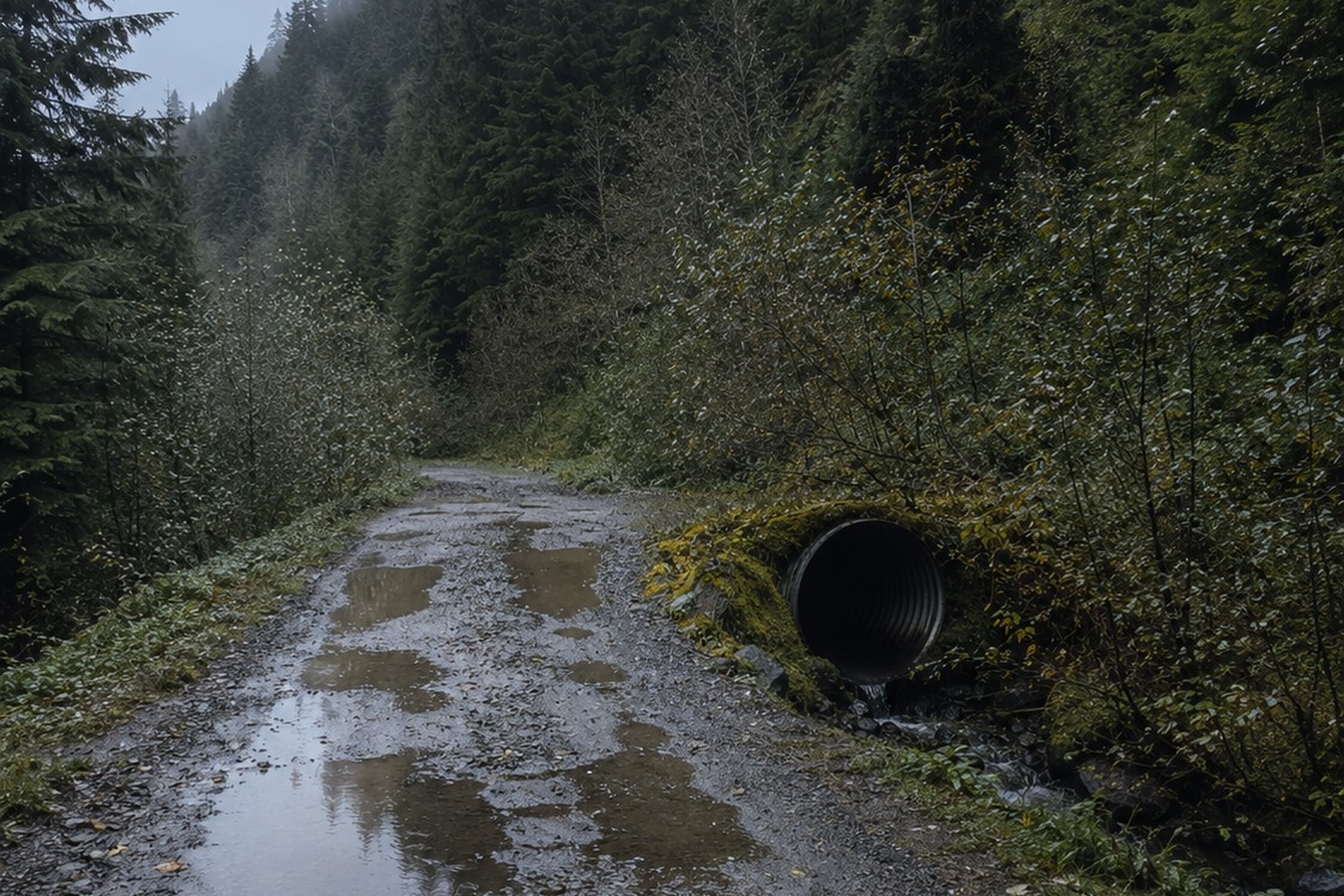
The alder branches lined up perfectly. The moss-covered stump remained exactly where expected. The culvert opening occupied the same place. Behind the brush…
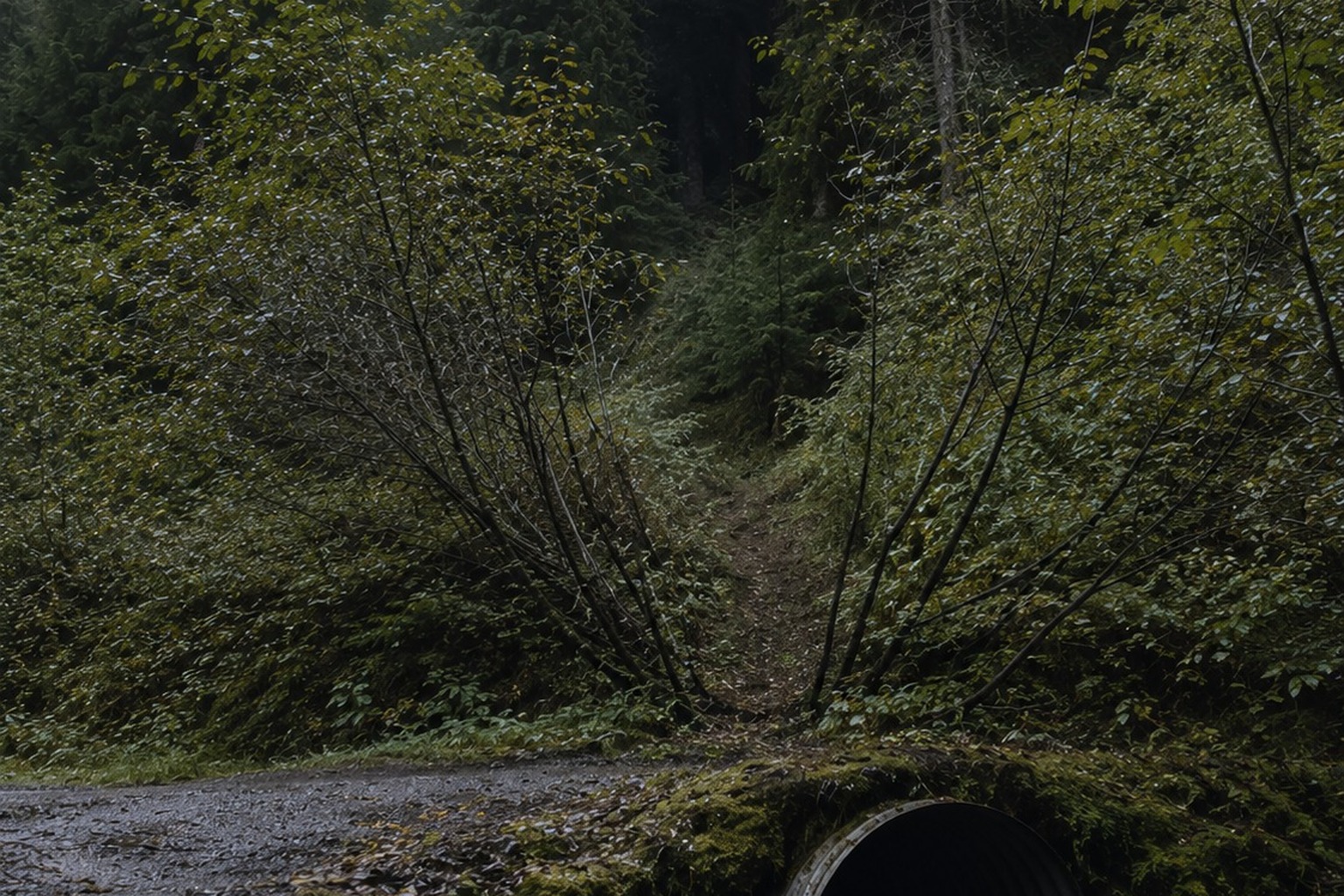
Nothing. Just more trees. He climbed the embankment, pushing through dripping alder stems that soaked his jacket within seconds. The ground behind the brush rose sharply toward a stand of mature cedar.
Why The Setting Made It Stranger
Looking back toward the road surprised him. From there he realized how little of the hillside was actually visible through the tangled branches. Anything standing several yards uphill could remain almost completely concealed while still appearing directly behind the alders in a photograph. He measured distances by pacing.
The place where the supposed figure would have stood was roughly thirty feet beyond the brush. At that range, whatever occupied the photograph would have towered over everything around it. He laughed uneasily. Perspective had to be playing tricks.
It had to. Then he noticed something odd about the vegetation. Several young alder trunks leaned outward as though something extremely wide had recently passed between them. Not broken.
Bent. They all angled away from a narrow corridor leading uphill into darker timber. The soil remained damp from the previous day's rain. He expected obvious footprints.
Instead, the forest floor showed only broad patches where moss had been pressed flat. No individual prints. No boot marks. Nothing identifiable.
The flattened moss continued uphill for perhaps twenty yards before disappearing beneath thick sword ferns. He followed anyway. The woods changed character surprisingly quickly. The younger regrowth ended.
The Detail People Usually Miss
Massive old cedar trunks replaced the thinner trees below. Everything became quieter. Even dripping water seemed farther away. He eventually reached a shallow depression where storm runoff collected during winter.
Fresh branches lay scattered across the ground despite there having been almost no wind. Several saplings had been pushed sideways instead of snapped. It looked less like storm damage and more like something impossibly heavy had moved through without caring what stood in its path.
The depression offered a clear view back toward the road. He could see the culvert. His parked truck. The stretch of gravel where he'd taken the photograph.
Standing there, he imagined something watching from exactly this position while remaining hidden by layers of vegetation. The realization unsettled him enough that he headed back. That should have ended the story. Instead, curiosity spread.
He shared the image among friends. One enlarged it using editing software. Another adjusted exposure. Someone outlined the visible edges with translucent overlays.
The shape became less human the more they studied it. The apparent head lacked any obvious neck. Its width exceeded anything proportionate. One arm—or what looked like an arm—hung lower than expected but blended almost seamlessly into overlapping shadows.
The Most Ordinary Explanation
Nobody could confidently identify where the figure ended and the forest began. Yet nobody could explain why the darkness maintained such strangely consistent boundaries. Weeks later, another visitor unknowingly photographed the same culvert from almost the same angle. His image showed nothing unusual.
The hillside appeared completely ordinary. A comparison between the two photographs became even stranger. Every tree aligned. Every branch matched.
Except one section behind the alder brush. The dark mass visible in the first image simply wasn't there. Not replaced. Absent.
As though the forest itself occupied the space differently. People debated lighting conditions. Cloud cover. Camera software.
Compression artifacts. Perspective. Reasonable explanations multiplied. None completely satisfied those who kept returning to the original image.
Eventually, local curiosity transformed into a quiet challenge. Visitors stopped at the culvert hoping to recreate the photograph. Most left disappointed. Some reported hearing unusually heavy movement uphill without seeing wildlife.
Why That Explanation Still Feels Incomplete
Others described the odd sensation of being watched while standing beside the drainage pipe. One retired logger reportedly refused to linger there after looking into the brush for several minutes. When asked why, he simply answered that forests have normal shapes. "That wasn't one."
No one could get him to elaborate. Winter eventually buried the road beneath snow. The alder branches bent under white weight, revealing far more of the hillside than autumn ever had. The strange concealment disappeared.
Nothing resembling the figure stood anywhere behind the brush. Spring returned. Leaves grew again. Visibility narrowed once more.
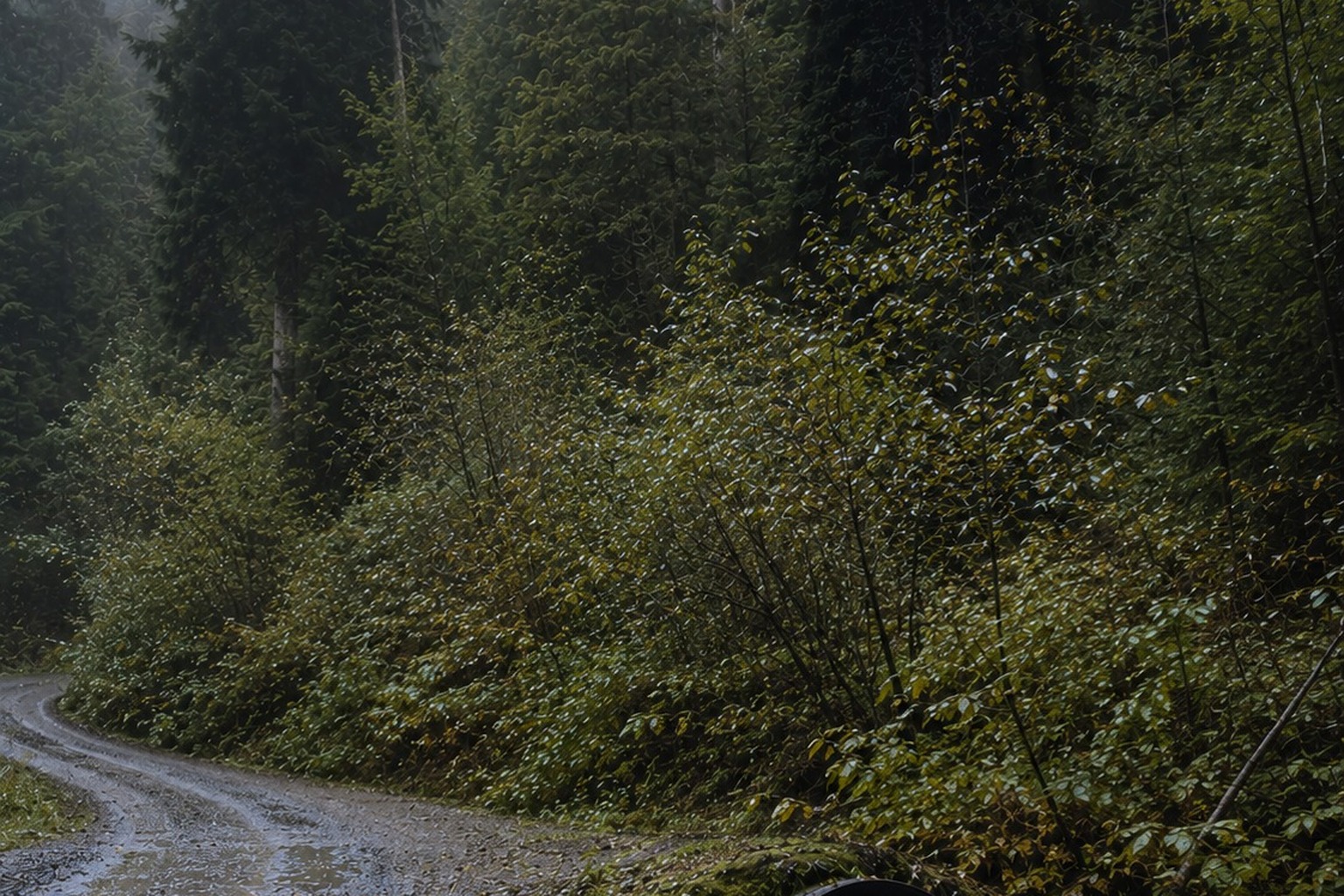
Visitors resumed stopping at the culvert. Some brought printed copies of the saved image. Most attempted to align themselves precisely where the photographer had stood. Few lasted very long.
Several later admitted the place felt uncomfortable for reasons they couldn't identify. One described repeatedly looking away from the hillside without realizing he'd done it. Another said his eyes kept sliding toward the culvert opening instead, as if avoiding something higher on the slope.
Years have passed since the photograph first circulated among those who know the old logging roads. The location itself remains unremarkable. No mysterious lights. No strange sounds caught on camera files.
The Part That Keeps The Story Alive
No dramatic encounters. Just an aging steel culvert beneath a forgotten road. Yet the photograph continues to unsettle people for one simple reason. The shape doesn't appear to be hiding behind the alder brush.
It appears to have chosen the only position where a passing person would never naturally look. The human eye follows roads. It notices open spaces. It scans culverts for wildlife.
Dense brush becomes background. Our brains dismiss it immediately. If something understood that instinct—even by accident—it could remain astonishingly close without ever being noticed. Looking at the image today, most people still focus first on the culvert.
Then the wet gravel. Then the mist beyond the curve. Only after someone points toward the alder brush does the outline begin separating itself from the forest. And once it does…
It becomes surprisingly difficult to convince yourself you're looking at ordinary trees. The broad silhouette seems to emerge slowly from the background, not because the photograph changes, but because your brain finally stops assuming the forest is empty. Perhaps that's why so many who visit the road eventually leave with the same uneasy impression.
The culvert isn't frightening. The woods aren't frightening. Even the photograph isn't frightening at first glance. What's frightening is realizing how much of any forest remains hidden simply because we expect it to be.
Maybe the huge shape behind the alder brush never existed at all. Maybe damp branches, gray light, and coincidence briefly assembled a perfect illusion. Or perhaps something unimaginably large stood motionless thirty feet uphill, quietly watching a man pause beside an old logging road, knowing he would photograph the landscape without ever raising his eyes high enough to see it.