The Quiet That Should Still Have Hissed
Alderwick College’s radio telescope was not famous.
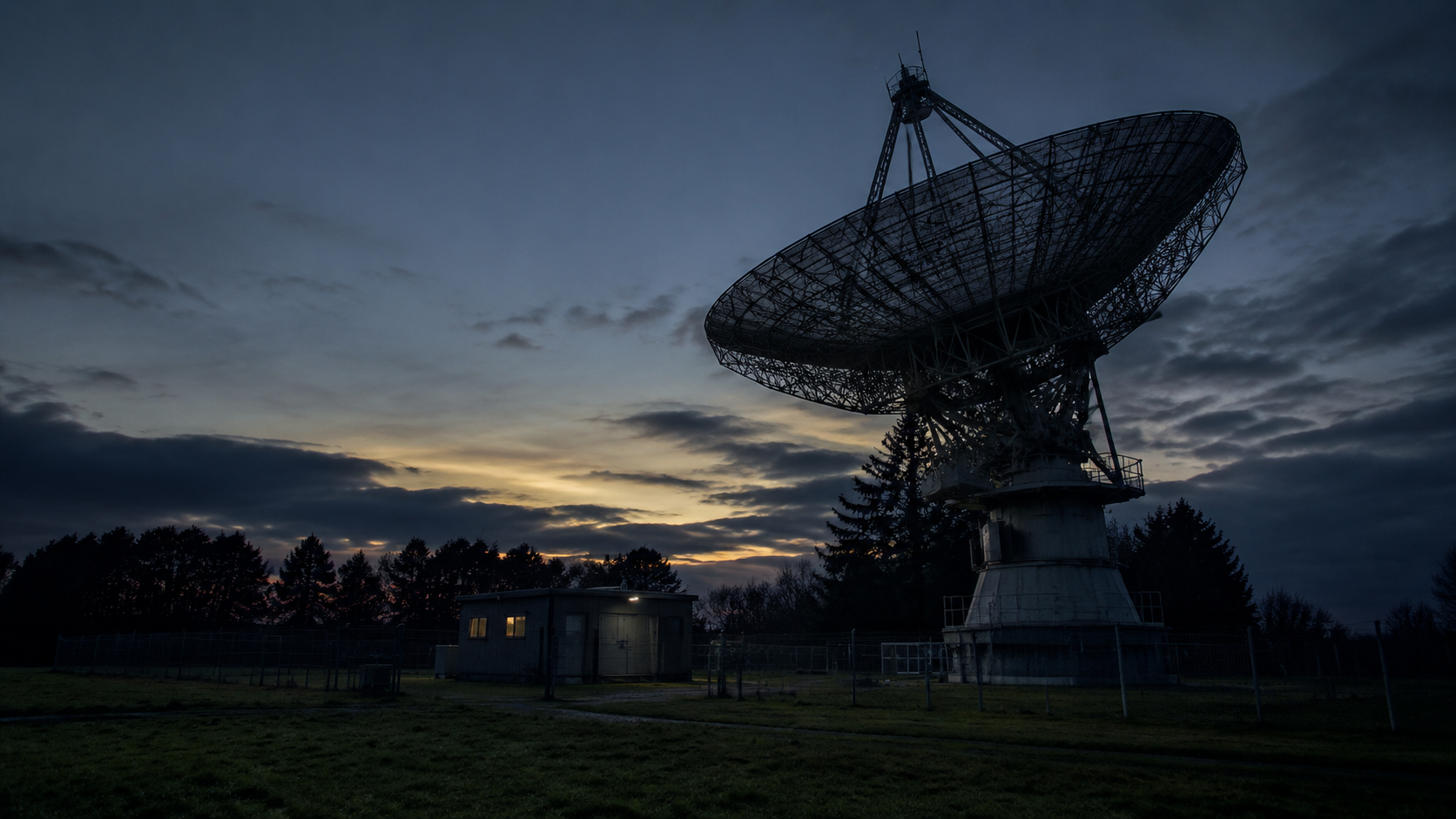
It sat behind the physics building on a fenced rise, facing soybean fields, a service road, and utility poles that everyone blamed whenever a demonstration went poorly. The dish was small enough for students to maintain and old enough to have a personality. It was a teaching instrument first, a research instrument only when someone had grant hours to spend.
In March 2012, a calibration exercise there produced a result that looked like nothing at all.
For one hour on several nights, the receiver showed less noise than the equipment should have been able to show. Not a clean signal. Not a local broadcast. A flat, low band where ordinary electronic and sky noise should have remained visible.
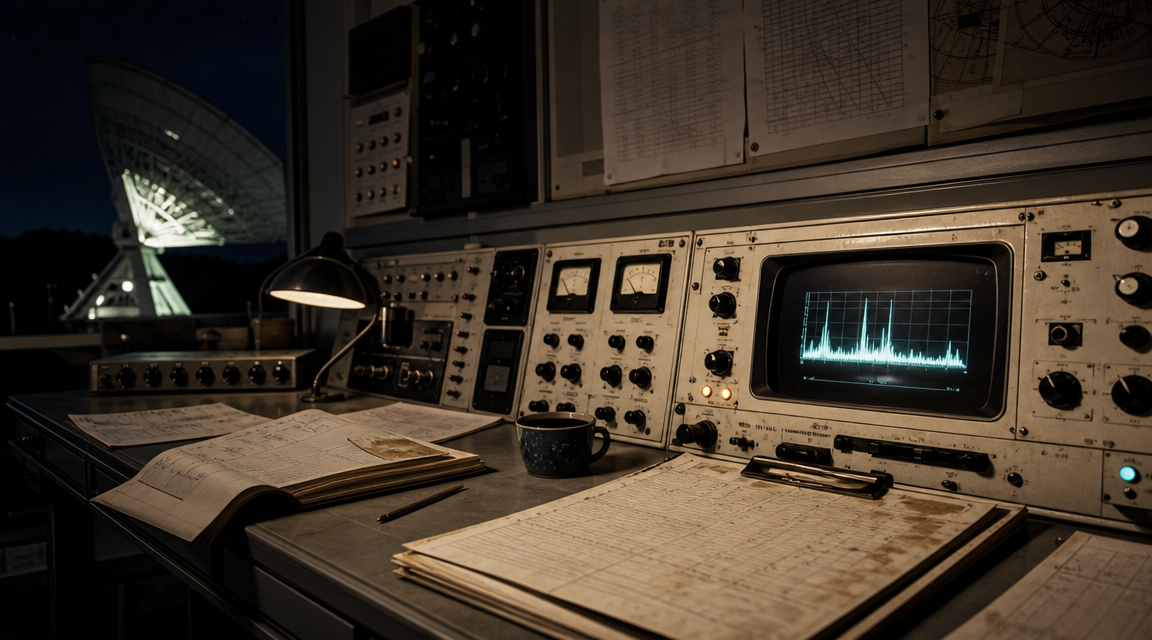
The staff called it the silent hour.
They did not mean silence in a poetic way. They meant a measurement that had gone unnaturally quiet.
A Routine Experiment
The work was modest.
A lecturer, two graduate assistants, and four undergraduates were checking drift after winter maintenance. They pointed the dish at known cold-sky regions, compared them with warmer references, and watched how the low-noise amplifier behaved overnight.
That kind of experiment is supposed to be dull. Dull is useful. A calibration run should reveal small offsets, not mysteries.
The telescope had quirks: campus power hum, brief spikes from passing aircraft systems, broadband hash from unknown devices, and the restless grain of thermal noise. The grain mattered. Even when the sky is quiet, the receiver should hiss because its components and environment are not perfect.
At 1:17 a.m. on the third overnight session, that grain nearly disappeared.
The display kept updating. Timestamps advanced. Motors still reported position. Housekeeping data did not freeze. Yet the observed band became a smooth floor lower than the manual’s expected minimum.
The student on duty assumed failure. He checked connectors, tapped the equipment rack, and restarted only the monitor display. The flatness remained until 2:17 a.m., when ordinary noise returned without a spike or warning.
The Repeat That Made It Matter
One odd hour can be dismissed.
A cable can settle badly. A program can misread a buffer. A student can mark the wrong setting in a tired notebook. The first event was logged as probable instrument dropout.
Five nights later, it happened again.
The start time was again close to 1:17 a.m. The duration was again almost exactly one hour. The telescope again looked healthy except for the impossible quiet in the measured band.
That repetition changed the tone of the notes. The team began checking raw files instead of screenshots. They looked for software smoothing, repeated data lines, timestamp errors, and automatic gain changes. The raw files showed fresh entries. Temperature readings and pointing values varied normally. The receiver had not simply copied one line for sixty minutes.
They also tested an internal calibration source. Before and after the silent hour, it behaved as expected. During the hour, its contribution seemed muted along with everything else.
That result was uncomfortable because it suggested the problem was not only outside the dish and not only inside the display. Something about the measurement chain was being suppressed.
Why Static Was the Wrong Explanation
People later called the event static, but that reverses the problem.
Static is extra noise. Alderwick had missing noise.
The group looked for normal causes anyway. They compared the events with weather, campus maintenance, and security radio logs. Nothing lined up cleanly. Calm nights did not always produce the hour. Rain did not stop it. No scheduled shutdown matched the windows.
A nearby road was quiet at that time, but road traffic had never controlled the receiver’s baseline. Farm machinery was possible, though March was early for heavy irrigation cycles. A delivery company repeater several miles away was checked informally; no test was reported for the first two windows.
Any ordinary explanation still had to account for two things at once: the hour of depressed receiver noise and another signal captured by a recorder outside the main digital path.
The Tape in the Annex
The analog recorder was almost an accident.
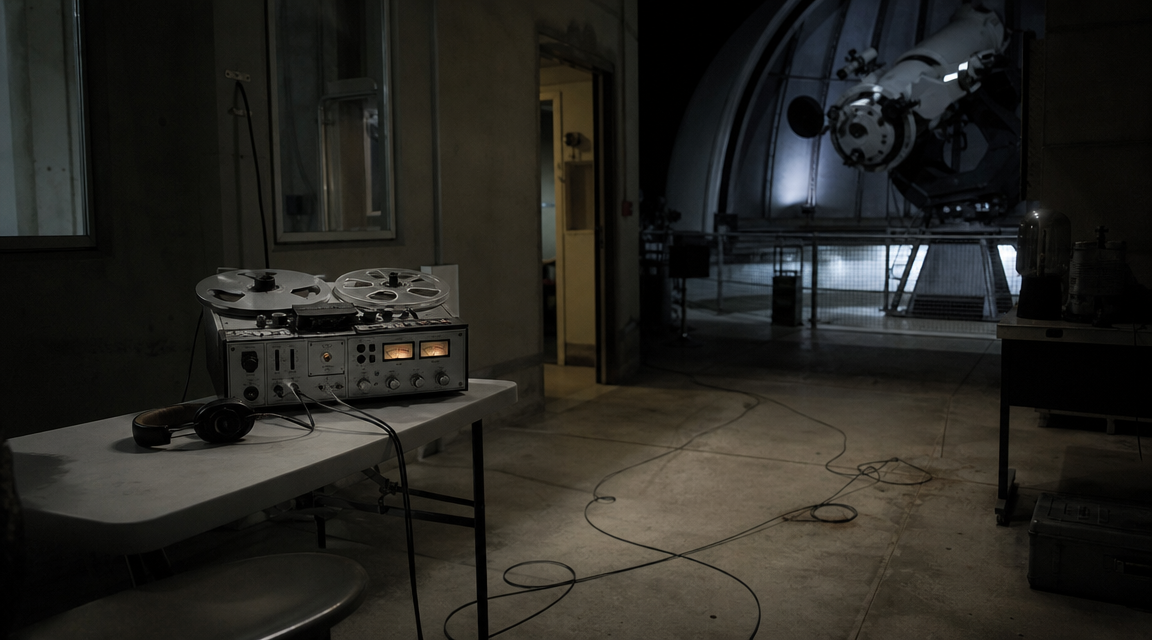
One undergraduate had brought an old reel-to-reel machine out of storage for a side demonstration on historical observing methods. It was connected to a separate monitoring line in the observatory annex, mainly so students could hear the hiss, clicks, and interference that earlier radio astronomers learned to recognize by ear.
No one considered it precision equipment. One channel was weak. The heads were worn. It picked up relay clicks, footfalls, and hum. In any formal report, it would have been supporting context at best.
After the second silent hour, the student played the reel back.
Several minutes before the digital receiver flattened, a faint pulse pattern appeared under the hiss. It was not speech. It was not clear enough to transcribe. Yet the grouping made listeners reach for the same comparison: counting.
Three pulses, pause. Two pulses, pause. Four shorter pulses, pause.
The pattern sat outside the telescope’s normal observing band, arriving through the analog setup rather than the main receiver file. That made it suspicious, not miraculous. It could have been local contamination. It could also have been the clue to whatever was affecting the calibration chain.
Counting-Like, Not Counting
The careful phrase in the notes was “counting-like interference.”
That hyphen matters.
Nobody at Alderwick claimed the tape contained a voice reciting numbers. Several listeners heard ordinary mechanisms rather than meaning, and one thought the pattern was only the brain imposing order on weak pulses.
Still, the timing was difficult to ignore.
On three nights, grouped pulses appeared within minutes of a silent-hour window. On one later night, the pulses appeared but the telescope did not enter a full hour of quiet. On two suspected nights, the tape had not been running, so the comparison was lost.
The pulse groups were not identical. They changed spacing and strength. That variability weakened any dramatic interpretation. It also made a simple playback defect less satisfying.
The team did not publish the audio or announce a discovery. They marked the tape segments, logged the settings, and tried to make the telescope misbehave on command.
It mostly refused.
What They Checked
Small departments investigate mysteries with borrowed tools and patient repetition.
They swapped cables.
They bypassed a patch panel. It returned once, but not reliably.
They moved the tape recorder across the annex. The pulses weakened, then appeared again during a later run.
They powered the recorder from a battery inverter. The pulse pattern remained faintly present on one recording, though the result was too messy to settle anything.
A receiver self-oscillation was discussed. So was an automatic gain-control fault. A local transmitter coupling into a vulnerable ground path remained the most practical theory.
None of those explanations was impossible. None was complete.
The Hour Slipped
At first, the near-perfect start time suggested a timer.
Then the hour moved.
Later sessions showed starts near 1:23 a.m., 1:11 a.m., and once just before 1:00 a.m. A partial event lasted forty-one minutes before normal texture returned. The shifts were small enough to feel related but too large for the easiest campus-clock explanation.
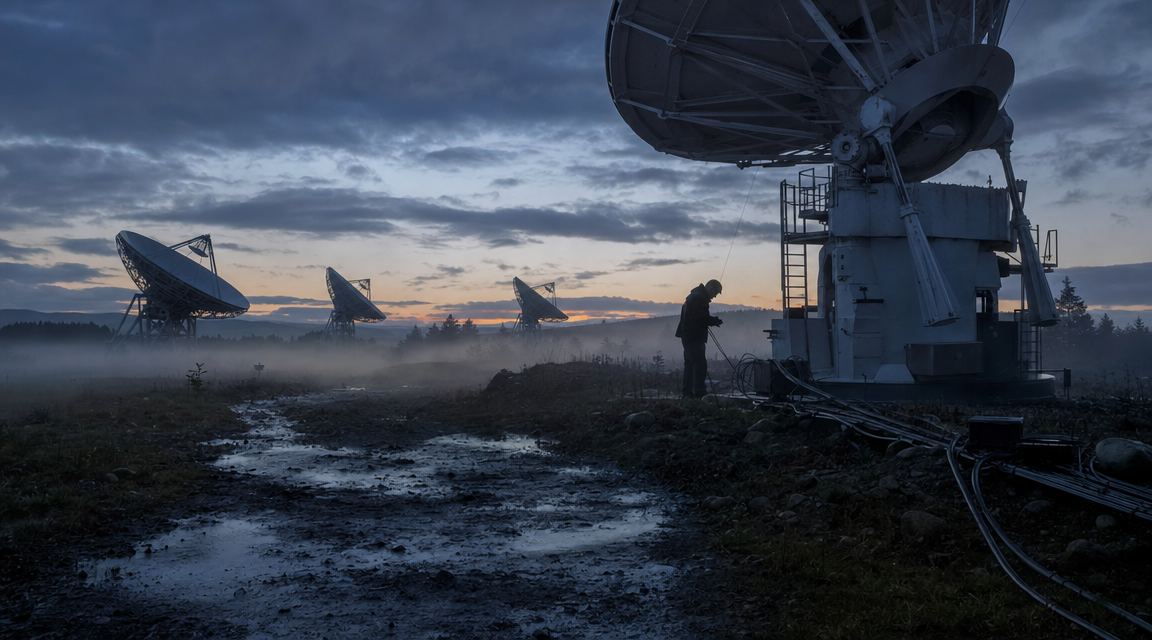
Pointing direction did not solve it. Some events happened during the same cold-sky target. Others happened with the dish at different azimuths. If a ground source was entering a sidelobe, the geometry never reduced to a clean map.
One clue remained consistent: the full silent hour appeared only in the sensitive calibration configuration. That could mean the setup revealed a real external effect, or that it created a failure state that looked external.
The department favored the second option, because careful experimenters blame their own apparatus first.
The Folder That Remained
Alderwick’s silent hour never became a formal paper.
The maintenance project ended. One graduate assistant left. The dish later went offline for bearing work, and parts of the receiver chain were rebuilt before the next long run. After that, the same anomaly did not return in a recognizable form.
What reportedly remains is a thin folder: plots, shift notes, equipment checklists, and references to several reels of tape. Some tape was digitized years later, but not every file retained reliable labels.
The strongest summary is restrained. It describes “anomalous suppression of measured noise floor during calibration configuration” and “correlated low-amplitude pulsed interference on independent analog recorder.” It does not say alien, message, haunting, or cover-up.
It also does not say solved.
That is why the case survives. It is too cautious for legend, yet too specific to forget. A silent receiver is usually broken. A pulsing tape recorder is usually contaminated. Together, repeatedly, they become a more interesting kind of problem.
The best explanation is probably still local: an interaction among equipment, shielding, power, and a signal nobody isolated. That does not make the episode worthless. It makes it experimental.
Instruments do not simply listen to the world. They listen through cables, grounds, amplifiers, software, habits, and assumptions.
At Alderwick, the students were looking for ordinary noise so they could calibrate it away. For one hour at a time, they found the stranger absence beneath that task: a quiet their telescope should not have been able to hear.
Reader Context
This Weird Witnessed story is an editorial reconstruction, written as eerie visual storytelling rather than a verified report. For more context, see How to Read Weird Witnessed Stories and How WeirdWitnessed Creates Reconstructed Horror Stories.